‘Very alarming’ winter sees Arctic sea ice hit record-low for second year running
Multiple Authors
03.27.26Multiple Authors
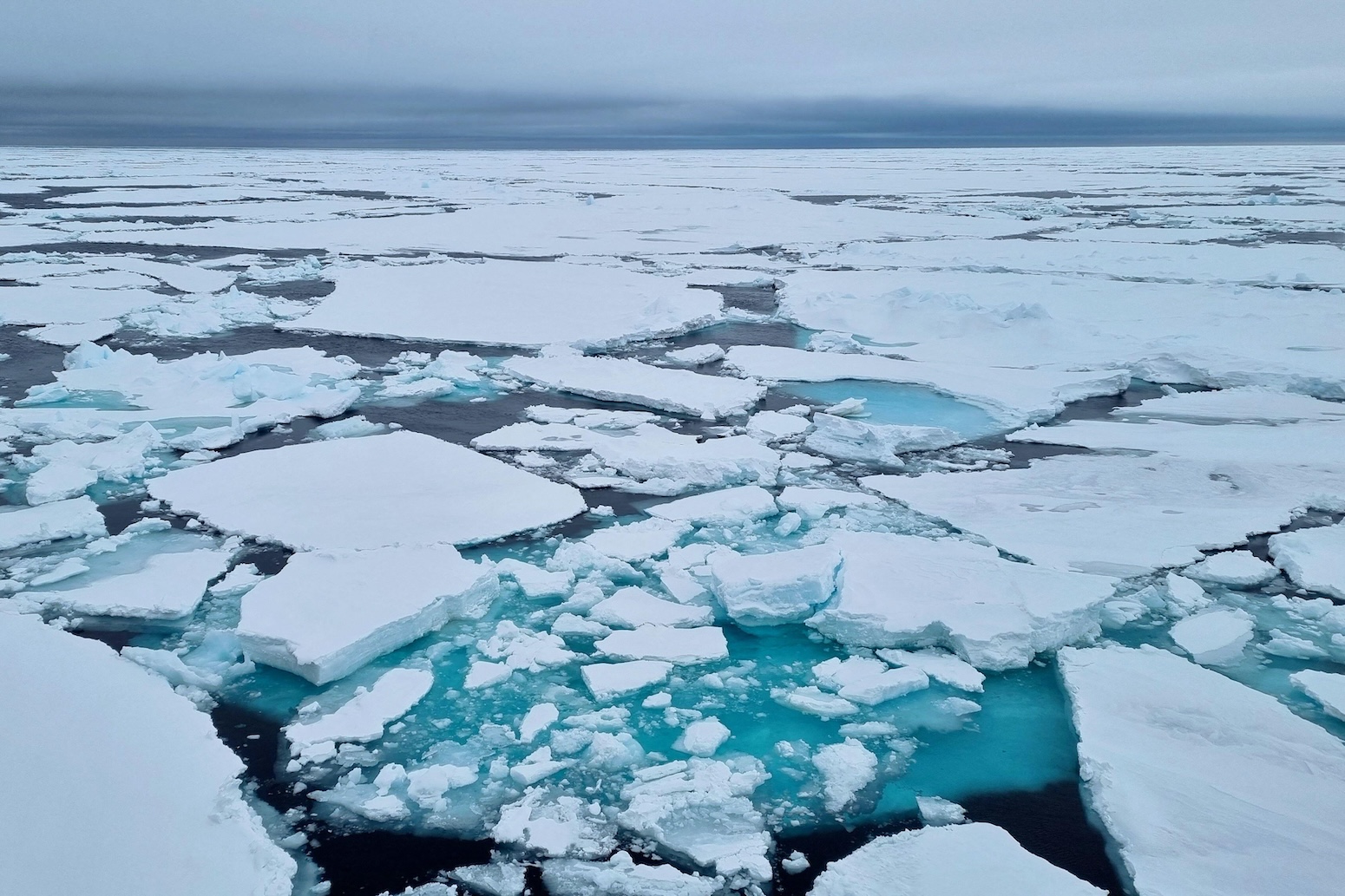
27.03.2026 | 12:43pmArctic sea ice has reached its peak extent for this winter, clocking in as the joint-smallest in a satellite record going back almost half a century.
Provisional data from the US National Snow and Ice Data Center (NSIDC) shows that sea ice extent peaked at 14.29m square kilometres (km2) on 15 March.
This is slightly smaller than the previous record for the annual maximum – set just last year – but it counts as a statistical tie, the NSIDC says.
The annual maximum is a key marker in a cycle that sees sea ice extent grow through the cold, dark winter, before melting in spring and summer to a yearly minimum.
The joint record marks a “very alarming” winter for Arctic sea ice, Dr Zack Labe – a scientist at Climate Central – tells Carbon Brief.
And there is more “grim news”, Labe says, as the thickness of the ice is near record lows – meaning that Arctic sea ice is “entering late winter in one of its weakest states in the satellite record”.
‘Unusually warm’
The past six months has seen Arctic sea ice extent “at record or near-record lows, alongside unusually warm conditions” across much of the region, says Dr Lettie Roach, a polar climate scientist at the Alfred Wegener Institute.
These go “hand in hand”, Roach tells Carbon Brief, as “warmer air and ocean temperatures help melt the ice and with less ice, the ocean absorbs more heat, which further speeds up warming”.
The chart below shows Arctic sea ice extent in 2025 (dark blue) and 2026 (red) so far. For comparison, the chart shows decadal averages (dotted lines) as well as 2012 (mid blue), the year of the smallest summer sea-ice minimum on record.
Recent months have seen “strong temperature contrasts” over the northern hemisphere, continues Roach:
“In addition to large parts of the Arctic, temperatures were unusually warm in the western US, southern Europe and eastern Eurasia, while northern Eurasia, northern Canada and the north-eastern US experienced unusually cold conditions.
“That’s linked to a more ‘wavy’ jet stream, which can push cold Arctic air southward while bringing warmer air into the Arctic.”
These conditions have contributed to “particularly bad” sea ice levels in regions such as the Sea of Okhotsk, Baffin Bay, Barents Sea and Kara Sea, says Labe. He adds that “one of the only regions with more sea ice relative to normal is across the eastern Bering Sea around Alaska”.
‘Long-term downward trend’
This year’s winter peak is the latest milestone in the “long-term downward trend we’ve observed” in Arctic sea ice since the start of satellite observations in the late 1970s, says Roach.
According to the NSIDC, the 2026 maximum extent is 1.36km2 smaller than the 1981-2010 average. That is “equivalent to about twice the size of Texas”, the centre says.
Arctic sea ice is “not just shrinking in extent”, says Roach, it is “also much thinner and more fragile than it used to be”.
Labe notes the “grim news” that sea ice “near the north pole has had record-low thickness for several months now”, adding:
“In February, total Arctic sea ice volume was the second lowest on record. Taken together, Arctic sea ice is entering late winter in one of its weakest states in the satellite record.”
While there is a “lot of year-to-year variability due to natural fluctuations in the atmosphere and ocean”, this long-term decline is “mainly due to human-caused climate change”, says Roach.
Labe adds:
“Human-caused climate change is completely reshaping the polar environment and this is already having wide-ranging consequences.”
The chart below shows the annual winter maxima (blue) and summer minima (red) since the start of the satellite record.
The chart highlights that the annual maximum has “shown a relatively steady decline over the past 40 years, with the [previous] record low occurring as recently as last year”, says Dr Mika Rantanen, a researcher at the Finnish Meteorological Institute.
This is in “sharp contrast to the annual minimum, where the record [low] still dates back to 2012”, he tells Carbon Brief. This indicates that the summer minimum is “more prone” to yearly ups and downs of natural variability, he explains.
It is for this reason that “it is still too early to say” what the low winter peak means for the forthcoming summer melt season as “regional weather can change quickly”, adds Labe:
“But winter of 2025-26 is another clear signal of just how fast the Arctic is shifting.”
‘Average’ Antarctica
At the Earth’s other pole, sea ice around Antarctica has been melting through the southern-hemisphere summer.
It reached its annual minimum extent of 2.58m km2 on 26 February, the NSIDC says, placing this year as the 16th smallest on record.
For most of the summer, Antarctic sea ice has been “below average”, Dr Clare Eayrs, a postdoctoral researcher at the Korea Polar Research Institute (KOPRI), tells Carbon Brief. However, she continues:
“That changed in January and February, when a shift in surface winds slowed the retreat. Southerly winds over the Weddell Sea pushed existing sea ice northward, keeping coverage higher than expected in that region, while sea ice cover in the Bellingshausen Sea remained low.”
These winds were mostly “redistributing ice rather than new ice forming in these regions”, Eayrs notes:
“This was enough to keep the summer sea ice coverage much closer to average than in the previous four years…It is a reminder that where a season starts does not always determine where it ends.”
Recent years have seen a series of record-low extents in the sea ice that surrounds Antarctica.
While it is “likely” that climate change is influencing Antarctic sea ice, scientists “remain uncertain about the extent and precise mechanisms involved”, says Eayrs:
“This uncertainty is itself an important part of the story. Antarctic sea ice has always been highly variable and its variability has masked any emerging long-term signal for much of the satellite era.”
However, recent research points to a recent “structural change” in Antarctica’s sea ice system, Eayrs notes. This is marked by a greater persistence of low sea ice and a “weaker tendency for the system to return to its earlier mean state”.
In other words, says Eayrs, “when sea ice drops to unusual lows, it no longer bounces back as readily as it once did”.
Facts Only
Arctic sea ice reached its winter peak extent of 14.29 million square kilometers on 15 March 2026.
This ties the record low set in 2025, marking the second consecutive year of record-low maximum extent.
The US National Snow and Ice Data Center (NSIDC) provided the provisional data.
The 2026 maximum extent is 1.36 million square kilometers smaller than the 1981-2010 average.
Arctic sea ice thickness is near record lows, with February 2026 recording the second-lowest total Arctic sea ice volume.
Unusually warm conditions were observed across much of the Arctic over the past six months.
Regional variations include particularly low sea ice in the Sea of Okhotsk, Baffin Bay, Barents Sea, and Kara Sea.
The eastern Bering Sea around Alaska had slightly more sea ice relative to normal.
Antarctic sea ice reached its summer minimum extent of 2.58 million square kilometers on 26 February 2026.
This ranks as the 16th smallest on record for Antarctic sea ice.
Surface winds in January and February 2026 slowed the retreat of Antarctic sea ice, particularly in the Weddell Sea.
Antarctic sea ice has shown high variability, with recent years experiencing record-low extents.
Executive Summary
Arctic sea ice reached its winter peak extent on 15 March 2026 at 14.29 million square kilometers, tying the record low set in 2025. This marks the second consecutive year of record-low maximum extent, with the ice also near record-low thickness, indicating a weakened state. Scientists attribute this to unusually warm conditions in the Arctic, driven by a combination of warmer air and ocean temperatures, which create a feedback loop accelerating ice melt. The past six months saw record or near-record lows in sea ice extent, with regional variations such as the Sea of Okhotsk and Baffin Bay experiencing particularly low coverage, while the eastern Bering Sea had slightly above-normal ice. The long-term decline in Arctic sea ice is primarily linked to human-caused climate change, though natural variability plays a role in yearly fluctuations.
In contrast, Antarctic sea ice reached its summer minimum on 26 February 2026 at 2.58 million square kilometers, ranking as the 16th smallest on record. While Antarctic sea ice has been below average for much of the summer, shifts in surface winds in January and February slowed the retreat, particularly in the Weddell Sea. Scientists note that Antarctic sea ice remains highly variable, with recent research suggesting a structural change in its behavior, where low sea ice levels are becoming more persistent and less likely to rebound to previous norms. The relationship between climate change and Antarctic sea ice trends is less certain than in the Arctic, with natural variability still playing a significant role.
Full Take
The strongest version of this narrative highlights a clear and alarming trend: Arctic sea ice is in a state of rapid decline, with consecutive record-low winter peaks and near-record-low thickness, signaling a weakened system. The data is presented with scientific rigor, citing reputable sources like the NSIDC and expert commentary from polar climate scientists. The article effectively contextualizes the Arctic's decline within the broader framework of human-caused climate change while acknowledging the role of natural variability. It also contrasts this with the more complex and uncertain situation in Antarctica, where sea ice behavior remains highly variable and less directly tied to climate change.
Patterns detected: none. The article avoids emotional exploitation, distortion, or bad faith tactics. It presents facts clearly, acknowledges uncertainty, and provides multiple perspectives without forcing a binary narrative. The focus remains on the data and expert interpretations, resisting sensationalism.
The root cause of this narrative is the paradigm of anthropogenic climate change, with the Arctic serving as a bellwether for global environmental shifts. The unstated assumption is that continued warming will further destabilize polar regions, with cascading effects on global weather patterns, ecosystems, and human communities. Historically, this echoes patterns of environmental degradation linked to industrialization and fossil fuel dependence, now amplified by feedback loops like ice-albedo effects.
The implications for human agency are profound. While the Arctic's decline is driven by global emissions, the costs are disproportionately borne by Indigenous communities and ecosystems dependent on stable ice conditions. Second-order consequences include accelerated global warming, rising sea levels, and disruptions to marine ecosystems. The Antarctic's uncertainty underscores the complexity of climate systems, where local variability can mask long-term trends.
Bridge questions: How might regional adaptations in the Arctic mitigate the worst impacts of declining sea ice? What role do natural climate oscillations play in the observed trends, and how can we better distinguish their effects from human-induced changes? What would it take to reverse the long-term decline in Arctic sea ice, and is such a reversal still feasible?
Counterstrike scan: If this narrative were part of a coordinated influence campaign, the playbook would likely emphasize the urgency of climate action while downplaying uncertainties in Antarctic trends to create a unified message. However, the article does not match this pattern. It presents a nuanced view, acknowledging gaps in understanding and regional variations, which aligns with genuine scientific communication rather than a manipulative agenda.