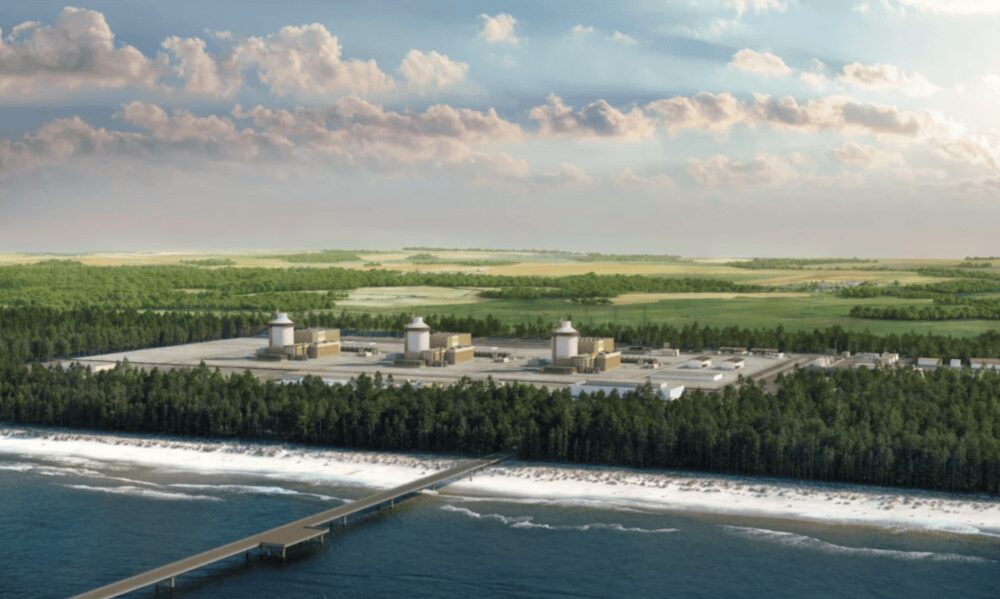
US engineering giant Bechtel has opened an office in Gdańsk, northern Poland to support the delivery of the country’s first nuclear power plant and develop a local workforce to grow Poland’s nuclear industry.
The office will serve as an engineering and operations hub for the nuclear facility in Choczewo, Pomerania, on the Baltic coast, which is Poland’s first nuclear project and will be built by Westinghouse and Bechtel alongside Polish utility company Polskie Elektrownie Jądrowe.
The price tag for the nuclear plant could reach $37bn and will contain three of Westinghouse’s AP1000 units generating 3GW of energy. The Generation III+ reactor has fully passive safety systems, a modular design and one of the smallest footprints per MWe.
Leszek Hołda, Bechtel Polska’s president, said: “We are building engineering capability in the region, creating opportunities for Polish professionals, and increasing participation by Polish companies in the project and the broader nuclear supply chain.”
Bechtel currently has an office in Warsaw and has partnered with academic institutions including the Gdańsk University of Technology.
According to Poland’s state nuclear agency, the first phase of the plant is due to open in 2036. Two additional units are expected to follow within the next three years.
The project aims to reduce Poland’s dependence on coal, reducing it from 51% at present, according to energy think tank Ember. The country is one of the top 10 emitters of coal mine methane globally.
If finance can be secured, a second plant will be built by Kepco of South Korea and will consist of two APR 1400 reactors installed in Poland’s central Patnów-Konin region.
- Subscribe to our newsletter here to receive construction news and insights from around the world straight to your inbox
Further Reading:
Facts Only
* Bechtel opened an office in Gdańsk, Poland.
* The office supports the delivery of the country’s first nuclear power plant and workforce development.
* The nuclear facility will be located in Choczewo, Pomerania, on the Baltic coast.
* The nuclear project is built by Westinghouse and Polskie Elektrownie Jądrowe.
* The plant could cost $37 billion.
* It will contain three Westinghouse AP1000 units generating 3GW of energy.
* The first phase of the plant is due to open in 2036.
* Two additional units are expected within three years.
* The project aims to reduce Poland’s coal dependence from 51%.
* Poland is one of the top 10 global emitters of coal mine methane.
* Bechtel currently has an office in Warsaw and partners with institutions like the Gdańsk University of Technology.
Executive Summary
Full Take
The narrative frames the nuclear project primarily through the lens of energy transition and industrial development, positioning it as a solution to Poland's reliance on coal. This framing implicitly links large-scale foreign investment and complex engineering partnerships (Bechtel, Westinghouse) directly to national economic sovereignty and environmental goals. The focus on developing a local workforce and increasing Polish company participation suggests a strategic intent: utilizing the project not just for energy production, but as a mechanism for structural industrial transformation and knowledge transfer.
The implication is that geopolitical or environmental necessity drives the acceptance of massive infrastructure projects involving significant foreign capital and technology. While the stated goal is decarbonization and local job creation, the reliance on external giants for foundational engineering capability raises questions about where true decision-making power resides within the Polish context. The narrative effectively uses the promise of climate mitigation as the central justification for these vast economic commitments, potentially masking the underlying complexities of regulatory hurdles, long-term political stability, and equitable distribution of benefits during implementation.
Patterns detected: ARC-0043 Motte-and-Bailey, ARC-0024 Ambiguity, ARC-0056 Authority Games
Sentinel — Human
The text is highly factual and structured like wire copy, suggesting it may have been drafted or heavily refined using structured data input, though the presence of a direct quote hints at human oversight.