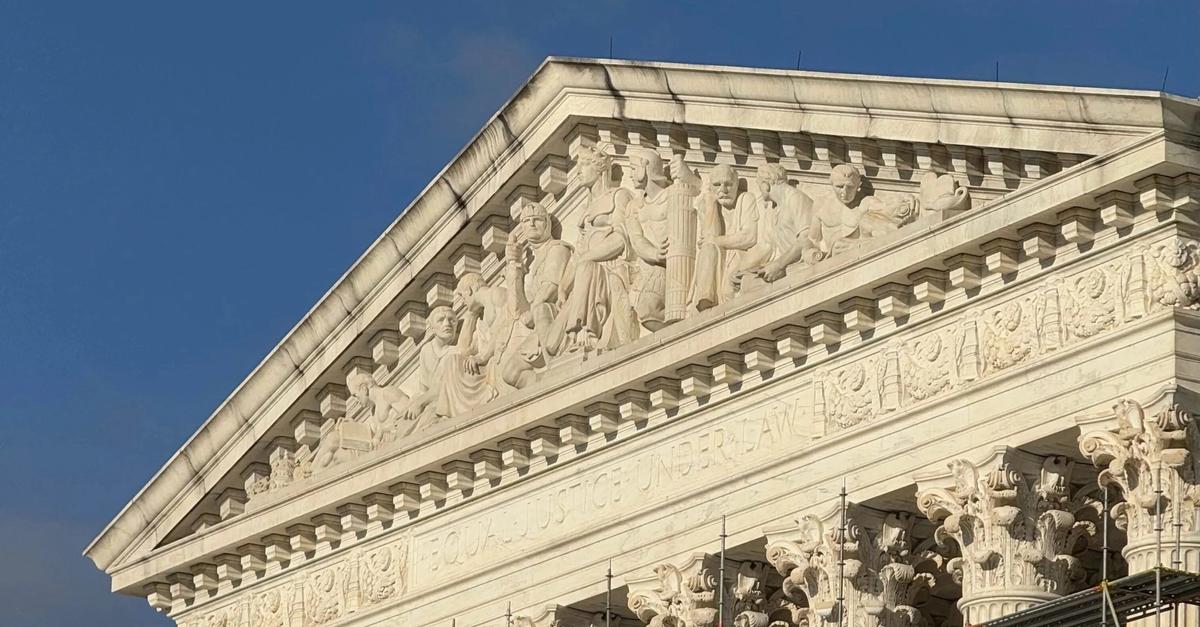
When you hear “courts and AI,” what comes to your mind? Likely the many recent articles about lawyers making costly, AI-generated mistakes or the growing debate over whether AI bots make for good judges. Against this (somewhat depressing) backdrop, the On the Docket project is hoping to show that AI can improve public engagement with the Supreme Court by presenting the justices’ work in new ways. During and after Wednesday’s argument in Mullin v. Doe, a case on whether the Trump administration properly ended temporary protected status for Haitian and Syrian nationals, On the Docket released videos that paired the actual audio from the courtroom with AI-generated visuals.
Week in Review
The court heard five arguments this week, during the second half of the April sitting. Here are the links to SCOTUSblog’s coverage.
- Chatrie v. United States: Case Preview and Argument Analysis
- Monsanto v. Durnell: Case Preview and Argument Analysis
- Cisco Systems, Inc. v. Doe I: Case Preview and Argument Analysis
- Mullin v. Doe: Case Preview and Argument Analysis
- Hikma Pharmaceuticals USA Inc. v. Amarin Pharma, Inc.: Case Preview and Argument Analysis
And on Wednesday, the court released its opinions in two cases: Louisiana v. Callais and First Choice Women’s Resource Centers v. Davenport.
- In Callais, a 6-3 court held that Louisiana’s map creating a second majority-black district was “an unconstitutional racial gerrymander.”
- In First Choice, a unanimous court held that a religious nonprofit organization could challenge a subpoena demanding the identities of its financial supporters in federal court.
At the Court
Today, the justices will meet in a private conference to discuss cases and vote on petitions for review. Orders from that conference are expected on Monday at 9:30 a.m. EDT.
On Thursday, the court denied requests for a stay of execution from James Hitchcock, who was sentenced to death in Florida for the murder of his step-niece, Cynthia Driggers, and James Broadnax, who was sentenced to death in Texas for the murders of Stephen Swan and Matthew Butler. Both men were executed last night.
The court has not yet indicated when it will next release opinions.
Morning Reads
Louisiana congressional primaries are suspended as a result of the Supreme Court’s ruling
Sara Cline, Jack Brook, and David A. Lieb, Associated Press
On Thursday, Louisiana Gov. Jeff Landry “issued an executive order postponing the U.S. House primary” in his state in response to the court’s ruling in Louisiana v. Callais, according to the Associated Press. “Allowing elections to proceed under an unconstitutional map would undermine the integrity of our system and violate the rights of our voters,” Landry said. “This executive order ensures we uphold the rule of law while giving the Legislature the time it needs to pass a fair and lawful congressional map.” Without the executive order, early voting in the House primary would have begun in Louisiana on Saturday. Early voting will still begin then for “[a]ll other races on the ballot,” and the secretary of state’s office “said it would post notices at early voting sites alerting the public about the suspended congressional primary.”
Trump says Tennessee plans to redistrict, Gov. Lee noncommittal
Stuart Dyos, Vivian Jones, and Rachel Wegner, Nashville Tennessean
On Thursday, President Donald Trump said in a social media post that Tennessee will also pursue redistricting after Wednesday’s ruling in Louisiana v. Callais. “I had a very good conversation with Governor Bill Lee, of Tennessee, this morning wherein he stated that he would work hard to correct the unconstitutional flaw in the Congressional Maps of the Great State of Tennessee,” the president wrote, according to The Tennessean, which noted that “[r]edrawing Tennessee’s districts in time for the 2026 elections would require an expedited timeline and heightened logistical challenges. ... Early voting for the August primaries is scheduled to begin July 17.”
First Trump tariff refunds expected about May 11
Zach Schonfeld, The Hill
U.S. Court of International Trade Judge Richard Eaton revealed on Wednesday that the “federal government is expecting to issue the first refunds of President Trump’s invalidated tariffs on or about May 11,” according to The Hill. U.S. Customs and Border Protection’s refund request system “went live last week. Importers have already successfully uploaded 21 percent of the affected entries into the system, according to Eaton’s new order.” However, Eaton noted that some issues, “including long wait times and problems with resetting usernames and passwords,” persist, and that he spoke with the government about addressing them. CBP will “submit a new update” about the refund process “to the court by May 12.”
The Comey indictment could be upended by this 2015 Supreme Court precedent
Perry Stein, The Washington Post
On Tuesday, former FBI director James B. Comey was indicted “for allegedly threatening President Donald Trump” by posting a photo last year “showing seashells on a beach arranged to spell out ’86 47.’” However, the criminal indictment “appears to fall short of a standard articulated by Chief Justice John G. Roberts Jr. in a 2015 opinion, when the Supreme Court pointedly distinguished a genuine threat from mere speech,” legal analysts told The Washington Post. “Roberts, along with a majority of the court, ruled in the 2015 case Elonis v. United States that prosecutors seeking to convict someone of sending a dangerous message must prove the person intended to make a violent threat – or at least knew there was a substantial chance it would be viewed as threatening.” “At a news conference announcing Comey’s indictment Tuesday, acting attorney general Todd Blanche said he understood that prosecutors need to prove intent, and he said they would do so at trial.”
Breyer makes case for civic education
Liz Mineo, The Harvard Gazette
During a recent event at Harvard University, retired “Justice Stephen Breyer argued that civic education could help reduce polarization and strengthen citizenship,” according to The Harvard Gazette. He recalled visiting the California Legislature as a child and how it “helped spark his interest in public service.” “When asked about the role of the Supreme Court in civic education, Breyer said that justices should write in a clear way to ensure that citizens understand both the complexities and the practical impact of a ruling.” He noted that he said as much to the Dalai Lama, when, during a visit to the Supreme Court, the spiritual leader asked how the court approaches writing a difficult decision.
On Site
After major voting rights ruling, parties dispute whether the Supreme Court should finalize decision immediately to allow changes to Louisiana’s congressional map
By Amy Howe
On Wednesday evening, the group of “non-African American” voters who prevailed earlier in the day in their challenge to Louisiana’s congressional map asked the Supreme Court to bypass its normal 32-day waiting period and send a copy of its opinion and order to the lower court immediately, making the decision final. On Thursday, the Black voters who defended the map urged the court to turn down the request.
Court unanimously sides with faith-based pregnancy centers in litigation dispute with New Jersey
By Amy Howe
The Supreme Court on Wednesday ruled that a group of faith-based pregnancy centers can litigate their challenge to New Jersey’s demands for information about the group’s fundraising practices in federal court. In a unanimous decision by Justice Neil Gorsuch, the justices rejected the lower courts’ conclusion that the group, First Choice Women’s Resource Centers, had not shown it had suffered the kind of injury from the subpoena that would give it a legal right to sue, known as standing.
Justices poised to protect generics manufacturers from liability for decisions of pharmacists about prescribing their products
By Ronald Mann
Wednesday’s argument in Hikma Pharmaceuticals USA v. Amarin Pharma showed a bench once again dubious about litigation trying to hold a large company responsible for the actions of others that it does not control.
Supreme court orders
By Stephen Wermiel
In his Nuts and Bolts column, Stephen Wermiel explained the significance of a Supreme Court order list, which he said “operates much like a traffic report, sorting cases into those that will be argued and those on which review is denied, and cleaning up numerous other details of the work of the justices.”
Church autonomy returns to SCOTUS
By Stephanie Barclay
In her Ratio Decidendi column, Stephanie Barclay explored U.S. Conference of Catholic Bishops v. O’Connell, “a case asking how broadly the First Amendment’s church autonomy doctrine – which prevents courts from delving into internal church affairs – reaches.” She joined one of 15 amicus, or “friend of the court,” briefs urging the court to take up the case.
Podcasts
Gutting the Voting Rights Act | Interview: Judge Roy K. Altman
Sarah Isgur and David French discuss the Louisiana v. Callais decision, weird indictments, and whether Israel is guilty of genocide.
Chief Justice William Rehnquist
It’s hard to believe, but we have reached William Rehnquist in our series on chief justices of the Supreme Court, John Roberts’ immediate predecessor. To give a glimpse of the man: When Rehnquist's elementary school teacher asked him what he wanted to do when he was older, the future chief justice supposedly replied: “I'm going to change the government.” And although it took a few decades, there is little doubt that he accomplished his childhood goal.
Born in 1924, Rehnquist, the son of a paper salesman and a mother who was a professional translator, grew up in a Milwaukee suburb during the Great Depression. His household was staunchly conservative, with Republican figures like Herbert Hoover among the family’s political heroes. After high school, Rehnquist served as a weather observer in North Africa during World War II and then attended Stanford under the GI Bill, where he graduated in 1948 with bachelor's and master's degrees in political science. Rehnquist then received a master's degree in government from Harvard in 1950, after which he returned to Stanford and graduated first in his law school class in 1952 – just two places ahead of his classmate Sandra Day O’Connor, who would later join him on the court (and who Rehnquist had once dated and proposed to, although this wouldn’t become public until 2018).
Rehnquist then clerked for Justice Robert Jackson (although, after his interview, Rehnquist thought Jackson had “written [him] off as a total loss”). Following this, Rehnquist moved to Phoenix (a city he reportedly chose for its “meteorological and political” climate) and spent 16 years in private practice while becoming involved in Republican politics, including speechwriting for Barry Goldwater's 1964 presidential campaign. That eventually brought him to the Nixon administration’s Justice Department in 1969 as assistant attorney general. Nixon, who called him “Renchberg” in the Watergate tapes, nominated him to the court as an associate justice in 1971, and the Senate confirmed him 68–26. Rehnquist was sworn in on Jan. 7, 1972.
On the court, Rehnquist relied on three “related constitutional ideas”: “strict construction” of the Constitution’s text, judicial deference to Congress on questions of policy (meaning judges should not invalidate laws simply because they seemed unwise), and a robust defense of states’ rights against what he saw as an excessive accumulation of federal power since the New Deal. Those convictions put him at great odds with most of his colleagues – in his first five terms he wrote 24 lone dissents (among 72 total), which earned him the nickname “the Lone Ranger.” (Rehnquist’s clerks would later present him with a Lone Ranger doll that remained on his office mantel for years.) By 1975, however, a more conservative court allowed him to write an increasing number of majority opinions, such as National League of Cities v. Usery, which invalidated a federal statute regulating the wages and hours of state government workers under the 10th Amendment.
When Chief Justice Warren Burger retired and President Ronald Reagan nominated Rehnquist as Burger’s successor in 1986, the confirmation fight was contentious. In particular, critics raised a memo Rehnquist had written as a law clerk urging that Plessy v. Ferguson’s “separate but equal” doctrine not be overturned in Brown v. Board of Education, and pointed to racially restrictive covenants in the deeds to his homes. The Senate nevertheless confirmed him 65–33, and he was sworn in on the same day Antonin Scalia was unanimously confirmed to fill Rehnquist’s vacated associate justice seat.
Responsible for the famous “hogs on ice” quotation (he said that the chief presides over eight “associates … as independent as hogs on ice. He may at most persuade or cajole them”), Rehnquist nevertheless continued the trend of an increasing rate of unanimous cases on a steadily more conservative court. Roberts, who clerked for Rehnquist in the 1980 term, said in his own confirmation hearings that in any given year’s biggest cases, the opinion assignments were “distributed very evenly among the nine justices … because the Chief made a priority of being fair.” To date, Rehnquist holds the highest authorship rate in “one-vote margin cases” – suggesting he was the chief justice “most able to command 5-4 majorities [and] author opinions while holding together coalitions in often the most consequential and coveted authorship decisions.”
In terms of the cases themselves, Rehnquist is perhaps most remembered for his efforts to limit Congress’ power. In 1995’s United States v. Lopez, the chief justice wrote the majority opinion striking down the Gun-Free School Zones Act and applied the same logic five years later in United States v. Morrison to invalidate a provision of the Violence Against Women Act. Rehnquist also presided over President Bill Clinton's 1999 Senate impeachment trial (at the time, one of only two chief justices in history to perform that duty, the other being Salmon P. Chase). And a year later, Rehnquist joined the court’s per curiam decision in Bush v. Gore, stopping Florida’s recount in a 5-4 decision that effectively allowed the election to be certified for George W. Bush. (Rehnquist also authored a concurring opinion arguing that Florida’s highest court had violated Article II: “[T]here are a few exceptional cases in which the Constitution imposes a duty or confers a power on a particular branch of a State’s government. This is one of them.”)
The 16th chief justice was diagnosed with thyroid cancer in October 2004, and continued to work until his death in 2005, just shy of his 81st birthday. According to his colleagues (who proved significantly more complimentary toward him than toward Burger), he “steered the Court along a path of responsibility and careful analysis throughout his 19 years as Chief Justice … and he was able to secure the cooperation and admiration of all of the Justices for the years in which he served” (Sandra Day O’Connor), “was a good man who epitomized fairness, dignity, and strength of character” (Clarence Thomas), and “was the fairest, most efficient boss I have ever had.” (Ruth Bader Ginsburg). Thirteen years later, Justice Brett Kavanaugh lauded Rehnquist as his “first judicial hero” who “brought about a massive change in constitutional law and how we think about the Constitution.”
SCOTUS Quote
CHIEF JUSTICE ROBERTS: “More generally, is there anything that your friend said that you disagree with?”
MR. PIPOLY: “No, Justice – Chief Justice – Mr. Chief Justice. My apologies.”
CHIEF JUSTICE ROBERTS: “Whatever.”
— Mullin v. Doe (2026)
Kelsey Dallas is SCOTUSblog's managing editor and the primary author of the SCOTUStoday newsletter.
Nora is an editorial assistant at SCOTUSblog, based in Washington, D.C.
Recommended Citation: Kelsey Dallas & Nora Collins, Recapping a busy week at the court, SCOTUSblog (May. 1, 2026, 9:00 AM), https://www.scotusblog.com/2026/05/recapping-a-busy-week-at-the-court/
Facts Only
The Supreme Court heard arguments in five cases this week, including *Chatrie v. United States*, *Monsanto v. Durnell*, *Cisco Systems, Inc. v. Doe I*, *Mullin v. Doe*, and *Hikma Pharmaceuticals USA Inc. v. Amarin Pharma, Inc.*
The court released opinions in *Louisiana v. Callais* and *First Choice Women’s Resource Centers v. Davenport*.
In *Louisiana v. Callais*, the court ruled 6-3 that Louisiana’s congressional map was an unconstitutional racial gerrymander.
In *First Choice Women’s Resource Centers v. Davenport*, the court unanimously held that a religious nonprofit could challenge a subpoena in federal court.
The On the Docket project used AI-generated visuals paired with courtroom audio to present Supreme Court arguments in *Mullin v. Doe*.
The court denied stays of execution for James Hitchcock in Florida and James Broadnax in Texas, both of whom were executed.
Louisiana Governor Jeff Landry postponed the state’s U.S. House primary due to the Supreme Court’s ruling on the congressional map.
Former FBI Director James Comey was indicted for allegedly threatening President Donald Trump, with legal analysts noting potential challenges under the 2015 *Elonis v. United States* precedent.
Retired Justice Stephen Breyer advocated for civic education to reduce polarization during a Harvard University event.
The Supreme Court’s orders list was explained as a tool for managing cases, including those to be argued and those denied review.
A profile of former Chief Justice William Rehnquist highlighted his influence on constitutional law, including cases like *United States v. Lopez* and *Bush v. Gore*.
The court is expected to release more opinions in the coming weeks, with no specific date announced.
Executive Summary
This week at the Supreme Court saw significant activity, including oral arguments in five cases, opinions released in two others, and ongoing debates about the role of AI in legal proceedings. The court heard arguments in cases ranging from criminal law to pharmaceutical liability, while also issuing rulings on racial gerrymandering in Louisiana and the standing of faith-based organizations to challenge subpoenas. The On the Docket project introduced AI-generated visuals paired with courtroom audio to enhance public engagement with Supreme Court proceedings. Meanwhile, the court denied stays of execution for two death row inmates, and Justice Stephen Breyer advocated for civic education to reduce polarization. The week also featured discussions about the implications of recent rulings, including Louisiana's congressional map being deemed unconstitutional, prompting the postponement of primary elections. Additionally, the court's historical context was highlighted through a profile of former Chief Justice William Rehnquist, emphasizing his influence on constitutional law and judicial philosophy.
The Supreme Court's decisions and activities this week reflect its ongoing role in shaping legal and political landscapes, with cases addressing voting rights, free speech, and the balance of power between state and federal governments. The use of AI in legal contexts, both as a tool for public engagement and as a subject of debate, underscores the evolving intersection of technology and the judiciary. The court's unanimous ruling in favor of faith-based pregnancy centers and its handling of redistricting cases demonstrate its impact on both social and political issues. The historical reflection on Rehnquist's tenure provides insight into the court's ideological shifts and the enduring influence of its justices.
Full Take
The Supreme Court's activities this week highlight its central role in shaping legal and political discourse, with rulings that have immediate and far-reaching consequences. The court's decision in *Louisiana v. Callais* to strike down a congressional map as an unconstitutional racial gerrymander underscores its ongoing involvement in voting rights and electoral integrity. This ruling not only affects Louisiana’s electoral process but also sets a precedent that could influence redistricting efforts in other states, as seen in the speculative discussions about Tennessee’s potential redistricting. The court’s unanimous decision in *First Choice Women’s Resource Centers v. Davenport* reinforces the protection of religious organizations' rights to challenge government actions, reflecting a broader trend of safeguarding institutional autonomy under the First Amendment.
The use of AI in the On the Docket project introduces a novel approach to public engagement with the judiciary, raising questions about the role of technology in enhancing transparency and accessibility. While AI-generated visuals paired with courtroom audio could democratize understanding of complex legal proceedings, it also invites scrutiny about the potential for misrepresentation or oversimplification of judicial processes. The indictment of James Comey, framed against the backdrop of the *Elonis* precedent, illustrates the ongoing tension between free speech protections and the legal thresholds for threats, a debate that will likely continue to evolve as digital communication reshapes public discourse.
The historical reflection on Chief Justice William Rehnquist’s tenure offers a lens through which to view the court’s ideological shifts and the enduring impact of its rulings. Rehnquist’s emphasis on states' rights and judicial restraint contrasts with more expansive interpretations of federal power, a tension that remains relevant in contemporary jurisprudence. His legacy, including landmark cases like *United States v. Lopez* and *Bush v. Gore*, demonstrates how judicial philosophy can shape constitutional interpretation and, by extension, the broader political landscape.
**Patterns detected: none**
The Supreme Court’s actions this week reflect its dual role as both an arbiter of legal disputes and a shaper of public policy. The court’s rulings on gerrymandering and religious freedoms, coupled with its engagement with emerging technologies like AI, underscore its adaptability and influence. However, the potential for these decisions to be weaponized in political or ideological battles—such as the redistricting debates in Louisiana and Tennessee—raises questions about the court’s role in an increasingly polarized society. How might the court’s rulings on electoral maps influence future redistricting efforts, and what safeguards exist to prevent partisan manipulation? Additionally, as AI becomes more integrated into legal processes, what ethical and practical challenges arise in ensuring that technology enhances, rather than distorts, public understanding of the judiciary? These questions invite further exploration into the intersection of law, technology, and governance.
Sentinel — Human
The text discusses a legal matter, weaving in commentary about the function of the judiciary and precedent. It then transitions into a detailed historical reflection on Chief Justice Warren Burger and the evolution of the Supreme Court, highlighting his impact on the Court's history.