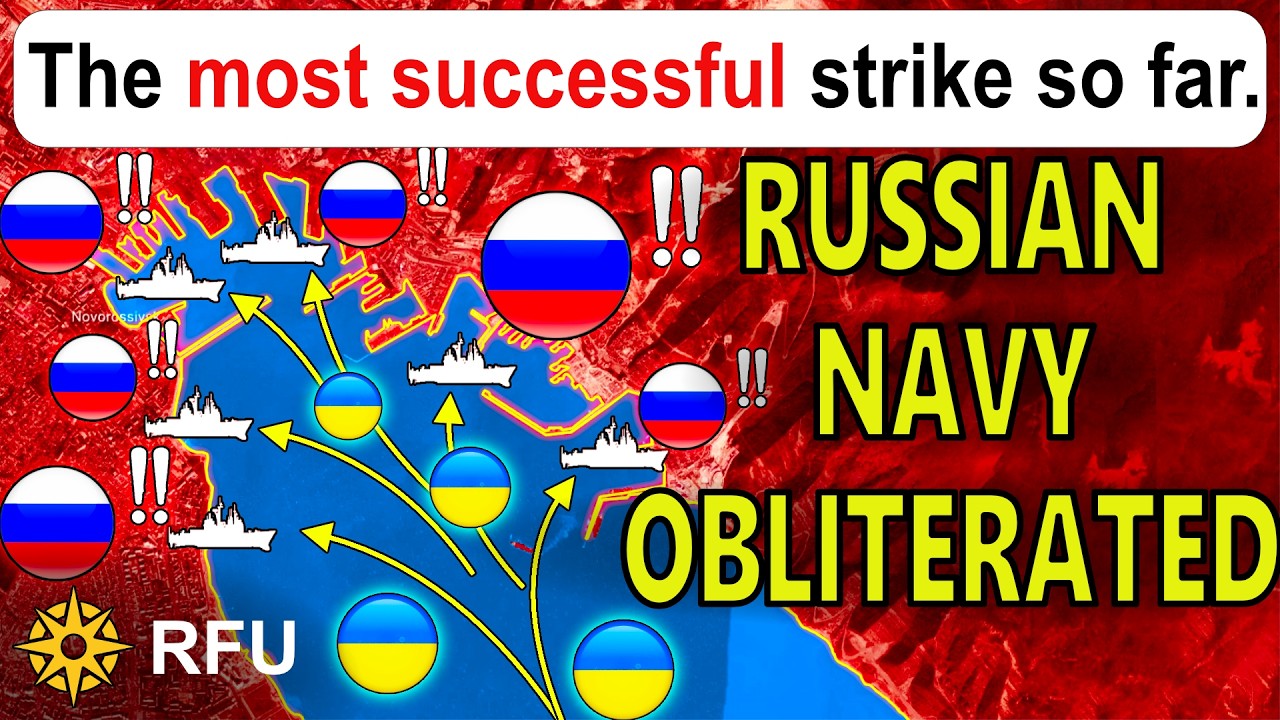
Title: Ukraine delivers most successful attack and destroys 5 Russian ships in unprecedented drone strike
Channel: RFU News — Strategic Geopolitics
Published: 2026-03-11
Duration: 5:53
Views: 306,277
Description:
✅ Spring Sale: starting from just $4.99! Get 50% OFF full access to the map + exclusive strategic updates: https://www.rfunews.com/pricing
💎 What is included in the membership?
1. Uncensored combat footage from every report.
2. Summaries of the most important geopolitical news in the world.
3. Timeline Builder tool to connect the dots between the news in real time.
4. Advanced tools and statistics to analyze news.
5. Exclusive strategic updates in the form of videos and articles.
Today, the biggest news comes from Russia.
Here, Russian naval power is facing one of its most dramatic setbacks of the war, signaling another decisive turn in the Black Sea. However, the scale of Ukraine’s latest strike not only represents a major blow to the Russian Navy but also demonstrates how Ukraine, unlike Iran, can counter a large naval adversary.
While the world was distracted by US strikes on Iran, Ukraine launched a truly massive drone operation against Novorossiysk, targeting Russia’s most important Black Sea naval hubs. Russia had already relocated a substantial portion of its Black Sea Fleet to Novorossiysk after repeated Ukrainian strikes made its Crimean bases increasingly untenable, which meant the attack targeted the very port Russia had designated as its safer alternative. The attack unfolded as a coordinated strike involving both aerial and maritime drones, designed to saturate Russian defenses and force rapid depletion of interceptors before more assets could be moved in. Russian sources and independent monitoring channels reported that approximately 200 drones were deployed in successive waves. The scale of the attack far exceeded previous Ukrainian naval and aerial drone operations, proving overwhelming for Russian radar coverage and air defense systems.
In the first wave, Ukrainians destroyed the guidance radar of the S 300 air defense system, and a modern Pantsir S2 air defense unit meant to protect the port. With Russian defenses degraded and spent, subsequent waves were able to damage at least five moored Russian warships, marking one of the most successful Ukrainian naval operations of the war. Confirmed hits included the minesweeper Valentin Pikul, which sustained the heaviest damage, and the corvettes Yeysk and Kasimov. Satellite analysis by independent groups suggested additional damage to the frigate Admiral Essen, including impacts to its superstructure. Interestingly, judging by aftermath and satellite footage of the strikes, Ukrainians targeted electronic warfare systems, radars, and air defense systems onboard of the warships, before subsequent strikes focused on more structural damage to the vessels. Additionally, the strike triggered explosions all across the port area, including at the Sheskharis oil terminal, where six of seven Russian oil tankers present were hit, causing a fire that burned throughout the night and well into the morning. Casualty reports indicated that during the attack, three Russian servicemen were kille
Facts Only
Ukraine launched a drone strike on Russia’s Novorossiysk naval base on March 11, 2026.
The attack involved approximately 200 drones deployed in successive waves.
Initial strikes disabled an S-300 air defense guidance radar and a Pantsir S2 air defense system.
At least five Russian warships were damaged, including the minesweeper *Valentin Pikul* and corvettes *Yeysk* and *Kasimov*.
Satellite analysis suggested potential damage to the frigate *Admiral Essen*.
The Sheskharis oil terminal was hit, causing fires that damaged six of seven Russian oil tankers.
Three Russian servicemen were killed during the attack.
Novorossiysk had become a key Russian naval hub after previous Ukrainian strikes on Crimean bases.
The operation targeted electronic warfare systems and radars before focusing on structural damage to vessels.
The attack occurred amid global attention on U.S. strikes in Iran.
Executive Summary
Full Take
This narrative presents Ukraine’s drone strike as a decisive blow to Russian naval power, emphasizing tactical innovation and strategic impact. The strongest version of this account highlights Ukraine’s ability to adapt, saturate defenses, and exploit vulnerabilities—crediting Kyiv’s evolving asymmetric capabilities. However, the framing leans toward a triumphalist tone, potentially oversimplifying the long-term strategic implications. The focus on drone numbers (200) and ship damage risks emotional exploitation (ARC-0043 Motte-and-Bailey), where the "success" metric is framed narrowly without addressing broader war dynamics.
Root cause assumptions include Ukraine’s technological edge and Russia’s defensive failures, but the narrative omits potential Russian countermeasures or escalation risks. Historically, this echoes Cold War-era proxy conflicts where asymmetric tactics reshaped power balances, but the Black Sea’s geopolitical stakes add complexity.
Implications for human agency: Ukraine’s success may embolden further asymmetric warfare, but civilian costs (e.g., oil terminal fires) and Russian retaliation remain unaddressed. Who benefits? Ukraine’s morale and Western backers; who bears costs? Russian naval capacity and regional stability.
Bridge questions: How might Russia adapt its naval doctrine post-strike? What second-order effects could this have on global drone warfare norms? What perspectives from Russian military analysts are missing here?
Counterstrike scan: A coordinated influence campaign would amplify Ukraine’s "David vs. Goliath" narrative while downplaying Russian resilience. This article aligns partially—emphasizing Ukrainian success—but avoids outright propaganda by citing independent satellite analysis. No full match to a disinformation playbook.
Patterns detected: ARC-0043 Motte-and-Bailey (narrow success framing), ARC-0024 Ambiguity (uncertainty on long-term impact).
Sentinel — Human
The article shows some stylometric and coordination signals but retains human-like idiosyncrasies and promotional elements, suggesting a likely human origin with possible editorial templating.