Facts Only
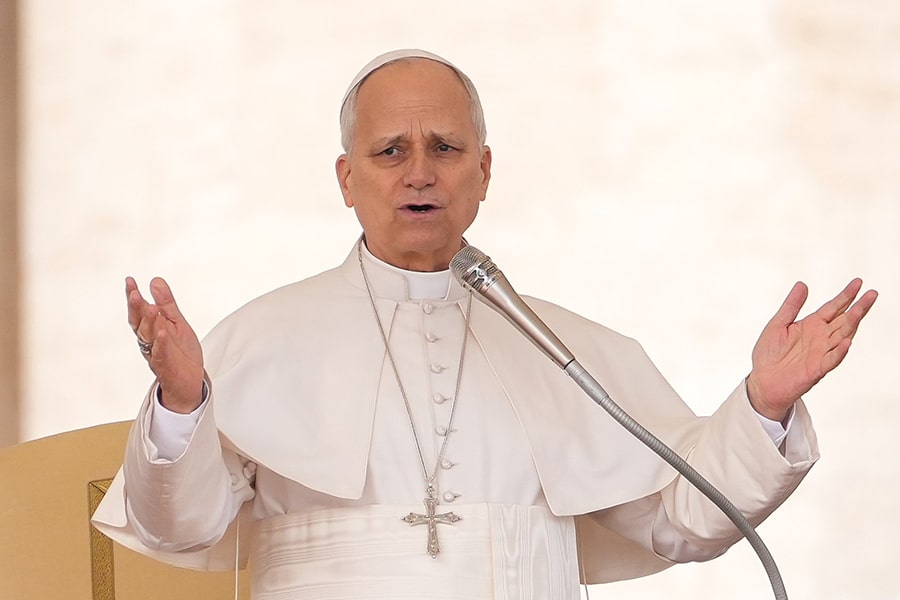
Pope Leo XIV delivered a weekly general audience in St. Peter’s Square on March 11, 2026.
He discussed the unity of the Catholic Church, citing faith in Christ as its foundation, not language, culture, or ethnicity.
The pope referenced the Second Vatican Council’s *Lumen Gentium*, which describes the Church as the "People of God."
He stated that love governs relationships within the Church and that believers are united through Christ.
The Church is described as the body of Christ, called to remain open to all humanity.
Pope Leo XIV mentioned the diversity of the Church as a sign of hope amid global conflicts.
He expressed closeness to the Lebanese people following the death of Father Pierre El-Rahi, a Maronite priest killed in an Israeli bombing on March 9, 2026.
Father El-Rahi’s funeral was held on March 11 in Al-Qlayaa, a Christian village in Lebanon.
The pope met privately with Cardinal Dominique J. Mathieu, Archbishop of Tehran and Isfahan, who had been evacuated from Iran.
Cardinal Mathieu arrived in Rome on March 8 after the evacuation of the Italian Embassy in Tehran.
Pope Leo XIV called for prayers for peace in Iran and the Middle East, particularly for civilian victims.
The Vatican released additional reports on women’s roles in Church leadership and other ecclesiastical updates.
Executive Summary
Pope Leo XIV addressed the weekly general audience in St. Peter’s Square on March 11, 2026, emphasizing the unity of the Catholic Church as rooted in faith in Christ rather than language, culture, or ethnicity. He referenced the Second Vatican Council’s *Lumen Gentium*, which describes the Church as the "People of God," united by their shared belief in Jesus. The pope highlighted love as the governing principle within the Church and called for openness to all humanity, particularly in a world marked by conflict. He also expressed solidarity with Lebanon following the death of Maronite priest Father Pierre El-Rahi, who was killed in an Israeli bombing, and met privately with Cardinal Dominique J. Mathieu, the Archbishop of Tehran and Isfahan, who had been evacuated from Iran. The pope urged prayers for peace in the Middle East, especially for civilian victims.
The address underscored the Church’s role as a sign of hope amid global divisions, with Pope Leo XIV framing its diversity as a testament to unity in faith. His remarks also touched on broader geopolitical tensions, linking spiritual principles to contemporary crises. The pope’s call for inclusivity and peace reflects ongoing Vatican efforts to address both theological and humanitarian concerns.
Full Take
The strongest version of this narrative presents the Catholic Church as a unifying force in a fractured world, with Pope Leo XIV framing faith in Christ as the antidote to division. The address skillfully weaves theological principles with contemporary geopolitical crises, positioning the Church as both a spiritual and moral authority. By highlighting the death of Father Pierre El-Rahi and the evacuation of Cardinal Mathieu, the narrative grounds abstract ideals in tangible human suffering, amplifying emotional resonance. This aligns with the Church’s historical role as a mediator in conflicts, leveraging moral authority to advocate for peace.
Patterns detected: none. The content avoids overt manipulation, though the framing of the Church as a universal beacon of hope could be seen as an appeal to authority (ARC-0012). The emphasis on unity amid division is a recurring theme in papal rhetoric, echoing post-Vatican II efforts to position the Church as inclusive yet doctrinally firm. The unstated assumption is that institutional religion remains a stabilizing force in global affairs—a claim that invites scrutiny given historical complexities.
The root cause of this narrative is the Vatican’s enduring mission to assert relevance in a secularizing world. By tying theological unity to contemporary conflicts, the Church reinforces its role as a transcendent moral voice. However, this risks oversimplifying geopolitical dynamics, where religious identity often intersects with nationalism and power struggles. The implications for human agency are mixed: while the call for inclusivity is laudable, it may inadvertently marginalize voices critical of institutional religion.
Bridge questions: How does the Church’s vision of unity reconcile with its own historical divisions? What role should religious institutions play in mediating modern conflicts, given their own political entanglements? Would the narrative shift if the focus were on grassroots interfaith efforts rather than institutional authority?
Counterstrike scan: A coordinated influence campaign might exploit the Church’s moral authority to legitimize specific political stances, framing dissent as a threat to unity. However, this address does not exhibit such alignment. The content remains within the bounds of traditional papal messaging, avoiding overt propaganda.
Sentinel — Human
The article exhibits strong human authorship signals, including natural stylistic variation, emotional depth, and specific, verifiable details, with no significant indicators of synthetic generation.