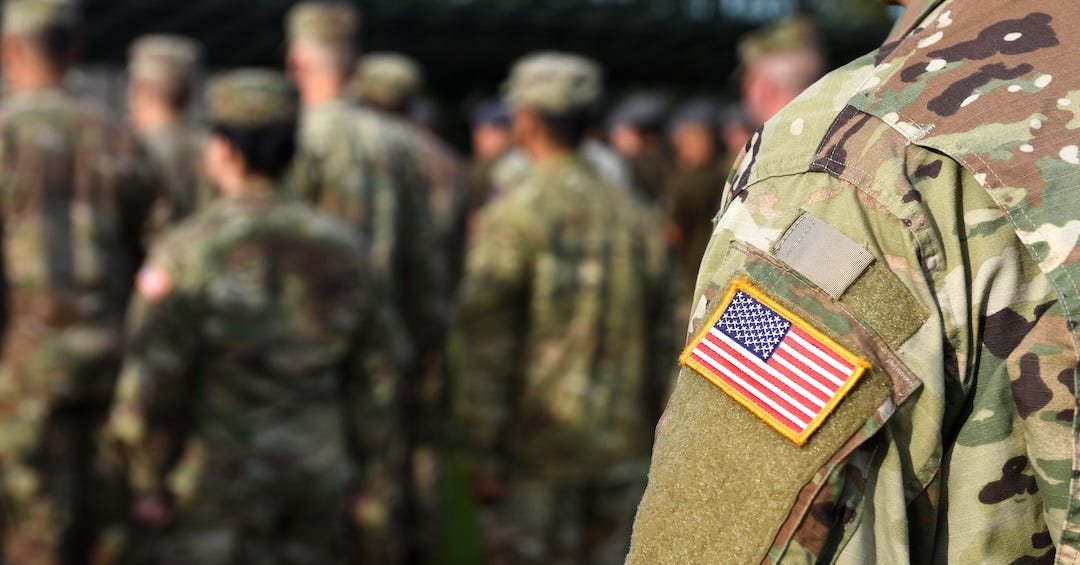
LBC has a report titled “Republicans ‘storm out’ of Iran briefing as they claim US ‘war machine’ is trying to put boots on ground” about MAGA lawmakers whining that Trump’s war looks set to turn into a land invasion.
LBC reports:
A number of usually loyal MAGA Republicans left the Iran briefing early — including US congresswoman Nancy Mace, who told the waiting media “we were misled” about the war after walking out of a Pentagon briefing.
Mace, a widely controversial lawmaker, was seen to urge President Trump to remove Lindsey Graham from the Situation Room — the White House’s round-the-clock command centre — as tensions rose.
The lawmaker claims Graham “brags about” advising the president and his aggressive war strategy.
It comes as the US is reportedly considering a massive troop deployment that would include ‘infantry and armoured vehicles,’ according to the Wall Street Journal.
Tensions continue to rise from within Trump’s own party amid plans to put troops on the ground in Iran, as peace talks continue amid the constantly changing situation.
I get so tired of all this American hand-wringing about “boots on the ground”. It’s a symptom of a wildly sick dystopia that these people are fine with raining military explosives on a densely populated city but draw the line at putting American troops in the line of fire.
Sure, killing kids is fine, just don’t put boots on the ground!
Sure you can rain hellfire on hospitals, homes and schools for weeks, just make sure you do all your massacring from the sky where nobody can return fire.
Killing is okie dokie, so long as our troops aren’t the ones getting killed.
These people have no compassion. No morality. No empathy. American conservatives are constantly wagging their fingers and bloviating puritanically about immorality and degeneracy, but they’re the least moral people in the country. Their positions aren’t driven by care for human life, no matter how hard they try to pretend otherwise. They are driven by blind loyalty to the empire and the groveling adoration of power.
If you only oppose mass military slaughter if it is carried out in a way that puts your own countrymen at risk, that makes you a piece of shit.
People should oppose the evil wars inflicted by their government and its allies because the wars are evil, not because they might impact someone you know. The people being murdered in Iran are no less human than Americans, and their lives don’t matter any less.
I want to live in a healthy world where self-evident statements like this don’t even need to be made. Instead I live in a world where the war on Iran is barely receiving any meaningful domestic opposition from the populations of the primary aggressor nations.
____________________
The best way to make sure you see everything I write is to get on my free mailing list. My work is entirely reader-supported, so if you enjoyed this piece here are some options where you can toss some money into my tip jar if you want to. Click here for links for my social media, books, merch, and audio/video versions of each article. All my work is free to bootleg and use in any way, shape or form; republish it, translate it, use it on merchandise; whatever you want. All works co-authored with my husband Tim Foley.
Bitcoin donations: 1Ac7PCQXoQoLA9Sh8fhAgiU3PHA2EX5Zm2
Feature image via Adobe Stock.
100%
At this point, Iranian and Palestinian lives are far more important to Yours Truly than AmeriKKKan ones.
Facts Only
A group of MAGA-aligned Republicans, including Congresswoman Nancy Mace, left a Pentagon briefing on Iran early.
Mace stated that lawmakers were "misled" about the war's trajectory.
Mace reportedly urged President Trump to remove Senator Lindsey Graham from the White House Situation Room.
Mace accused Graham of "brag[ging] about" advising Trump on an aggressive war strategy.
The Wall Street Journal reported that the U.S. is considering deploying infantry and armored vehicles to Iran.
Tensions within the Republican Party are rising over plans for potential ground troop deployment in Iran.
Peace talks between involved parties are ongoing amid shifting military plans.
The article criticizes the selective opposition to war based on whether U.S. troops are at risk.
The author argues that opposition to war should stem from the inherent harm to all human life, not just American casualties.
The piece describes a pattern where aerial bombardments are accepted while ground invasions are opposed.
The author claims American conservatives prioritize loyalty to state power over moral consistency.
The article asserts that Iranian and Palestinian lives are being devalued in U.S. political discourse.
Executive Summary
Tensions are rising within the Republican Party over potential U.S. military escalation in Iran, with some MAGA-aligned lawmakers expressing dissatisfaction after a Pentagon briefing. Congresswoman Nancy Mace and others walked out, claiming they were misled about the war's direction, particularly regarding plans for a ground invasion. Mace reportedly urged President Trump to remove Senator Lindsey Graham from the Situation Room, accusing him of advocating for an aggressive war strategy. Meanwhile, reports suggest the U.S. is considering deploying infantry and armored vehicles to Iran, even as peace talks continue. The article critiques the selective opposition to war among some Americans, arguing that moral outrage should focus on the broader human cost of military action—regardless of whether U.S. troops are directly involved—rather than solely on the risk to American lives. The piece frames this as a symptom of a broader moral failure, where the value of foreign lives is dismissed in favor of nationalist priorities.
The situation reflects deep divisions within the GOP and raises questions about the ethical boundaries of military intervention. While some lawmakers resist ground troops, the article highlights a perceived hypocrisy in accepting aerial bombardments that kill civilians. The lack of significant domestic opposition to the war is presented as evidence of a dystopian acceptance of state violence, provided it remains distant and "clean." The author's perspective is unapologetically critical of American militarism and the moral inconsistencies they see in its supporters.
Full Take
The strongest version of this narrative is a moral indictment of selective anti-war sentiment, particularly among American conservatives. It highlights a genuine inconsistency: opposition to war often hinges on the safety of U.S. troops rather than the broader humanitarian consequences. The piece effectively challenges the hypocrisy of accepting remote warfare—drones, airstrikes, sanctions—as morally permissible while drawing the line at ground invasions. This is a valid critique of how nationalism distorts ethical priorities, framing foreign lives as expendable collateral in geopolitical strategy. The author’s emotional intensity serves a purpose, forcing readers to confront the dehumanization embedded in modern warfare.
However, the piece also employs patterns of emotional exploitation and distortion. The rhetoric leans heavily on moral outrage, framing opponents as "scumbags" and "pieces of shit," which risks alienating readers who might otherwise engage with the core argument. This aligns with **ARC-0012 Rage Bait** and **ARC-0030 Provocation**, where anger is weaponized to shut down nuanced discussion. Additionally, the binary framing—"you either oppose all war or you’re complicit"—echoes **ARC-0043 Motte-and-Bailey**, where the argument retreats to an extreme position ("all war is evil") while attacking a strawman version of the opposition ("you only care about American lives"). The piece also assumes a monolithic "American conservative" position, ignoring internal debates or alternative perspectives within the right.
The root cause here is the paradox of modern warfare: technology allows nations to wage war with minimal domestic risk, reducing public resistance. The author’s frustration stems from a broader historical pattern where empires justify violence by dehumanizing the "other," a dynamic seen in colonialism, the War on Terror, and now potential conflicts with Iran. The implications are stark—when opposition to war is contingent on self-interest rather than universal ethics, it normalizes perpetual violence against marginalized populations. The cost is borne by civilians in Iran, Palestine, and elsewhere, while the benefit accrues to political and military elites who avoid accountability.
Bridge questions: How might a consistent anti-war movement balance concern for U.S. troops with solidarity for foreign civilians? What structural incentives make remote warfare more politically palatable than ground invasions? Would the author’s argument hold the same weight if applied to other conflicts, or does it risk selective outrage?
Counterstrike scan: If this were part of a coordinated influence campaign, the playbook would involve amplifying moral outrage to polarize audiences, using dehumanizing language to discredit opponents, and framing the issue as a binary choice to suppress dissent. The actual content partially matches this pattern—especially in its use of provocative language and binary framing—but it also contains genuine ethical concerns about war. The alignment isn’t structural enough to suggest bad-faith coordination; it’s more a case of rhetorical overreach in service of a principled (if flawed) argument.
**Patterns detected: ARC-0012 Rage Bait, ARC-0030 Provocation, ARC-0043 Motte-and-Bailey**
Sentinel — Human
The article is likely human-written, displaying human-like sentence length variance and a strong personal voice. However, it's important to remember that the presence of certain indicators doesn't automatically confirm human authorship; AI can mimic these characteristics as well.