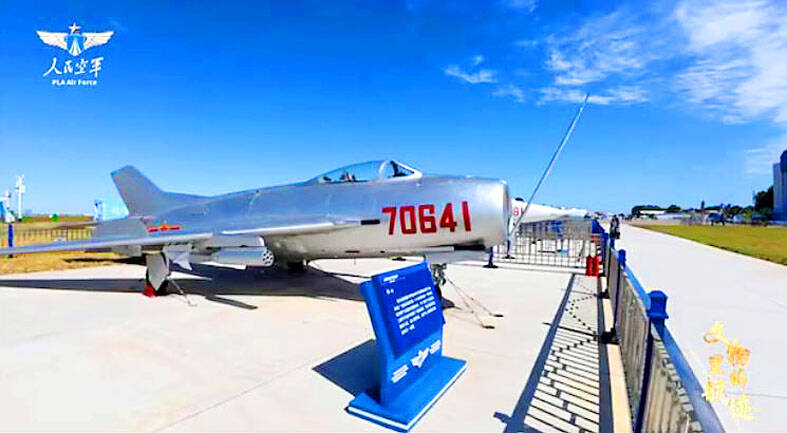
China has stationed obsolete supersonic fighters converted to attack drones at six air bases close to the Taiwan Strait, a report published this month by the Arlington, Virginia-based Mitchell Institute for Aerospace Studies said.
Satellite imagery of the airfields from the institute’s “China Airpower Tracker” shows what appear to be lines of stubby, swept-winged aircraft matching the shape of J-6 fighters that first flew with the Chinese People’s Liberation Army (PLA) Air Force in the 1960s. Since their conversion to drones, the aircraft have been identified at five bases in China’s Fujian Province and one in Guangdong Province, the report said.
J. Michael Dahm, a senior fellow at the Mitchell Institute, said that the PLA has deployed an estimated 200 or more obsolete fighters converted to drones to airfields near the Taiwan Strait.
Photo: Reuters / Screen grab via PLA Air Force WeChat page
The jets-turned-drones would fly into targets in the opening phase of an assault on Taiwan, said Dahm, a former US naval intelligence officer.
They would be used more like cruise missiles than autonomous or remote-controlled uncrewed aerial vehicles (UAV), he said.
“They will attack Taiwan, US or allied targets in large numbers, effectively overwhelming air defenses,” he said.
He compiled the data for the report from open-source intelligence and commercial satellite imagery.
China dominates the global commercial drone market. It is also investing heavily in military drone technologies.
The converted drones identified in the Mitchell Institute report are part of Beijing’s expanding mix of airpower weapons, including bombers with stand-off missiles, modern fighters, ballistic missiles, cruise missiles and swarms of modern UAVs, experts on air warfare said.
This month, the US intelligence community said that its assessment is that China is not currently planning to invade Taiwan in 2027.
That contrasted with the Pentagon’s annual report on China’s military power late last year that said China “expects to be able to fight and win a war on Taiwan by the end of 2027.”
The key purpose of the converted drones is “to exhaust Taiwan’s air defense systems in the first wave of an attack,” a senior Taiwanese security official said.
To prevent China from “striking high-value targets, we will inevitably face the cost-efficiency issue of using expensive missiles to intercept them at a distance,” the official said.
In a report to the legislature this week, the Ministry of National Defense outlined plans to rapidly acquire a new generation of counterdrone systems.
The ministry referred to a 2022 report by the Institute for National Defense and Security Research, which said that the drones were “a form of asymmetric warfare that cannot be ignored.”
The Chinese Ministry of National Defense and Beijing’s Taiwan Affairs Office did not respond to questions for this story.
The Pentagon also did not respond to a request for comment.
In a Taiwan conflict, China could launch a “large attack wave” of strike aircraft, missiles flying on different trajectories, and fast and slow drones, said Peter Layton, a visiting fellow at Griffith University in Australia and a retired Royal Australian Air Force group captain who has worked at the Pentagon.
“There would be a lot of diverse things all coming at the same time,” Layton said. “It would be an air defense nightmare.”
The drones do not rank among China’s most threatening, advanced UAVs, but they would be costly to combat, he said.
The small, high-speed interceptor drones that Ukraine has been fielding in its war with Russia would be ineffective in shooting them down, he said.
“Those J-6s would need a proper expensive missile,” he added.
The protracted conflict in Ukraine and the US-Israeli war with Iran have demonstrated that drones are a crucial element of modern warfare.
Some can be built in large numbers, deployed in mass formations and quickly replaced after battlefield losses.
China is developing new UAVs, including a stealth attack drone that experts said would operate from an aircraft carrier.
Military attaches and security analysts said that China is already testing the use of drones in deception operations in potential rehearsals of a Taiwan invasion.
The twin-engine J-6 was derived from the 1950s-era Soviet Mig-19 fighter.
This jet and other Soviet-derived aircraft formed the core of China’s fighter fleet until the mid-1990s, the US Air Force’s Air University said.
Dahm estimated that more than 500 of the aircraft have been converted to drones.
The drone version of the J-6 is designated the J-6W.
The PLA Air Force in September last year exhibited one of the converted fighters at the Changchun Air Show in northeast China.
On an information board displayed next to the drone, it was described as a J-6 UAV, a photograph from the air show published by the Chinese Ministry of National Defense showed.
“This aircraft is a modified version of the J-6 fighter jet,” the information board said.
The fighter’s cannons and other equipment were removed, and it was fitted with an automatic flight control system and terrain matching navigation technology, it said.
The UAV made its first successful flight in 1995 and could be used as attack aircraft, or a training target for fighter pilots, anti-aircraft guns, surface-to-air missiles or radar operators, the board said.
The Chinese airfields closest to the Taiwan Strait where J-6 drones are based would be vulnerable to counterattack from Taiwan and its allies in a conflict, Dahm said.
“The idea is to launch all the drones in the first hours of a PLA operation,” he said.
‘UNFRIENDLY’: Changing the nationality listing of Taiwanese residents to ‘China’ goes against EU foreign policy as well as democratic and human rights principles, MOFA said Taiwan yesterday called on Denmark to correct its designation of the nationality of Taiwanese residents as “China” or face retaliatory measures. The Danish government in 2024 changed the nationality of Taiwanese citizens on their residence permits from “Taiwan” to “China.” The decision goes against EU foreign policy and contravenes democratic and human rights principles, Ministry of Foreign Affairs (MOFA) spokesman Hsiao Kuang-wei (蕭光偉) said. Denmark should present a solution acceptable to Taiwan as soon as possible and correct the erroneous designation to preserve the longstanding friendship between the two nations, Hsiao said. The issue could damage Denmark’s image and business reputation in Taiwan,
KEY INDUSTRY: The vice premier discussed a plan to create a non-red drone supply chain by next year, which has been allocated a budget of more than NT$7.2 billion The government has budgeted NT$44.2 billion (US$1.38 billion) to cultivate Taiwan’s uncrewed aerial vehicle (UAV) industry over the next five years, which would make the nation a major player in the industry’s democratic supply chain in the Asia-Pacific region, Premier Cho Jung-tai (卓榮泰) said yesterday. Cho made the remarks during a visit to the facilities of Cub Elecparts Inc (為升電裝). Democratic Progressive Party (DPP) Legislator Chen Su-yueh (陳素月) and Chinese Nationalist Party (KMT) Legislator Hsieh Yi-fong (謝依鳳) also participated in the trip. Cub Elecparts has transitioned from the automotive industry to the defense industry, which is the top priority among the nation’s
Taiwan climbed to its highest position in global export rankings in more than three decades last year, buoyed by demand linked to artificial intelligence (AI) that lifted shipments of semiconductors and technology products, Ministry of Finance data released yesterday showed. Taiwan accounted for 2.4 percent of global exports last year, or about US$640 billion, ranking 12th worldwide, the data showed. That was up four places from a year earlier and marked the nation’s best ranking since 1994, the ministry said. Taiwan’s share of global exports rose by 0.5 percentage points from the previous year, the largest increase among major economies, reflecting the nation’s
FIRST TRIAL: Ko’s lawyers sought reduced bail and other concessions, as did other defendants, but the bail judge denied their requests, citing the severity of the sentences Former Taipei mayor Ko Wen-je (柯文哲) was yesterday sentenced to 17 years in prison and had his civil rights suspended for six years over corruption, embezzlement and other charges. Taipei prosecutors in December last year asked the Taipei District Court for a combined 28-year, six-month sentence for the four cases against Ko, who founded the Taiwan People’s Party (TPP). The cases were linked to the Core Pacific City (京華城購物中心) redevelopment project and the mismanagement of political donations. Other defendants convicted on separate charges included Chinese Nationalist Party (KMT) Taipei City Councilor Angela Ying (應曉薇), who was handed a 15-year, six-month sentence; Core Pacific
Facts Only
China has stationed over 200 converted J-6 supersonic fighter drones at six air bases near the Taiwan Strait.
The drones are located at five bases in Fujian Province and one in Guangdong Province.
The J-6 fighters, originally from the 1960s, have been modified into drones designated as J-6W.
Satellite imagery from the Mitchell Institute for Aerospace Studies confirms the presence of these drones.
The drones are intended to overwhelm Taiwanese air defenses in the early stages of a potential conflict.
The U.S. intelligence community stated in 2024 that China is not currently planning to invade Taiwan in 2027.
The Pentagon’s 2023 report suggested China expects to be capable of winning a war over Taiwan by 2027.
Taiwan’s Ministry of National Defense is investing NT$44.2 billion over five years to develop its UAV industry.
The J-6W drone was first successfully flown in 1995 and can be used for attack missions or training.
Denmark changed the nationality listing of Taiwanese residents to "China" in 2024, prompting Taiwan to demand correction.
Former Taipei Mayor Ko Wen-je was sentenced to 17 years in prison for corruption and embezzlement.
Taiwan’s global export share rose to 2.4% in 2023, ranking 12th worldwide, its highest position since 1994.
Executive Summary
Full Take
The strongest version of this narrative highlights China’s strategic use of obsolete but repurposed military hardware to create a cost-effective swarm capability, a tactic that aligns with modern warfare trends seen in Ukraine and other conflicts. The deployment of J-6 drones near Taiwan reflects a calculated effort to exploit asymmetrical advantages, forcing Taiwan to expend expensive missile defenses against relatively low-cost assets. This pattern echoes historical strategies of using numerical superiority to offset technological inferiority, a hallmark of Soviet-era military doctrine from which the J-6 itself originates.
However, the narrative also carries potential manipulation patterns. The framing of China’s drone deployment as an imminent threat could amplify fear appeals (ARC-0012), while the contrast between U.S. intelligence assessments and Pentagon warnings may create a false binary (ARC-0043) that obscures the nuanced reality of China’s long-term military planning. The inclusion of Taiwan’s export success and Ko Wen-je’s sentencing, while factually relevant, risks diluting focus on the core security issue, potentially serving as a distraction (ARC-0031).
Root causes include China’s broader military modernization and Taiwan’s precarious geopolitical position, where economic resilience and legal accountability are intertwined with defense preparedness. The implications for human agency are stark: Taiwan’s ability to counter drone swarms will test its technological adaptability, while the cost of interception raises questions about resource allocation in asymmetric warfare. Who benefits? China gains a low-cost, high-impact tool; Taiwan faces escalating defense costs. Second-order consequences may include accelerated drone arms races in the region and increased pressure on U.S. allies to bolster Taiwan’s defenses.
Bridge questions: How might Taiwan’s counterdrone investments reshape its defense industry’s priorities? Could Denmark’s nationality designation reflect broader EU policy shifts, or is it an isolated incident? What would change your assessment of China’s intent—evidence of drone testing in simulated Taiwan invasion scenarios, or a reduction in deployments?
Counterstrike scan: A coordinated influence campaign would emphasize the drone threat to justify military aid to Taiwan while downplaying China’s long-term strategic patience. The actual content aligns partially with this pattern but includes balancing perspectives (e.g., U.S. intelligence assessments), suggesting a more nuanced presentation than a pure propaganda playbook.