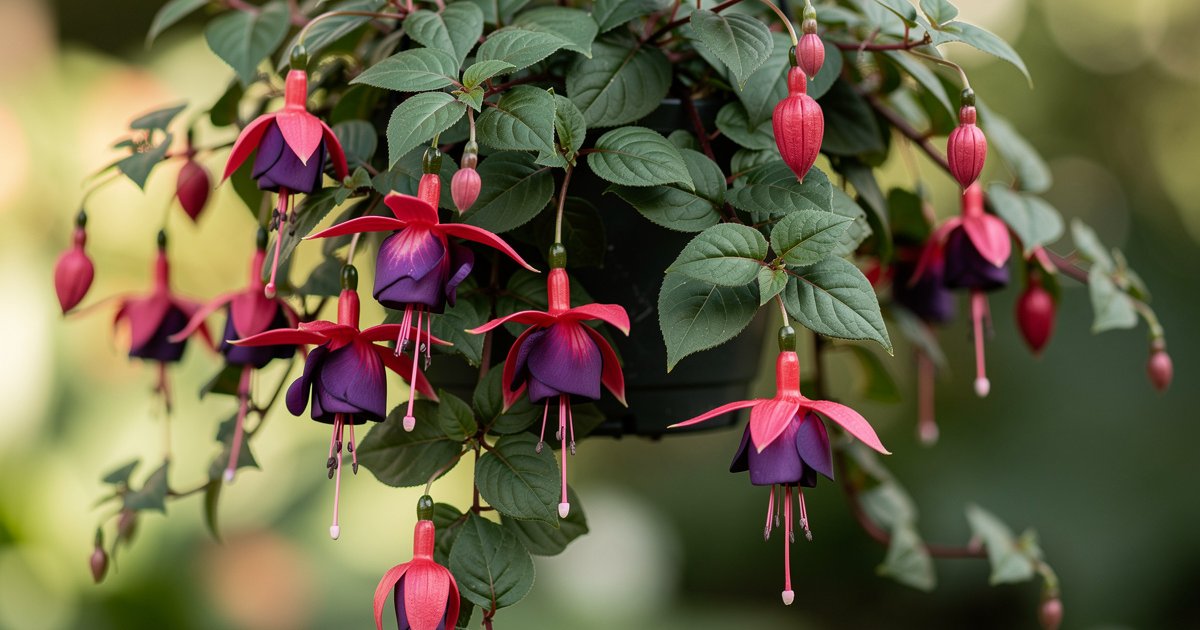
In the layered brightness of Fort Collins summers, where sunlight can feel both generous and exacting, some plants refuse the logic of upright structure altogether. Trailing Fuchsia belongs to that refusal. It does not stand so much as it drapes, cascades, and suspends itself in midair color.
Where many annuals organize space vertically or horizontally, trailing Fuchsia introduces a third dimension: downward motion as design.
A Study in Vertical Inversion
Fuchsia, particularly trailing varieties, is defined by pendulous blooms that hang like small lanterns beneath arching stems. Each flower is a layered structure—sepals flaring outward, petals tucked within—creating a form that feels both botanical and ornamental.
In Fort Collins garden design, this creates a distinctive spatial reversal:
- It introduces downward visual movement in upward-facing spaces
- It creates color at the edges and undersides of containers
- It extends bloom presence into vertical negative space
It is not a plant that sits in the garden. It hangs within it.
The Architecture of Suspension
Trailing Fuchsia behaves less like a bedding plant and more like a living curtain. Its stems elongate outward and downward, responding to gravity as a compositional partner rather than a constraint.
This gives it a unique design language:
- Blooms are distributed along arcs rather than clusters
- Foliage remains supportive rather than dominant
- The plant reads as motion held in partial stillness
It is structure that refuses rigidity.
Container Expression in Northern Colorado
In Fort Collins, trailing Fuchsia is almost exclusively a container plant. The climate—dry air, strong sun, and cold winters—frames it as a seasonal performer rather than a permanent resident.
Container culture is not a limitation here; it is essential to its form:
- Elevated planters allow cascading visibility
- Hanging baskets amplify pendulum-like movement
- Shaded patios support temperature-sensitive bloom stability
Position becomes part of the plant’s architecture. Height determines meaning.
Light, Water, and Environmental Sensitivity
Trailing Fuchsia is more responsive than most annuals, requiring a balance that is steady rather than extreme.
- Light: Bright, indirect light or morning sun with afternoon shade; harsh midday exposure can reduce bloom quality
- Water: Consistent moisture is essential; it does not tolerate prolonged dryness
- Soil: Rich, well-draining, moisture-retentive mix
- Climate behavior: Performs best in cooler summer pockets rather than reflective heat zones
In Fort Collins’ dry environment, it often succeeds best where irrigation is predictable and heat is moderated.
Compositional Role: The Edge Condition
Trailing Fuchsia is most effective when used at boundaries—where structure ends and air begins. It defines edges not by containment, but by extension.
In design pairing:
- With upright plants (Coleus, Dracaena, ornamental grasses)
It softens rigidity by introducing downward motion beneath vertical forms.
- With bold bloomers (Geranium, Petunia)
It adds layered complexity, preventing compositions from flattening visually.
- With silver foliage (Dusty Miller)
The contrast becomes tonal and spatial—soft light above, suspended color below.
- With minimal containers or modern planters
It transforms geometry into movement, breaking hard lines with organic flow.
It is the element that “falls out” of composition without leaving it.
Seasonal Behavior and Temporal Sensitivity
Trailing Fuchsia is precise in its seasonal rhythm. It does not rush, but it is sensitive to disruption.
- Early growth focuses on stem development and structural reach
- Mid-summer delivers peak bloom density and color articulation
- Late season often shows fatigue if heat or dryness becomes excessive
Unlike more resilient annuals, it does not simply fade—it signals imbalance through form first, bloom second.
Care as Environmental Negotiation
Caring for trailing Fuchsia is less about intervention and more about maintaining equilibrium.
Key practices include:
- Ensuring consistent moisture without saturation
- Protecting from strong afternoon heat and wind exposure
- Removing spent blooms to maintain continuous flowering rhythm
- Feeding lightly during peak growth to support sustained bloom production
It responds quickly to neglect—but also quickly to correction.
The Aesthetic of Cascading Softness
Trailing Fuchsia introduces a particular kind of softness into garden composition—not blur, but descent. Its visual effect is not static decoration; it is movement suspended at the edge of gravity.
In Fort Collins gardens, where strong light tends to sharpen and define, this plant introduces a counterpoint: softened edges, lowered focal points, and color that appears to hang rather than sit.
It changes where the eye rests.
Final Thoughts
Trailing Fuchsia does not compete for attention in the way upright bloomers do. It repositions attention entirely. It draws the gaze downward, outward, and into edges that might otherwise be ignored.
Placed in containers alongside structured foliage or bold seasonal color, it acts as a quiet disruption of symmetry—a reminder that not all garden structure moves upward.
Some of it spills over the edge.
Facts Only
Trailing Fuchsia is a plant found in Fort Collins gardens
It has pendulous blooms and elongating stems that cascade downward
It introduces downward visual movement in upward-facing spaces
It adds layered complexity to compositions
It pairs well with upright plants, bold bloomers, silver foliage, and minimal containers or modern planters
It prefers bright, indirect light, consistent moisture, and a rich, well-draining soil mix
It shows peak bloom density in mid-summer and potential fatigue in late season due to excessive heat or dryness
Executive Summary
In this article, the focus is on Trailing Fuchsia, a unique plant that thrives in Fort Collins gardens, particularly in containers. The plant is defined by its pendulous blooms and elongating stems that cascade downward, creating a distinctive spatial reversal in the garden. It introduces downward visual movement in upward-facing spaces, adds layered complexity to compositions, and softens rigidity by introducing movement beneath vertical forms.
The article provides information about the plant's care requirements, such as its preference for bright, indirect light, consistent moisture, and a rich, well-draining soil mix. It also discusses the plant's seasonal behavior, with early growth focusing on stem development, peak bloom density in mid-summer, and potential fatigue in late season due to excessive heat or dryness.
In terms of composition role, Trailing Fuchsia is most effective when used at boundaries, where it defines edges not by containment but by extension. It pairs well with upright plants, bold bloomers, silver foliage, and minimal containers or modern planters.
The article concludes by emphasizing that Trailing Fuchsia repositions attention in garden compositions, drawing the gaze downward, outward, and into edges that might otherwise be ignored. Placed alongside structured foliage or bold seasonal color, it acts as a quiet disruption of symmetry.
Full Take
The article presents Trailing Fuchsia as a plant that introduces a third dimension to garden design, downward motion as design. This is achieved through its pendulous blooms and elongating stems that cascade downward, creating a distinctive spatial reversal in the garden. The plant softens rigidity by introducing movement beneath vertical forms, adding layered complexity to compositions.
In terms of patterns, the article does not appear to engage in emotional exploitation, distortion, bad faith, false framing, evasion, or authority games as defined by the A.R.C. Codex. However, it does use a form of systemic pattern in that the plant's behavior is influenced by its environment (light, water, climate).
The article suggests that Trailing Fuchsia can be used to disrupt symmetry and soften rigidity in garden compositions, potentially influencing design trends in Fort Collins. However, it does not provide any evidence or data to support this claim beyond anecdotal observations.