SpaceX is targeting Tuesday, July 7 for the launch of its Transporter-17 rideshare mission. A Falcon 9 rocket will lift off from Space Launch Complex 4E at Vandenberg Space Force Base in California. The 95-minute launch window opens at 12:10 a.m. Pacific Time.
The mission will deliver 81 payloads to low-Earth orbit (LEO). These include CubeSats, microsatellites, and orbital transfer vehicles. For the Canadian space sector, the flight carries four payloads focused on environmental monitoring and academic research.
EarthDaily Analytics is flying the Loft-EarthDaily-8 (EDA-8) satellite. This launch follows the company’s deployment of six EarthDaily satellites earlier this year on the CAS500-2 mission. The EDA-8 spacecraft adds to a growing constellation designed to provide daily multispectral imagery of the globe. The resulting data supports commercial applications in agriculture, water management, and disaster response. EarthDaily plans to launch two more payloads later this year.
GHGSat continues to expand its greenhouse gas monitoring constellation with two new payloads, LEMUR-2-ELEONORE (GHGSat-C-16) and LEMUR-2-NURAY (GHGSat-C-17). Following company tradition, the satellites are named after the children of GHGSat employees. These instruments are hosted on Spire satellite buses and will monitor methane emissions from industrial sites worldwide. Independent emissions intelligence is a growing market for energy companies and regulators looking to track leak repairs and enforce compliance.
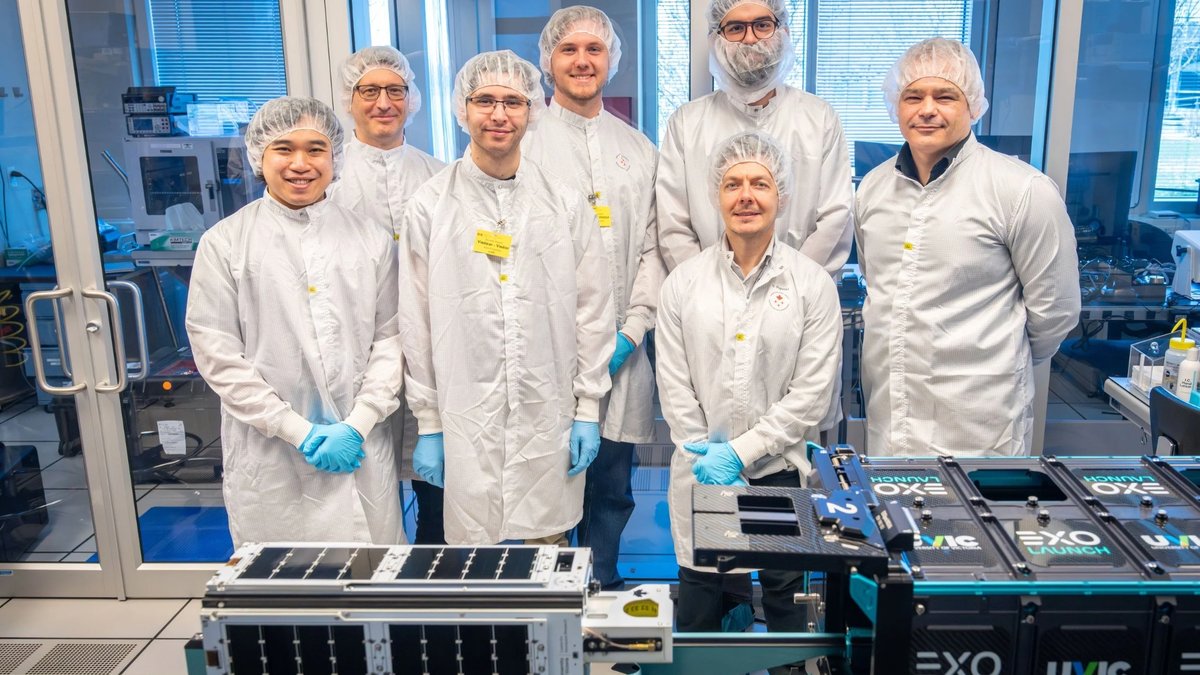
The University of Victoria is also represented on this flight with MARMOTSat. This cubesat was designed and built by students under the Canadian Space Agency CubeSats Initiative in Canada for STEM (CUBICS) program. The satellite will study the ionosphere for climate change data and test an open-source radio communications system.
Deployments for the Canadian payloads will begin less than an hour after liftoff. ELEONORE is scheduled to separate at the 54-minute mark, followed closely by MARMOTSat, NURAY, and EDA-8.