Half of the Sweet 16 is set. The final eight spots are on the line Monday as the second round of the 2026 women's NCAA tournament wraps up.
We're tracking every game, from regular-season rematches to lower seeds looking for another upset.
Here is ESPN's guide to all the Day 4 action, which tips off at noon ET on ESPN.
Monday's schedule:
(6) Alabama vs. (3) Louisville, noon ET, ESPN
(10) Virginia vs. (2) Iowa, 2 p.m. ET, ESPN
(6) Notre Dame vs. (3) Ohio State, 4 p.m. ET, ESPN
(5) Kentucky vs. (4) West Virginia, 5 p.m. ET, ESPN2
(9) Syracuse vs. (1) UConn, 6 p.m. ET, ESPN
(7) Illinois vs. (2) Vanderbilt, 7 p.m. ET, ESPN2
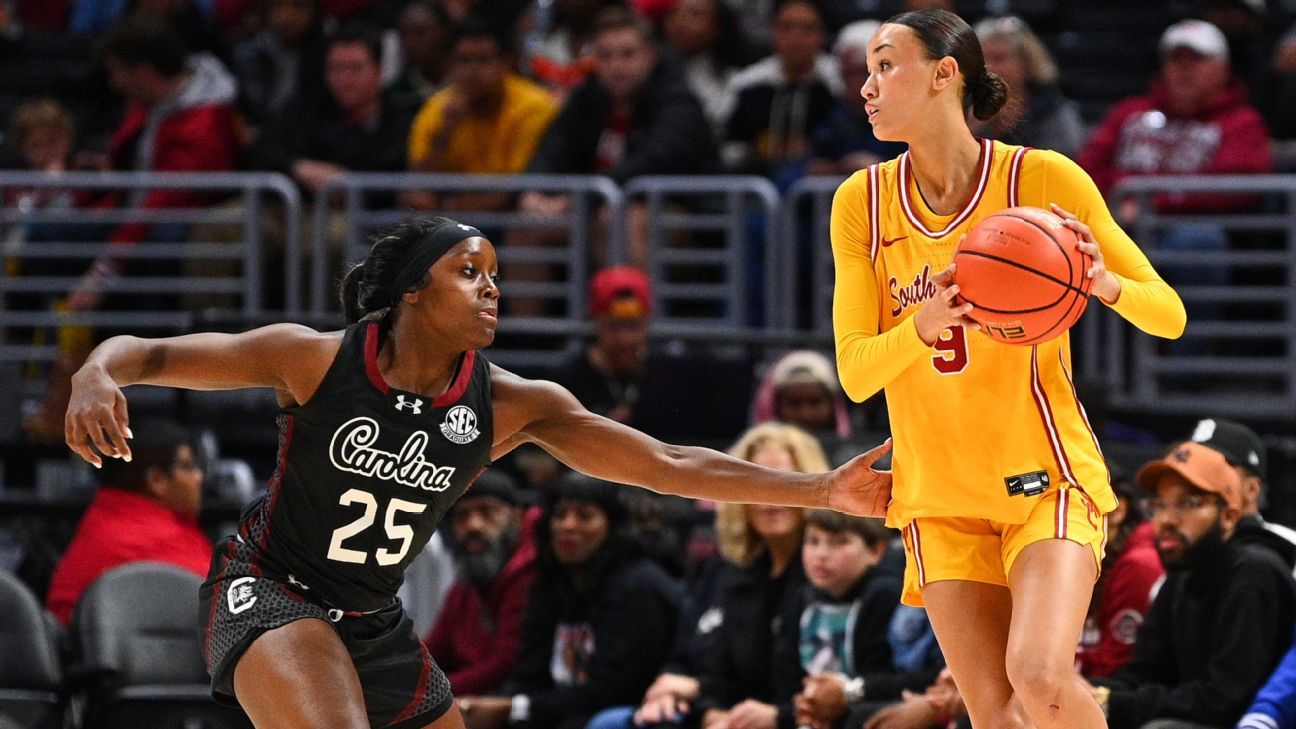
(9) USC vs. (1) South Carolina, 8 p.m. ET, ESPN
(8) Oklahoma State vs. (1) UCLA, 10 p.m. ET, ESPN
(6) Alabama vs. (3) Louisville
Noon ET, ESPN
How the Crimson Tide can advance to the Sweet 16: There will be plenty for Alabama coach Kristy Curry to correct headed into its matchup against Louisville. Though the Crimson Tide dominated Rhode Island in the paint in the first round, they had too many turnovers (14), leading to 18 Rhode Island points. Rhode Island also outrebounded Alabama 32-31 -- including 13-5 on the offensive boards. One more area of note: Alabama missed six free throws, going 14-of-20 from the line. Having said all that, Louisville started slowly in its game against Vermont. If the Crimson Tide can set the tone early and find ways to establish themselves as the aggressors in the paint, it will give them a shot to pull the upset. -- Andrea Adelson
How the Cardinals can advance to the Sweet 16: Louisville coach Jeff Walz will want his team to get off to a much better start after struggling in particular to score off the pass. The ball movement vastly improved in the second half, and the way Mackenly Randolph has played over the last five games is something for Louisville to build off headed into its next game. Vermont provided a test the Cardinals can learn from as they move forward. -- Andrea Adelson
(10) Virginia vs. (2) Iowa
2 p.m. ET, ESPN
How the Cavaliers can advance to the Sweet 16: The Cavaliers are playing with confidence and belief right now. Even when they trailed in the fourth quarter in the first round, they stayed calm and poised. It helps to have scorers such as Kymora Johnson, who had 28 points in the win. Sa'Myah Smith also had a huge game, with 23 points and 11 rebounds in her best game this season. Romi Levy scored 14 and played terrific defense in the second half. If Virginia can stay out of foul trouble and play more cleanly when defending, the Cavaliers have the scorers to help them advance. -- Andrea Adelson
How the Hawkeyes can advance to the Sweet 16: The Hawkeyes need to shoot better from the perimeter against the Cavaliers than they did against FDU (1-for-13, 8%). Virginia already has won two games on the Carver-Hawkeye Arena court: 57-55 Thursday over Arizona State in the First Four and then Saturday's 82-73 overtime win over No. 7 seed Georgia in the first round. Virginia junior guard Kymora Johnson had a combined 45 points, 17 rebounds and 11 assists in those games, so the Hawkeyes will need to try to slow her down while continuing to rely on their powerful post offense. -- Michael Voepel
(6) Notre Dame vs. (3) Ohio State
4 p.m. ET, ESPN
How the Fighting Irish can advance to the Sweet 16: Notre Dame will enter its matchup with Ohio State on a hot streak, with wins in eight of its last nine games. As always, Hannah Hidalgo will be the key to their success. In the first round, Hidalgo notched her second career NCAA tournament game with at least 20 points, five rebounds, five assists and five steals -- and no other player has ever had three. If she completes that feat against the Buckeyes, the Fighting Irish should make their fourth straight Sweet 16. -- Kendra Andrews
How the Buckeyes can advance to the Sweet 16: While the press is disruptive against any team, it typically is less impactful the higher the level of competition. That's where Jaloni Cambridge comes in. She is one of the best guards in the country. Her ability to penetrate and create fuels anything Ohio State does on offense. The Buckeyes' hopes for their first trip to the Sweet 16 since 2023 rest with Cambridge playing well. She did that against Howard with 21 points, two steals and two blocks. The Buckeyes were also effective from 3-point range (9-of-24), particularly Chance Gray, who made 3-of-6 and finished with 11 points. -- Charlie Creme
(5) Kentucky vs. (4) West Virginia
5 p.m. ET, ESPN2
How the Wildcats can advance to the Sweet 16: Coach Kenny Brooks, whose Wildcats took on his former team, James Madison, in the first round, won 337 games at JMU and took the Dukes to six NCAA tournaments from 2002 to 2016. He probably would have preferred the urgency that his Wildcats showed in the first quarter to continue, but Kentucky did plenty right that it can carry over into Round 2. The Wildcats won the rebounding battle (46-38), took away JMU's perimeter game (3-of-17 from 3-point range) and had 16 assists on 24 field goals. -- Charlie Creme
How the Mountaineers can advance to the Sweet 16: The Mountaineers are heading to the second round for the third consecutive year, but their aspirations are set further than that. West Virginia wants to make it to the second weekend for the first time since 1992. That year was also the last time West Virginia hosted the first two rounds of the tournament, which it is doing this year as well. To get back to the Sweet 16, the Mountaineers will have to go through Kentucky. -- Andrea Adelson
(9) Syracuse vs. (1) UConn
6 p.m. ET, ESPN
How the Orange can advance to the Sweet 16: The Orange will need to pull an epic upset. UConn has made the Sweet 16 every tournament from 1994 to 2025, and it has defeated Syracuse 27 times in a row, going back to the days when both schools were in the old Big East. In all, UConn is 39-4 against the Orange. Their last meeting was a 72-64 UConn victory in the 2024 NCAA second round.
With ACC Rookie of the Year Uche Izoje and another 6-foot-3 player, forward Journey Thompson, the Orange have some size to go up against UConn star forward Sarah Strong. But considering what Iowa State's Audi Crooks (37 points) was able to do against Syracuse, the Orange will need better defense against Strong and the Huskies. -- Voepel
How the Huskies can advance to the Sweet 16: UConn has advanced to at least the regional semifinals every season since 1993, when they fell in the first round. So the Huskies are heavily favored to move on to Fort Worth, but there are some things they will want to do better than they did in the first round. That includes 3-point shooting -- the Huskies were 7-of-33 (21%) from behind the arc against UTSA -- and avoiding the foul trouble that limited the minutes for Azzi Fudd and KK Arnold on Saturday. -- Michael Voepel
(7) Illinois vs. (2) Vanderbilt
7 p.m. ET, ESPN2
How the Illini can advance to the Sweet 16: The Illini have made it to the regional semifinals just twice: in 1997 and 1998 under coach Theresa Grentz. To do it again, they need to beat Vanderbilt on its home court, something no team has done this season. The Commodores are 17-0 at Memorial Gymnasium in Nashville, including Saturday's 102-61 victory over High Point. Illinois will have to try to slow down Vandy star Mikayla Blakes, the leading scorer in Division I this season, who had 30 points in the opening round. -- Michael Voepel
How the Commodores can advance to the Sweet 16: The Commodores are headed to the round of 32 for the first time since 2013, where they ran into then-No. 1-seeded UConn. This year, they will face Illinois -- with a chance to advance to their first Sweet 16 since 2009. After falling to Ole Miss in the first round of the SEC tournament a few weeks ago, the Commodores believe they have a lot more in them than what they showed. Blakes, who trailed only UConn's Sarah Strong in ESPN's national player of the year debate, leads the nation in scoring this season (27.1 PPG). -- Kendra Andrews
(9) USC vs. (1) South Carolina
8 p.m. ET, ESPN
How the Trojans can advance to the Sweet 16: The Trojans have one of the toughest tests in the bracket ahead of them -- and have already lost once this season to the Gamecocks. South Carolina beat USC 69-52 in L.A. on Nov. 15. That was just 12 days into the season, yet USC -- playing without reigning player of the year JuJu Watkins -- briefly led in the second quarter as South Carolina struggled to hit shots. After the break, the Gamecocks' size and frontcourt took over as they outrebounded the Women of Troy 56-32. USC star freshman Jazzy Davidson, who had eight points (4-of-11 shooting), three assists and four turnovers in that game, has had a much bigger impact as the season has progressed and leads USC in scoring at 18.0 PPG. -- ESPN
How the Gamecocks can advance to the Sweet 16: This was an impressive way for the Gamecocks to begin the NCAA tournament, but even a blowout win here was just a necessary step to the bigger goal of a national championship. The 69-point margin in the first round was the largest in program history. If Dawn Staley has to look for something to address in film sessions, it might be 3-point shooting. South Carolina improved as the game progressed, finishing 8-of-28 from beyond the arc after starting 1-of-13 in the first half, but that remains an area of improvement for a team that ranked eighth in the country at 37.1% during the season. -- Charlie Creme
(8) Oklahoma State vs. (1) UCLA
10 p.m. ET, ESPN
How the Cowgirls can advance to the Sweet 16: Oklahoma State was a well-rounded team this season, with five players averaging 10 or more points per game. According to ESPN Research, it was the only team in the Big 12 with five players averaging double-digit scoring. On Saturday against Princeton, Oklahoma State came close to that number, with four players in double digits and eight points for guard Stailee Heard. Oklahoma State lost in the first round of the tournament a year ago to South Dakota State, and that loss stuck with the team. In her pre-tournament news conference, guard Micah Gray said she thought the team was "hungry" to get a win and get out of the first round. Oklahoma State accomplished that on Saturday and will face UCLA on Monday. -- Sarah Barshop
How the Bruins can advance to the Sweet 16: Despite a 53-point first-round win, UCLA allowed 34 points in the first half, the most the team had allowed in a first half since Jan. 18 against Maryland. The Bruins will want to compete against Oklahoma State more like they did in the second half, when they held California Baptist to nine points. The biggest discrepancy between the teams showed up on the glass. In the regular season, UCLA averaged 15.6 second-chance points per game. On Saturday against California Baptist, it had 17 second-chance points in the first half. The Bruins used their size advantage over the Lancers to outrebound CBU 62-21. -- Barshop
Facts Only
The 2026 women's NCAA tournament second round concludes Monday with eight games.
Games air on ESPN and ESPN2 from noon to 10 p.m. ET.
Matchups include (6) Alabama vs. (3) Louisville, (10) Virginia vs. (2) Iowa, (6) Notre Dame vs. (3) Ohio State, (5) Kentucky vs. (4) West Virginia, (9) Syracuse vs. (1) UConn, (7) Illinois vs. (2) Vanderbilt, (9) USC vs. (1) South Carolina, and (8) Oklahoma State vs. (1) UCLA.
Alabama had 14 turnovers and was outrebounded 32-31 by Rhode Island in the first round.
Louisville struggled early against Vermont but improved ball movement in the second half.
Virginia defeated Georgia in overtime in the first round, with Kymora Johnson scoring 28 points.
Iowa shot 1-for-13 from three-point range in its first-round win over FDU.
Notre Dame's Hannah Hidalgo recorded 20 points, five rebounds, five assists, and five steals in the first round.
Ohio State's Jaloni Cambridge scored 21 points in the first round.
Kentucky outrebounded James Madison 46-38 in the first round.
West Virginia is hosting the first two rounds for the first time since 1992.
UConn has defeated Syracuse 27 consecutive times and has made the Sweet 16 every year since 1994.
Vanderbilt is 17-0 at home this season and features Mikayla Blakes, the nation's leading scorer (27.1 PPG).
South Carolina defeated USC 69-52 earlier this season.
UCLA outrebounded California Baptist 62-21 in the first round.
Executive Summary
The second round of the 2026 women's NCAA tournament concludes Monday with eight games determining the final Sweet 16 spots. Key matchups include No. 1 seeds UConn, South Carolina, UCLA, and Iowa facing lower-seeded opponents, while No. 2 seeds Vanderbilt and Iowa also look to advance. Notable storylines include Alabama's attempt to overcome turnovers and rebounding issues against Louisville, Virginia's confidence after an overtime first-round win against Iowa, and Notre Dame's reliance on star guard Hannah Hidalgo. UConn aims to extend its Sweet 16 streak, while West Virginia seeks its first Sweet 16 appearance since 1992. USC faces a rematch with South Carolina, and Oklahoma State looks to build on its balanced scoring attack against UCLA. The games span from noon to 10 p.m. ET across ESPN and ESPN2.
The analysis highlights team strengths, weaknesses, and historical context, such as UConn's dominance over Syracuse and Vanderbilt's undefeated home record. Coaches and players are emphasized as pivotal factors, with individual performances—like Mikayla Blakes' scoring for Vanderbilt or Kymora Johnson's clutch play for Virginia—potentially deciding outcomes. The narrative balances optimism for underdogs with the expectations placed on top seeds, acknowledging the unpredictability of tournament play.
Full Take
The strongest version of this narrative frames the second round of the women's NCAA tournament as a clash between established powerhouses and hungry underdogs, with historical streaks and individual brilliance shaping the outcomes. The analysis credibly highlights UConn's dominance, South Carolina's physicality, and the emergence of players like Virginia's Kymora Johnson and Vanderbilt's Mikayla Blakes. It also acknowledges the volatility of tournament play, where lower seeds can exploit weaknesses—turnovers for Alabama, perimeter shooting for Iowa—to pull upsets.
Pattern scan: The narrative leans into the classic "David vs. Goliath" trope, which can subtly reinforce the idea that underdogs are inherently more virtuous, even when top seeds have earned their status through consistent excellence. There's also a slight tendency to frame games as binary outcomes (e.g., "upset or bust") rather than acknowledging the spectrum of competitive performances. However, the analysis avoids overt emotional exploitation or distortion, focusing instead on measurable factors like rebounding margins and scoring efficiency.
Root cause: The paradigm here is the NCAA tournament's mythos—unpredictability as a virtue, the drama of single-elimination play, and the elevation of individual stars within team structures. The unstated assumption is that March Madness is a meritocracy where preparation and talent always prevail, though luck and matchups often play decisive roles. Historically, this echoes the commercialization of college sports, where narratives of triumph and heartbreak drive engagement.
Implications: For human agency, the focus on coaching adjustments and player performances reinforces the idea that success is earned through effort and strategy. However, the emphasis on historical streaks (e.g., UConn's Sweet 16 run) could inadvertently pressure teams to conform to legacy expectations rather than play freely. The beneficiaries are primarily the NCAA and broadcasters, who profit from the drama, while the costs—physical and emotional toll on athletes—are rarely centered.
Bridge questions: How might the pressure of historical streaks (like UConn's) affect player performance in ways that aren't captured by statistics? What role does luck play in these matchups, and how could that nuance change how we evaluate "upsets"? If the tournament were structured differently (e.g., best-of-three series), would the narratives around underdogs and favorites shift?
Counterstrike scan: A coordinated influence campaign would amplify the "underdog" angle to manufacture moral stakes, portraying top seeds as villains and lower seeds as heroic. It might also exaggerate historical rivalries (e.g., UConn vs. Syracuse) to stoke artificial conflict. The actual content does not match this pattern; it presents balanced analysis without demonizing any team or overhyping narratives. The focus remains on on-court factors rather than manufactured drama.
Sentinel — Human
The article exhibits strong human characteristics, including nuanced analysis, natural variability in sentence structure, and specific, verifiable details typical of sports journalism.