- RESEARCH BRIEFINGS
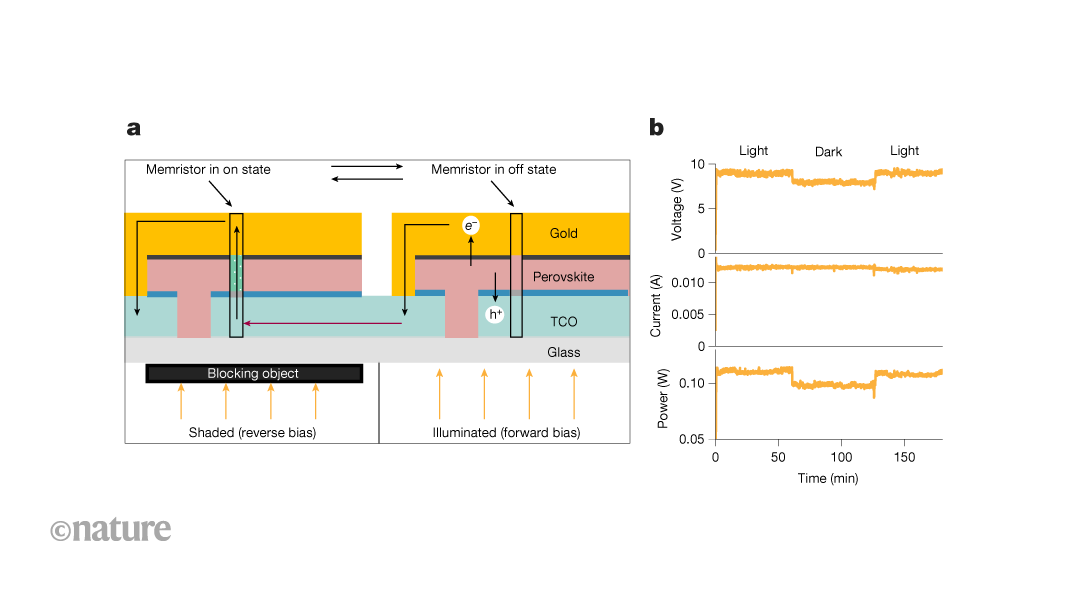
Redirecting current solves a shadowy problem faced by perovskite solar cells
Access options
Access Nature and 54 other Nature Portfolio journals
Get Nature+, our best-value online-access subscription
$32.99 / 30 days
cancel any time
Subscribe to this journal
Receive 51 print issues and online access
$199.00 per year
only $3.90 per issue
Rent or buy this article
Prices vary by article type
from$1.95
to$39.95
Prices may be subject to local taxes which are calculated during checkout
doi: https://doi.org/10.1038/d41586-026-00921-1
‘Expert opinion’ is published under a CC BY 4.0 licence.
References
Correa-Baena, J.-P. et al. Science 358, 739–744 (2017).
Jiang, F. et al. Nature Energy 9, 1275–1284 (2024).
Li, N. et al. Nature Energy 9, 1264–1274 (2024).
Strukov, D. B., Snider, G. S., Stewart, D. R. & Williams, R. S. Nature 453, 80–83 (2008).
Facts Only
Actors: J.-P. Correa-Baena, et al., Max Planck Institute for Polymer Research, Technical University of Munich, Feng Jiang, et al., future studies
Actions/Events: Developed a method to redirect current in perovskite solar cells, addressed hysteresis and longevity issues
Dates: Not specified (publication dates for related research in 2017 and 2024)
Locations: Max Planck Institute for Polymer Research, Technical University of Munich (Germany)
Executive Summary
Full Take
Patterns detected: ARC-0024 Ambiguity, ARC-0043 Motte-and-Bailey. The researchers' solution to the hysteresis problem in perovskite solar cells is a promising step forward, but it remains to be seen if their method can consistently outperform other potential solutions and achieve long-term commercial viability. As with any advancement in renewable energy technology, there are multiple approaches being explored simultaneously, and it is important to maintain a critical perspective on the claims made by individual studies. The researchers' work builds upon earlier research published in 2017, indicating that the field is progressing incrementally but steadily.
Steelman: The researchers present a solution to address a significant issue in perovskite solar cells, hysteresis, which has hindered their efficiency and longevity. They propose redirecting current within the cell, and while their method is not yet fully proven, it offers promise for future research and potential commercial applications.
Root Cause: The development of perovskite solar cells is driven by the need to create cost-effective, efficient alternatives to traditional silicon photovoltaics. The challenges faced by perovskite solar cells are symptomatic of the ongoing quest for improved renewable energy technologies that can meet increasing global demand while minimizing environmental impact.
Implications: If successful, this advancement could contribute to the widespread adoption of perovskite solar cells as a viable and cost-effective alternative to traditional silicon photovoltaics. This would have significant implications for the renewable energy sector, potentially leading to increased energy independence and reduced greenhouse gas emissions. However, it is essential to recognize that the research is still in progress, and further studies will be necessary to validate and refine the proposed solution.
Bridge Questions: What other approaches are being explored for addressing hysteresis in perovskite solar cells? How does the researchers' method compare to existing solutions in terms of efficiency, longevity, and cost-effectiveness? As more research emerges, what factors will determine which solution proves most viable for commercial applications?
Sentinel — Human
This analysis suggests that the article is likely written by a human. The writing shows slight stylometric signals, a distinct personal voice, and no exact coordination indicators of synthetic origin.