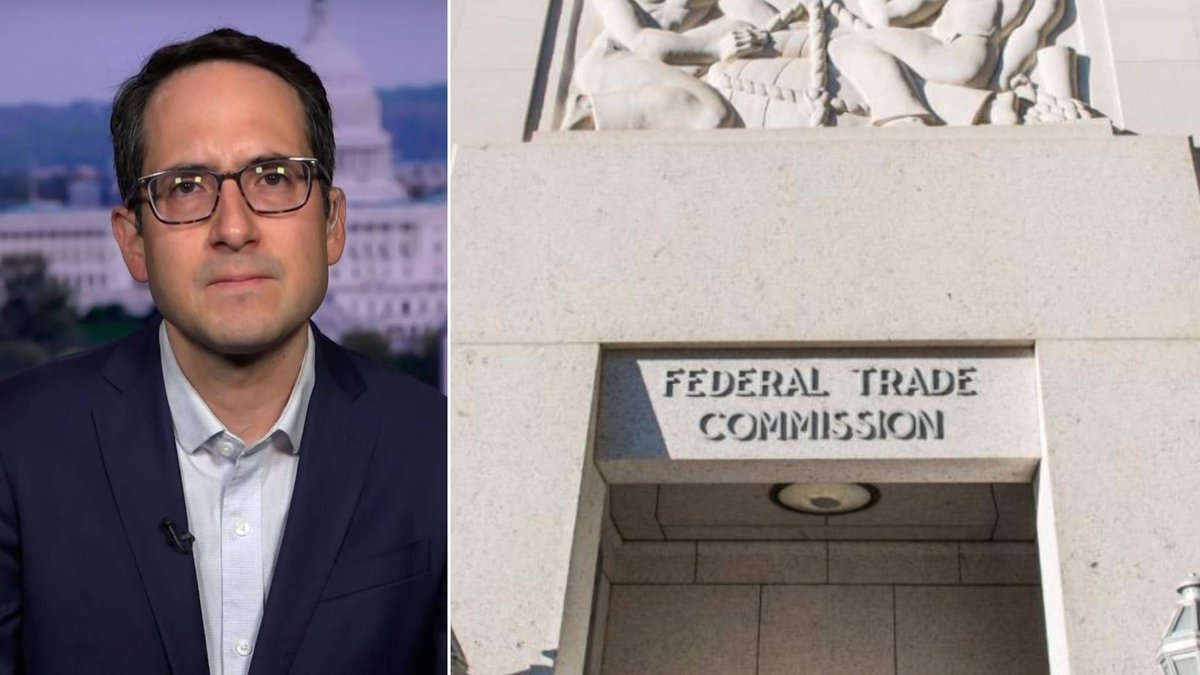
In a 6-3 ruling this week that overturned nine decades of precedent, the Supreme Court granted President Donald Trump the power to fire and replace officials at independent government agencies like the Federal Trade Commission. But in a separate 5-4 decision, the justices ruled that Federal Reserve Governor Lisa Cook can stay in her job as she challenges Trump’s efforts to fire her.
The seemingly contradictory rulings suggest a two-tier system of regulation, says Alvaro Bedoya, a former FTC commissioner who was fired by Trump last year. The independence and stability of the Federal Reserve is important to “billionaire Wall Street Bankers,” and therefore remains protected, says Bedoya. “But then you have this whole series of other agencies that keep your toys safe, that keep health insurers from robbing people blind, that keep supermarkets from merging to make milk, eggs and beef … even more expensive. The court said that all those regulators can report directly to the president and be entirely beholden to his whims.”
Transcript
AMY GOODMAN: This is Democracy Now!, democracynow.org. I’m Amy Goodman, with Nermeen Shaikh.
NERMEEN SHAIKH: The Supreme Court has granted President Trump the power to fire and replace commissioners at independent government agencies. Monday’s 6-to-3 ruling overturns more than 90 years of precedent that insulated regulatory agencies set up by Congress from presidential control. The case focused on the Federal Trade Commission, where two commissioners were fired by President Trump in March of 2025: Alvaro Bedoya and Rebecca Slaughter, who was the lead plaintiff in the case. In a separate ruling announced Monday, justices ruled 5 to 4 that Federal Reserve Governor Lisa Cook could remain in her job as she challenges Trump’s efforts to fire her, as well.
AMY GOODMAN: Writing for the majority, Chief Justice John Roberts argued the Trump administration’s efforts to end the Federal Reserve’s independence is, quote, “an interpretive leap out of step with the statute Congress enacted and our Nation’s tradition of central banking protected from political interference,” unquote.
Alvaro Bedoya, former FTC commissioner who was fired by Trump, responded to the ruling, quote, “They’re making clear that the Wall Street bankers, the central bankers, they deserve an independent above-the-fray regulator. The rest of us schmucks get stuck with the loyalists,” Bedoya said. He’s now a senior adviser at the American Economic Liberties Project, co-host of a weekly podcast, The Fair Fight with Alvaro & Max. He’s joining us now from Maryland.
Alvaro Bedoya, welcome to Democracy Now! You’re former commissioner of the Federal Trade Commission, fired by Trump last year. Talk about these two Supreme Court rulings.
ALVARO BEDOYA: I think the key thing here, Amy, is to follow the money, because, on the one hand, on Monday, you had the regulator that’s most important to those central bankers, most important to those billionaire Wall Street bankers — why? Because they want a nice, steady ship with interest rates, with other interventions in the market. The Supreme Court reaffirmed — surprise, surprise — that those regulators should, at least for now, remain above the fray and independent. But then you have this whole series of other agencies that keep your toys safe, that keep health insurers from robbing people blind, that keep supermarkets from merging to make milk, eggs and beef even — to keep it from being even more expensive. The court said that all those regulators can direct — can report directly to the president and be entirely beholden to his whims, and, at the end of the day, his donors, his billionaire donors over his shoulder at the inauguration. That’s what this is about.
NERMEEN SHAIKH: And, Alvaro, if you could explain what the implications of this might be, well beyond Trump? Is it the case now that the president will always have this power?
ALVARO BEDOYA: Well, this is a really important point, because I’ve started to get questions already. “Oh, you know, Alvaro, how do we restore independent agencies?” This is a Supreme Court ruling. The only way to change this ruling would be either to change the court or to pass an amendment. And honestly, I think we should consider both of those things: changing the court and passing an amendment to the Bill of Rights.
Let me tell you quickly what I mean here. So, this pair of rulings isn’t some kind of accident. You need to stack it up on top of Citizens United, the court saying that corporations are people, and then they can spend as much as they want to buy our elections; a ruling called Concepcion, which said that corporations can keep actual humans out of court by making them sign fine-print arbitration contracts; and then, of course, Trump v. U.S., where the court said that the CEOs of these corporations can, effectively, bribe the president by buying his weird cryptocoin or donating to his weird golden ballroom, letting him make billions of dollars, and the president would be immune from bribery charges.
We need a Supreme Court that looks like the American people. And I actually mean this less in terms of race or gender, and more in terms of not being over the age of 70, not having lifetime jobs – no American has, you know, a lifetime job, outside of a very few — and lastly, not being in this intractable love affair with billionaires. And so, all it takes is an act of Congress to change this court. And I think we need to do that; otherwise, any future Congress, any future administration is going to see their efforts to check corporate power stymied.
AMY GOODMAN: I want to go to —
ALVARO BEDOYA: Here’s the other thing. We’re about to celebrate America’s — oh, please.
AMY GOODMAN: No, go ahead.
ALVARO BEDOYA: Oh, you know, we’re about to celebrate America’s, you know, 250th birthday. We made a mistake at our founding. So, our founders hated monopolies. That’s what the Boston Tea Party was about. It was a protest against a monopoly on the East India Company on tea, importing tea into the colonies. Thomas Jefferson, for all his faults, actually repeatedly told Madison, “We need an amendment against monopolies in the Bill of Rights,” over and over, 1788, 1789. Madison didn’t listen. New York ratified an amendment to do that. Congress blocked it. I think it’s time to reconsider adding an amendment to the Bill of Rights banning monopolies and protecting the American people from concentrated corporate power.
NERMEEN SHAIKH: Well, Alvaro, last year, you wrote a piece for The New Republic titled “How I Became a Populist.” The piece is subtitled “My time at the Federal Trade Commission — before Donald Trump fired me — totally changed the way I see our political divide.” In it, you wrote, quote, “I used to think that the defining fight for our country was between the left and the right. Now, I am much more worried about the money at the top crushing everyone underneath.”
AMY GOODMAN: And I want to go to, following up on Nermeen’s point, the speech that you gave, just an excerpt of it, as you join with Senator Sanders, as you join with AOC. This is right after you were fired, this massive rally of tens of thousands of people, part of the Fighting Oligarchy Tour. This is what you said.
ALVARO BEDOYA: So, what is the FTC? We are the independent federal agency that fights fraudsters and monopolists. We take — we take the Martin Shkrelis and Jeff Bezos of the world to court, and we win!
AMY GOODMAN: So, Alvaro Bedoya, that was you in Denver. Where are you headed from here? Talk about this movement that is building, and even how it fits into this latest explosive news of the more than $2 billion President Trump and his family have made in the last year since he came back into office.
ALVARO BEDOYA: Amy, I think this country is hungry for hope. And when you look at the world less in terms of Democrat versus Republican and more in terms of people’s struggles every single day against the money at the top, people look a lot more similar than they do different.
I’ll give you one quick example. You know, I spend a lot of time talking to farmers in Iowa. You know what’s happening to them? They’re having to pay $25,000, $50,000 extra booking fertilizer for the next harvest. Meanwhile, you have ride-share drivers in New York City who are paying an extra $10,000 a year for the extra cost of gasoline because of the Iran war. Those drivers wake up in the morning to try to drive the morning commute there in New York City, and they find they’re locked out, out of Uber and Lyft, because of these software duopolies. I got farmers in Iowa who are waking up in the morning, cannot start their John Deere combine, because John Deere has locked that combine. That monopoly has locked the software on that combine, so only that billionaire multinational could fix it, and therefore make the money off of it.
And what I see happening across the country is, whether it’s ride-share drivers in Iowa, you know — in New York, farmers in Iowa, you know, documentary filmmakers in California, shrimpers in Louisiana, people are starting to recognize that they do have one very powerful thing in common, which is a revulsion at oligarchy and billionaires. And the more we can weave this class-based movement together to fight that concentrated corporate power, I think that opens the door for a hopeful future in this country.
AMY GOODMAN: Alvaro Bedoya, we thank you so much for being with us, former commissioner of the Federal Trade Commission, fired by President Trump last year, now a senior adviser at the American Economic Liberties Project. He is co-host of The Fair Fight with Alvaro & Max, a weekly podcast.
Coming up, as we head into the July Fourth weekend, we speak to UCLA historian Robin D. G. Kelley. His latest piece, “'Do You Understand Your Own Language?': Black radicals read the Declaration of Independence.” Back in 20 seconds.
[break]
AMY GOODMAN: “Ella’s Song (We Who Believe in Freedom Cannot Rest Until It Comes)” by Sweet Honey in the Rock, performing at the 2025 Peace Ball.
Media Options
Sentinel — Human
LIKELY_HUMAN (confidence: 0.15)