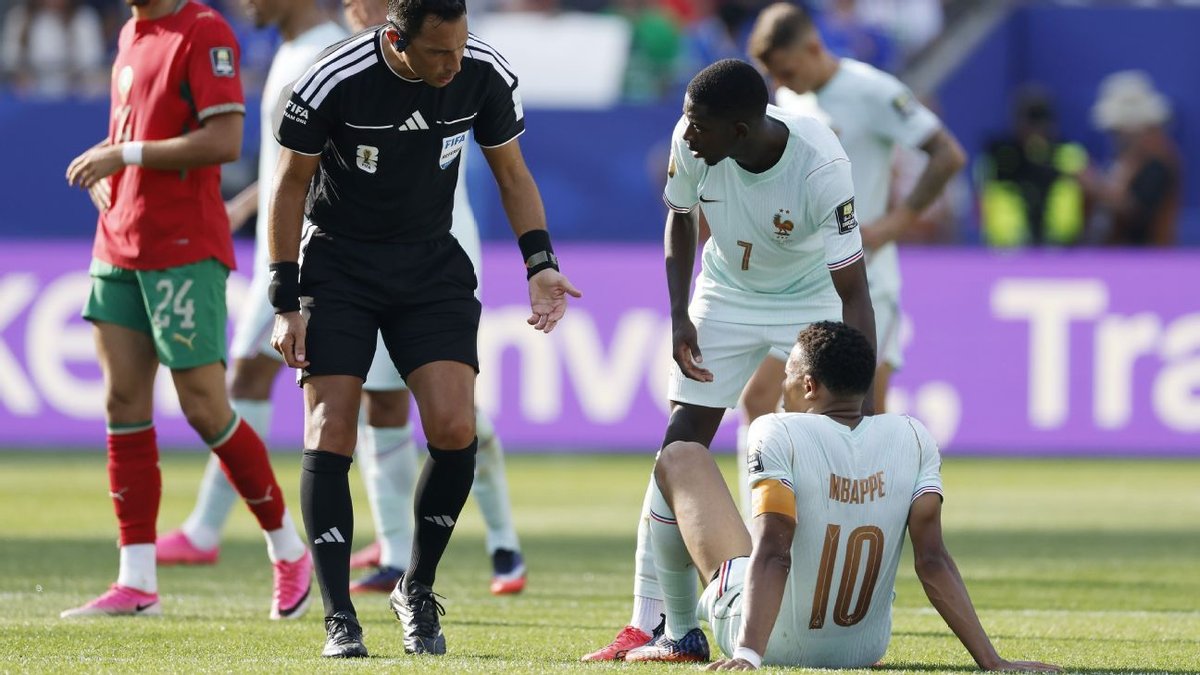
Kylian Mbappé has downplayed concerns over what he described as a "knock on his ankle" during France's 2-0 World Cup quarterfinal win over Morocco on Thursday in Foxborough, Massachusetts, saying, "I'm all good."
Mbappé received treatment on the pitch at Boston Stadium (Gillette Stadium) from the France physio before being substituted in the 77th minute and replaced by Jean-Philippe Mateta.
The 27-year-old walked off while applauding the crowd and did not appear to be in extreme pain. Television footage subsequently showed Mbappé sitting on the bench with ice strapped to his right foot.
"I'm all good. I got a knock on the ankle, but it's all good. JP [Mateta] was more able than me to play the last 15 minutes" Mbappé said after the game.
"There are no concerns to have on Kylian's ankle," a source told ESPN.
Mbappé was leading the celebrations with the fans on the pitch after the victory and also inside the team's changing room, with a smile on his face.
France's 2-0 win over Morocco comes four years after they won by the same scoreline in their semifinal meeting in Qatar. Mbappé explained the French mindset going into the game against a team they knew well.
Mbappé is close friends with Morocco captain and his former Paris Saint-Germain teammate Achraf Hakimi.
Six Moroccan players were born in France and many players of both teams enjoy a close relationship.
"Here, there is no sentiment. There are no emotions. I'm here to win and he [Hakimi] was here to win too," Mbappé said. "But it's true that when I will go to see him in the dressing room, it will hit me, because he is a very close friend."
Having missed a first-half penalty, the France captain tied Lionel Messi at the top of the scoring chart with his eighth goal of the tournament as he fired a shot past Morocco goalkeeper Yassine Bounou from the edge of the area.
His assist for Ousmane Dembélé's goal six minutes later was his third of the tournament.
Mbappé has now registered 10-plus goal involvements in both of the two most recent World Cups (eight goals, two assists in 2022; eight goals, three assists in 2026). He's the only player since 1966 to achieve this in two tournaments.
His 11 in 2026 are the most by a single player since Gerd Müller in 1970 (10 goals, three assists).
- Mbappé, France lethal vs. Morocco in reaching World Cup semifinals
- World Cup Golden Boot tracker: Will Messi, Mbappé, or other score most goals?
France will play either Spain or Belgium in the semifinals in Arlington, Texas, on Tuesday.
"We are very happy. We are aware that there is only one way to relax, it's to win. But we still have a long way. We know that what is coming next will be even harder but we are ready for face anything," Mbappé said. "We will recover nicely and watch the game tomorrow to see who we will face."
Information from ESPN's Global Sports Research contributed to this report.
Facts Only
* Kylian Mbappé experienced a knock on his ankle during the World Cup quarterfinal win over Morocco in Foxborough, Massachusetts.
* Mbappé received treatment on the pitch from the France physio before being substituted in the 77th minute for Jean-Philippe Mateta.
* Television footage showed Mbappé sitting on the bench with ice strapped to his right foot.
* Mbappé stated he felt "all good" regarding the ankle injury.
* Mbappé commented that Jean-Philippe Mateta was more able than him to play the last 15 minutes of the game.
* A source indicated there were no concerns regarding Kylian's ankle.
* France won 2-0 against Morocco in the World Cup quarterfinal.
* The French team had won 2-0 against Morocco in their semifinal meeting in Qatar four years earlier.
* Mbappé registered 10-plus goal involvements in both of the two most recent World Cups (eight goals, two assists in 2022; eight goals, three assists in 2026).
* France will play either Spain or Belgium in the semifinals in Arlington, Texas, on Tuesday.
Executive Summary
Full Take
The narrative weaves together themes of managed pain, relational dynamics under pressure, and the construction of identity through shared experience. The initial framing of Mbappé downplaying a physical ailment suggests a tension between the public expectation of peak performance and the private reality of physical vulnerability. This act of minimizing pain serves as a form of self-regulation, asserting control over a bodily experience that is inherently uncontrollable, especially in high-stakes environments.
The transition to the relationship with Hakimi introduces a pattern where emotional connection is deliberately filtered through a lens of competitive necessity: "There are no emotions. I'm here to win and he was here to win too." This suggests a strategic compartmentalization of deep personal bonds when situated within an adversarial context. The acknowledgment that seeing his friend would evoke emotion highlights the constructed nature of this public stoicism; the outward performance of purely objective competition masks an underlying sensitivity to established relationships.
Furthermore, the repetition of Mbappé's statistical achievements—leading in goal involvements across two tournaments—presents a pattern of exceptional individual output juxtaposed against the immediate physical reality of injury. The implicit question here is whether this sustained high-level performance necessitates the suppression of internal experience. What systems are in place to allow an athlete to process physical setbacks while simultaneously maintaining the externally projected persona of invulnerability and focused determination? Does the emphasis on "winning" act as a dominant cognitive filter that supersedes the need for full emotional acknowledgment, and what is the cost of this enforced resilience on long-term well-being?
Sentinel — Human
The text reads like standard sports reporting, blending factual incident reporting with subjective quotes, consistent with human editorial work.