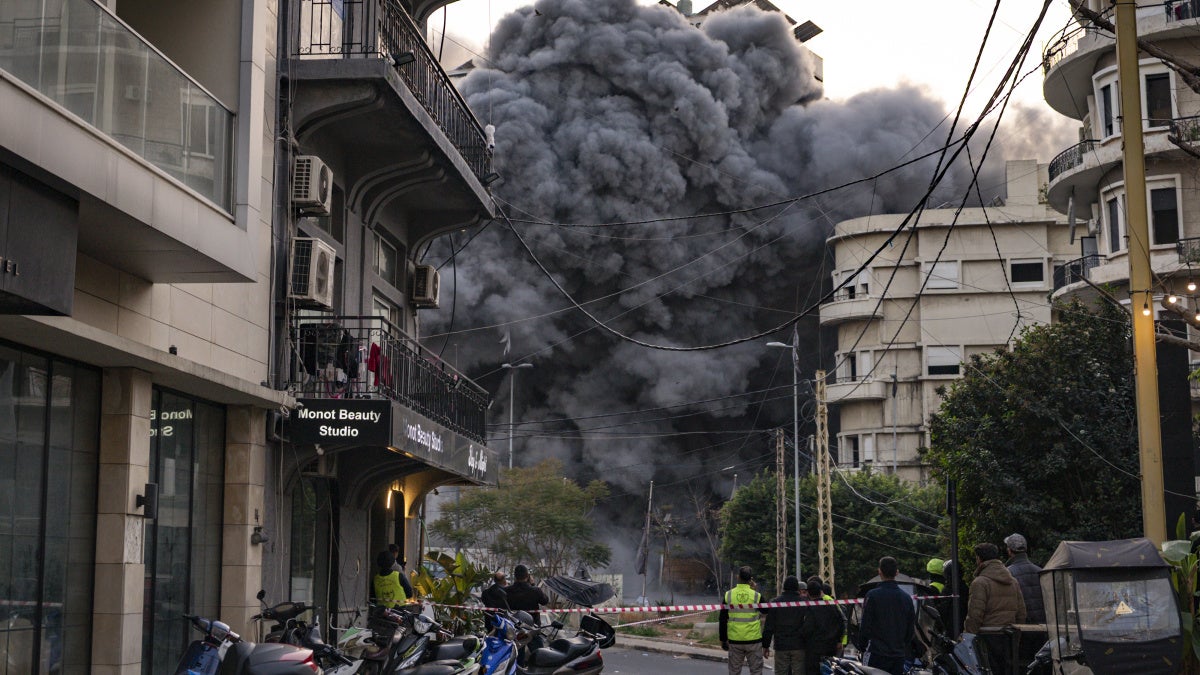
(Beirut, March 23, 2026) – Israeli forces have expanded ground operations in southern Lebanon after indicating an intent to forcibly displace residents, destroy civilian homes and conduct strikes that could target civilians, Human Rights Watch said today. Forcible displacement, wanton destruction and attacks deliberately targeting civilians are war crimes. Countries that continue to provide Israel with arms and military aid risk complicity in the Israeli government’s serious violations in Lebanon.
On March 22, Israel’s defense Minister, Israel Katz, issued a statement announcing that he and Israel’s Prime Minister Benjamin Netanyahu have “ordered the acceleration of the demolition of Lebanese houses in the border villages in order to thwart threats to Israeli communities - in accordance with the Beit Hanoun and Rafah models in Gaza.” On March 16, 2026, Katz said that “hundreds of thousands of Shiite residents of southern Lebanon […] will not return to their homes south of the Litani area until the safety of Israel’s northern residents is guaranteed.” Displacement orders issued by the Israeli military to residents of the southern suburbs of Beirut between March 11 and 15 further stated that the Israeli military “will not hesitate to target anyone who is present near Hezbollah members, facilities, or means of combat.”
“For over two years, Israel’s allies and European states that purport to support and uphold human rights have buried their heads in the sand as atrocities continue in Lebanon, as in Gaza,” said Ramzi Kaiss, Lebanon researcher at Human Rights Watch. “Atrocities flourish when there is impunity, and other countries should no longer stand by as they continue.”
Since the recent escalation of hostilities between Israel and Hezbollah on March 2, Israeli attacks have killed at least 1,029 people in Lebanon, including 118 children and 40 medical workers, as of March 22 according to Lebanon’s Ministry of Public Health. In recent days, Hezbollah has fired an average of about 150 rockets per day, according to the Israeli military. Hezbollah attacks have injured at least 15 people in Israel, according to Israeli mediareports.
On March 4 and 5, the Israeli military issued displacement orders for the entire population of Lebanon south of the Litani River and all residents of Beirut’s southern suburbs, which include hundreds of thousands of people. Since March 12, the Israeli military has expanded the areas subject to displacement orders, ordering residents of southern Lebanon to evacuate north of the Zahrani River, 15 kilometers north of the Litani River, and 40 kilometers north of Lebanon’s southern border with Israel. Over a million people have been displaced in Lebanon thus far.
The Israeli defense minister’s statement, indicating that Shiite residents of southern Lebanon will be prevented from returning to their homes until an undetermined safety standard for Israel’s northern residents is guaranteed, signals that Israel will prevent residents from returning to their homes for an indefinite period. The sweeping nature of the displacement orders, and the statements that do not address the protection of the displaced civilians, raises concerns of the war crime of forced displacement, Human Rights Watch said.
Singling out Shiite residents further indicates that Israel is imposing such measures based on their religion, a human rights violation, and further indicates that the residents’ security is not the aim of the displacement.
Ordering the Israeli military to accelerate the destruction of Lebanese homes raises serious risk of the war crime of wanton destruction and violations of the prohibition under international law against deliberately destroying civilian property except when necessary for lawful military reasons. The mere possibility of future military use by armed groups of some civilian structures cannot under the laws of war justify the wide-scale destruction of whole homes across Lebanon’s border.
Between March 11 and 15, the Israeli military’s Arabic spokesperson issued at least five nearly identical displacement orders for residents of seven neighborhoods in Beirut’s southern suburbs, after first issuing a sweeping displacement order for entire southern suburbs of Beirut on March 5. The statement ordered residents to “evacuate the area immediately” and called on them to “not return to those neighborhoods until further notice.”
The orders further stated that the Israeli military “will not hesitate to target anyone who is present near Hezbollah members, facilities, or means of combat.” This differs from previous orders issued to residents of Beirut’s southern suburbs, which stated, for example, that “Anyone who is near Hezbollah members, facilities or means of combat is putting their lives at risk.”
On March 5, minister in the defense ministry, Bezalel Smotrich, who sits on the security cabinet and also serves as Israel’s finance minister, recorded a video statement standing at the Israel-Lebanon border, stating that “very soon, Dahieh [Beirut’s southern suburb] will look like Khan Younis,” in Gaza. Human Rights Watch has previously documented war crimes, crimes against humanity, and acts of genocide by the Israeli military in Gaza.
These statements, combined with Israeli forces’ previous conduct of war in Lebanon, raise serious concern that the Israeli military may target civilians, based solely on their presence in or proximity to areas where Hezbollah is present.
Since October 7, 2023, Israeli forces have committed numerous violations of the laws of war and apparent war crimes in Lebanon with total impunity, including apparently deliberate or indiscriminate attacks on journalists, civilians, medics, financial institutions, reconstruction-related facilities, and peacekeepers. They have also unlawfully used white phosphorus in populated areas, among other violations. Human Rights Watch has documented several unlawful attacks in Lebanon using US-made weapons.
Civilians who chose to stay in areas subject to displacement orders in southern Lebanon are particularly at risk of being cut-off from food and medicine supplies and other aid, Human Rights Watch said.
In a statement published on March 18, the Israeli Military Arabic spokesperson said that bridges crossing over the Litani River into southern Lebanon would be struck “to prevent the movement of reinforcements and means of combat” into southern Lebanon. Between March 13 and 22, the Israeli military said that it struck at least four Litani River bridges.
Hezbollah should take all feasible precautions to protect civilians in its operations in Lebanon and Israel.
Civilians who do not evacuate following orders are still fully protected by international humanitarian law. Forced displacement is prohibited under the laws of war, except in cases in which civilian security is involved or for imperative military reasons.
A person who commits serious violations of the laws of war with criminal intent—that is, intentionally or recklessly—may be prosecuted for war crimes. Individuals may also be held criminally liable for assisting in, facilitating, aiding, or abetting a war crime.
Lebanon’s judicial authorities should initiate domestic investigations of serious international crimes, and the government should accede to the International Criminal Court’s Rome Statute and submit a declaration accepting the court’s jurisdiction prior to the date of accession, including since at least October 7, 2023.
Israel’s key allies, including the United States, the United Kingdom, and Germany, should suspend military assistance and arms sales to Israel and impose targeted sanctions on officials credibly responsible for ongoing serious abuses. They should levy further pressure on Israel to ensure that displaced residents can return to their homes once hostilities end or once the reasons for their displacement cease to exist.
“The Israeli military does not get to decide when civilians lose protections afforded by international law nor should it be allowed to prevent displaced residents from returning to their homes based on some undefined ‘safety’ standard,” Kaiss said. “Deliberately targeting civilians, civilian objects, and others protected under international law would be a war crime, and countries supplying Israel with weapons need to realize they are risking complicity in war crimes too.”
Facts Only
Israeli forces have expanded ground operations in southern Lebanon, issuing displacement orders and threatening to demolish civilian homes.
On March 22, 2026, Israeli Defense Minister Israel Katz announced plans to accelerate the demolition of Lebanese houses in border villages, citing the "Beit Hanoun and Rafah models" used in Gaza.
On March 16, 2026, Katz stated that Shiite residents of southern Lebanon would not return to their homes until Israel’s northern residents are guaranteed safety.
Displacement orders were issued to residents of Beirut’s southern suburbs between March 11 and 15, warning that the Israeli military would target anyone near Hezbollah members or facilities.
Since March 2, 2026, Israeli attacks in Lebanon have killed at least 1,029 people, including 118 children and 40 medical workers.
Hezbollah has fired an average of 150 rockets per day into Israel, injuring at least 15 people.
Displacement orders initially covered areas south of the Litani River and Beirut’s southern suburbs, later expanding to areas north of the Zahrani River.
Over a million people have been displaced in Lebanon due to the conflict.
Israeli officials, including Finance Minister Bezalel Smotrich, have made statements comparing Beirut’s southern suburbs to Gaza’s Khan Younis, where war crimes have been documented.
The Israeli military has struck at least four Litani River bridges to prevent movement into southern Lebanon.
Human Rights Watch has documented unlawful attacks in Lebanon using US-made weapons and called for Israel’s allies to suspend military assistance.
Lebanon’s Ministry of Public Health reported the death toll in Lebanon as of March 22, 2026.
Executive Summary
Full Take
The strongest version of this narrative presents a clear and urgent case for potential war crimes by Israeli forces in Lebanon, supported by documented statements from high-ranking officials, displacement orders, and a pattern of civilian targeting. Human Rights Watch’s framing emphasizes the legal and moral obligations of Israel’s allies to halt military aid, grounding its argument in international humanitarian law. The inclusion of specific dates, casualty figures, and direct quotes from Israeli officials strengthens the credibility of the claims, while the call for Hezbollah to protect civilians adds a layer of balance.
However, the narrative leans heavily on emotional appeals—highlighting civilian deaths, displaced children, and the destruction of homes—to galvanize outrage. The repeated invocation of war crimes and complicity risks framing the conflict in binary terms, where Israel is the sole aggressor and Hezbollah’s role is minimized beyond its rocket attacks. The pattern of focusing on Israeli actions while downplaying Hezbollah’s military strategy (e.g., embedding in civilian areas) could be seen as a form of selective framing (ARC-0024 Ambiguity), though the article does acknowledge Hezbollah’s responsibility to protect civilians.
Rooted in the paradigm of humanitarian intervention, the narrative assumes that international pressure and legal accountability can deter further abuses. Yet it overlooks the geopolitical complexities that often render such mechanisms ineffective. The historical echo of Israel’s 2006 war in Lebanon, where similar accusations of disproportionate force were made, suggests a recurring pattern of escalation without resolution.
The implications for human agency are stark: civilians in Lebanon face indefinite displacement, while Israel’s allies risk complicity in potential war crimes. The second-order consequences include further destabilization of Lebanon, deepened sectarian tensions, and the normalization of forced displacement as a military tactic.
Bridge questions: How might Hezbollah’s use of civilian areas as shields complicate the legal and moral calculus of Israeli strikes? What alternative frameworks for de-escalation exist beyond humanitarian appeals? Would evidence of Hezbollah’s deliberate endangerment of civilians shift the narrative’s balance?
Counterstrike scan: A coordinated influence campaign would amplify civilian casualties while omitting Hezbollah’s military tactics, framing Israel as uniquely culpable to justify sanctions or intervention. This article includes Hezbollah’s role but prioritizes Israeli actions, aligning partially with such a playbook. However, it stops short of outright demonization, maintaining a focus on legal and humanitarian principles. The alignment is partial but not structural.
Sentinel — Human
The article shows strong signs of human authorship, with a clear advocacy voice, specific attributions, and stylistic idiosyncrasies typical of Human Rights Watch reporting.