Smithsonian chief emphasizes 'accuracy and integrity' after White House report
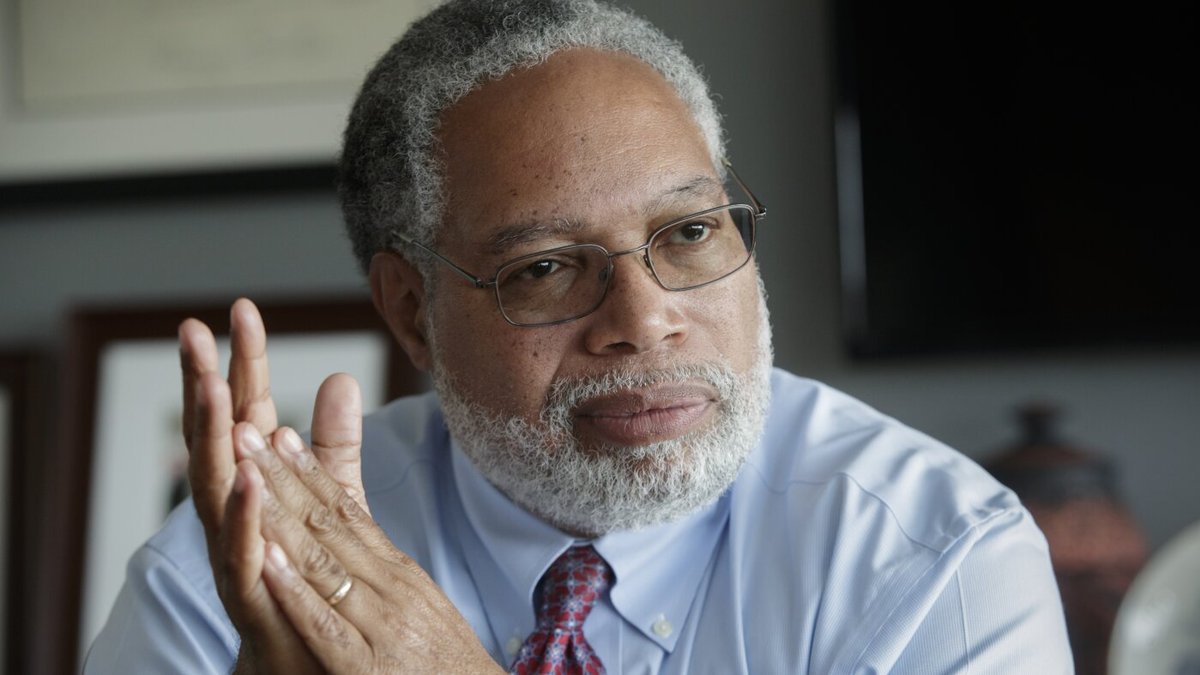
In a memo addressed to staffers sent Tuesday, the secretary of the Smithsonian, Lonnie G. Bunch III, defended the institution after the White House issued a 162-page report that characterizes the National Museum of American History as a place which has become "subject to institutional capture by a radical, activist ideology that is fundamentally opposed to telling the noble, honest story of the great country we know and love."
In his email, which NPR has obtained, Bunch wrote in part: "While there will always be room for improvement, this report is not a fair characterization of the work and totality of the National Museum of American History. At the Smithsonian, our work is driven by scholarship, accuracy and an uncompromising commitment to tell the fullness of America's story. As public servants and the keepers of this institution, we are charged with helping a nation find understanding, hope and clarity and as part of that duty, we are dedicated to excellence, reflection and growth."
He continued: "We remain focused on what grounds us: a steadfast commitment to scholarship, nonpartisanship, independence, accuracy and integrity. For nearly 180 years, the Smithsonian has worked alongside partners across government — from the White House to Congress to our governing Board of Regents — guided by our enduring mission to increase and diffuse knowledge. That purpose remains: to pursue knowledge with rigor and to serve the American public with clarity and care."
The White House report was issued on July 4 by the Domestic Policy Council under the title "Saving America's Story: How Ideological Capture at the Smithsonian Institution's National Museum of American History Erases Our Heritage."
The council faults the National Museum of American History on a multitude of fronts, saying it underemphasized the Founding Fathers and early colonial and Revolutionary history; was not sufficiently celebratory of the country's 250th anniversary; and that it engaged in "anti-white," "illegal alien" and transgender activism.
It also accuses the museum of trying to "indoctrinate" teachers and students through its exhibitions, programming and teaching resources.
In the report, the council also specifically criticizes museum director Anthea Hartig, who has led the National Museum of American History since 2019 and is concurrently the president of the Organization of American Historians, calling her "an activist advancing an ideological agenda contradictory to the museum's founding purpose of fostering patriotism."
The Trump administration has made the Smithsonian museums one of its primary targets in its efforts to reshape cultural narratives to align with its viewpoints. In August 2025, the White House requested a "comprehensive internal review" of eight Smithsonian museums, including the National Museum of American History, following an executive order issued by President Trump in March 2025 in which he called for the removal of "improper ideology" from the Smithsonian's offerings.
According to the Smithsonian's charter, all of its 21 museums, 14 education and research centers, and the National Zoo are meant to be run independently of the federal government. The Smithsonian is overseen by Bunch and a board of regents, which includes Vice President Vance, Supreme Court Chief Justice John Roberts and other members appointed by Congress.
In an interview with NBC's Meet the Press on Sunday, Bunch spoke about the Smithsonian's 250th anniversary special exhibition at the Smithsonian Castle, which is called "American Aspirations."
He told NBC: "It's really important for people to understand that America is much an ideal as it is a place, that it's a series of aspirations that have really shaped who this country is. And so for me, what is so powerful is to say, 'Let us honor the words of Thomas Jefferson and the founders, but let us use those to challenge us to be better.'"
Jennifer Vanasco edited this story.
Sentinel — Human
This text appears to be a professionally reported piece synthesizing statements from museum leadership and a White House report regarding ideological critique of the Smithsonian, exhibiting standard journalistic style.