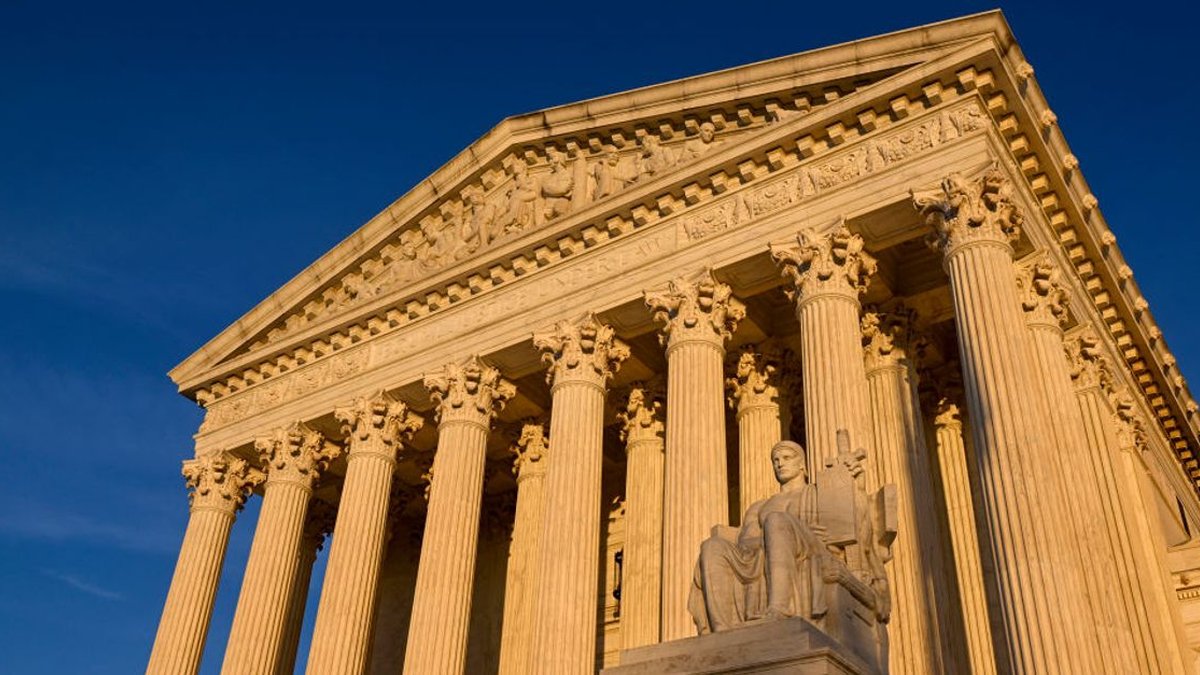
Last week, the Supreme Court finished handing down its opinions in argued cases this term. In light of its decisions on birthright citizenship and the administrative state, one decision, from the prior week, may be somewhat easy to overlook. But I think this ruling is of great importance. This is the majority opinion in Landor v. Louisiana Department of Corrections, decided on June 23, which is based on a premise with troubling, and massive, implications: federal spending programs should be treated as contracts. This is not the first case resting on this assumption. It also has been the basis for denying federal courts jurisdiction to hear challenges to the Trump administration’s illegal termination of federal grants and for restricting the ability to use Section 1983 to challenge violations of federal laws. But it is a relatively new development in the law and one that is unjustified.
Landor v. Louisiana Department of Corrections
Damon Landor is a Rastafarian whose religious convictions require him to leave his hair uncut. He was imprisoned in Louisiana and near the end of his sentence he was transferred to a different prison. The guards there went to cut his hair. Previously, the U.S. Court of Appeals for the 5th Circuit had expressly ruled that a federal statute – the Religious Land Use and Institutionalized Persons Act – bars prisons from cutting Rastafarians’ hair.
Landor had a copy of the court’s opinion and gave it to the guards. They threw it in the trash, forcibly held him down, and shaved his head.
Landor sued under RLIUPA, which says that state and local governments receiving federal funds for their prisons and jails cannot infringe a person’s religious beliefs unless the action is necessary to achieve a compelling government purpose. No one disagreed that the Louisiana prison guards blatantly violated this law. The issue was whether Landor could sue the prison guards under RLIUPA, which authorizes courts to provide “appropriate relief against a government.”
The Supreme Court, in a 6-3 decision along ideological lines, held that there cannot be suits against individual government officials who violate the statute unless they consent to being sued. Justice Neil Gorsuch wrote for the court and said that RLIUPA is a federal spending program with conditions. He wrote that “[t]o sort out whether consent exists—and thus whether a condition associated with spending legislation is enforceable—we have traditionally turned to contract principles for guidance.” The court said that the crucial question is whether the individual prison guards had consented to be sued under the act. It concluded: “[B]ecause they never agreed to answer suits like this one, Mr. Landor’s case cannot proceed against them any more than a breach of contract action might proceed against a defendant who never formed a contract.”
This effectively nullifies the ability to enforce RLIUPA against government officers who violate it. None are going to consent to be sued. Even if federal spending programs are looked at through the lens of contract law, it is unclear, and the court does not explain in any detailed way, why the individual prison guards must consent to being sued. The state government takes the federal money on the condition that the federal court can grant “appropriate relief.”
This also flies in the face of the necessary and proper clause of Article I, Section 8 of the Constitution. Under this clause, Congress can choose any means to carry out its powers that are not prohibited by the Constitution. Creating civil liability for both state institutions and individual actors to enforce RLIUPA is exactly that. Gorsuch rejected this argument by saying it would give Congress too much power. He wrote that it would “be elastic enough to allow the ‘extraction of money damages’ from virtually anyone who violates virtually any condition found in Spending Clause legislation.” But if Congress can set conditions on federal grants, Congress should be able to choose the means to enforce them, including authorizing suits against officers who violate them.
Landor thus means that the conditions contained in the myriad of federal laws adopted under Congress’ spending power no longer can be enforced against individual government employees who violate their terms. But – in viewing spending programs as contracts – the implications of that are even broader.
Limiting federal jurisdiction to hear challenges to illegal termination of grants
In two rulings last year in cases on the emergency docket, the Supreme Court ruled that federal district courts lack the authority to hear challenges to the Trump administration’s allegedly illegal termination of federal grants. In 5-4 decisions, with Chief Justice John Roberts joining the three liberal justices in dissent, the court said that federal grants are contracts and that lawsuits for breach of contract against the United States must be brought in the U.S. Court of Federal Claims.
In Department of Education v. California, the court stayed a temporary restraining order by a federal district court stopping the termination of $65 million in federal teacher training grants. The federal district court found that the Department of Education had violated the federal Administrative Procedure Act in terminating the grants. But in a brief opinion, the Supreme Court treated the action as a suit for a breach of contract and said that under the Tucker Act (which authorizes claims for money against the federal government) only the Court of Federal Claims could hear the suit. It declared: “the Tucker Act grants the Court of Federal Claims jurisdiction over suits based on ‘any express or implied contract with the United States.’”
The court followed this in National Institutes of Health v. American Public Health Association. A federal district court issued a preliminary injunction against the termination of grants by the National Institutes of Health as violating the Administrative Procedure Act. The Supreme Court stayed this, with Gorsuch writing a concurring opinion chastising the federal district court for not following the earlier emergency docket ruling in Department of Education v. California, which held that such challenges must be brought in the Court of Federal Claims.
As Justice Ketanji Brown Jackson argued in a forceful dissent in that case, there is much that is disturbing about the court’s actions, including in treating federal grants as contracts. Also, the Court of Federal Claims is limited in the relief it can provide. She lamented: “At a time when the Executive Branch is racing to terminate federal grants on a mass scale—and, according to too many courts to count, often unlawfully—this Court has now constructed a deeply inefficient and likely impotent scheme of judicial review for grant-related APA claims.”
Suits under Section 1983
Under 42 U.S.C. §1983, a lawsuit may be brought against a local government or a state or local official for violating the Constitution or laws of the United States. There is a large body of case law as to which federal laws can be enforced under this statute. Many federal statutes adopted under the spending power contain requirements imposed on the recipients of the money, but do not in themselves authorize suits for enforcement. The issue therefore arises as to whether Section 1983 can be used for enforcement of these laws.
Here, too, the Supreme Court, by treating federal spending programs as contracts, has limited relief for plaintiffs. Last year, in Medina v. Planned Parenthood of South Atlantic, the court ruled that plaintiffs could not sue under Section 1983 to enforce provisions of the federal Medicaid statute. No state is required to participate in the Medicaid program, but states that choose to take federal Medicaid funds must meet the requirements set out in federal law. One of these requirements is that patients can choose any qualified health care provider. This is meant to allow Medicaid recipients to choose their own doctors.
South Carolina adopted a law preventing Planned Parenthood from receiving state Medicaid money. This was not a case about Medicaid funds being used for abortion; state and federal law already prohibited that. Rather, it was about whether women could receive other medical care from Planned Parenthood offices. The plaintiffs argued that federal law required that South Carolina allow them to use Medicaid funds for any qualified provider, including Planned Parenthood.
The Supreme Court, in an opinion by Gorsuch, held that the plaintiffs could not sue under Section 1983 because the Medicaid statute did not clearly and unambiguously confer individual rights enforceable under that statute. The express premise of the decision was that spending power legislation should be treated as contracts between the federal government and the recipients. The court declared: “Because spending-power legislation is ‘in the nature of a contract’ a grantee must ‘voluntarily and knowingly’ consent to answer private § 1983 enforcement suits before they may proceed.”
An ill-conceived premise
These cases show the importance of the court’s treating federal spending programs as contracts, and how doing so cuts off relief for those seeking redress. Yet the foundation for this is questionable. As Jackson described in her dissent in Landor, many earlier Supreme Court cases rejected this analogy, and the primary authority for it was in a much more limited context. Indeed, every Supreme Court decision treating grants as contracts begins by citing the 1981 case of Pennhurst State School and Hospital v. Halderman, which held that if Congress is going to put conditions on federal grants to state governments it must say so expressly. For reasons of federalism, it makes sense that if Congress is going to impose conditions on state governments it should make those explicit. But that does not establish that all federal spending programs should be treated as contracts with recipients or that contract law is the appropriate legal framework for analyzing other issues that arise.
There is no dispute that Congress, to serve the interests of the federal government and to achieve its goals, can put conditions on the money it disburses. But treating this as a contract takes an analogy far too literally. Again, Jackson, in her dissent in Landor, explained: “In the end, the Court reduces some of Congress’s greatest legislative achievements—federal laws that secure civil rights, environmental stability, healthcare, and more—to nothing more than the wheelings-and-dealings of an especially wealthy private party.”
The Constitution broadly grants Congress the power to spend for the “general welfare.” In the 1936 case of United States v. Butler, even at a time when the court was greatly limiting congressional power, it held that Congress has broad power to tax and spend for the general welfare so long as it does not violate other constitutional provisions.
Simply put, if Congress can spend the money and create conditions, Congress should have the power to provide for their enforcement. The court’s treating spending programs as contracts undermines that and serves no good purpose.
Recommended Citation: Erwin Chemerinsky, The Supreme Court’s disturbing approach to federal spending , SCOTUSblog (Jul. 7, 2026, 10:30 AM), https://www.scotusblog.com/2026/07/the-supreme-courts-disturbing-approach-to-federal-spending/
Sentinel — Human
This text exhibits the characteristic structure of high-level legal analysis, synthesizing complex judicial reasoning with an underlying critique of contract theory applied to federal spending programs.