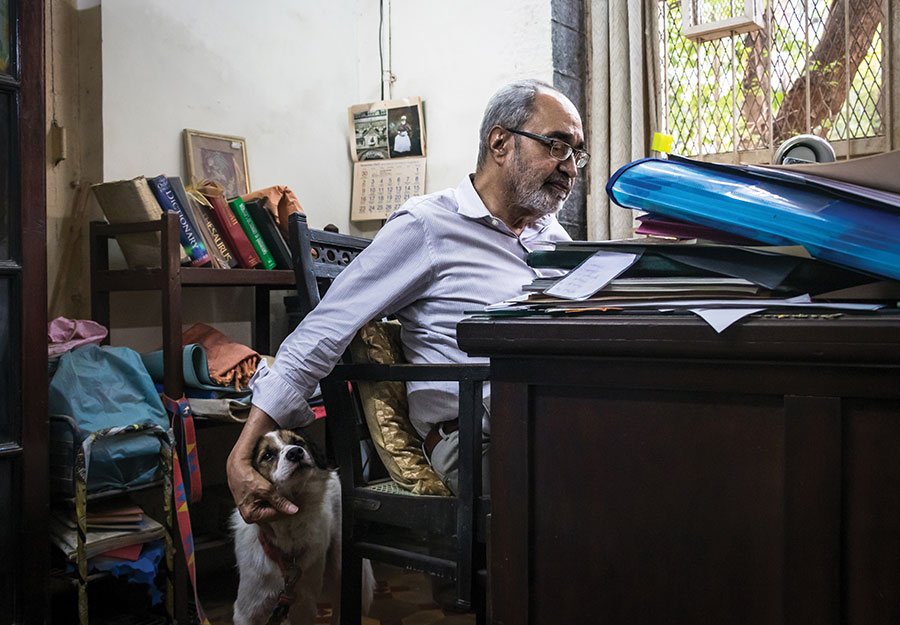
The office of Parsiana, a magazine for the Parsi community, is hidden in the dimly lit corridors of the Parsi Lying-in Hospital in Fort, a neighbourhood in South Mumbai (formerly known as South Bombay). The hospital itself has been closed for twenty-five years; the magazine moved in after the closure. There’s a sense of heaviness when one enters Parsiana’s office: high ceilings, the scent of old paper, distant sounds from outside juxtaposed with an unavoidable silence against the faded tiles and peeling plaster. A skeleton staff works diligently, frozen in time like a typical magazine office from the 1950s. A staff member is sitting at her computer, maintaining records, while bundles of files and documents are scattered across tables and shelves in different corners of the room, carrying the intimate narratives of a fading community.
Jehangir Patel, Parsiana’s editor, is in his eighties and appears both fragile and indomitable. He smiles warmly, stroking his dog as he talks with his staff, pausing between words to tend to health and habit. The gentle rhythm of his attention—between paper and pet, life and legacy—frames the story of a magazine inseparable from its editor and the community it served for more than six decades until its final issue in October 2025.
- Tags: Ashish Kumar Kataria, India, Issue 42, Mohsina Malik, Parsiana
Facts Only
Who: Parsiana (magazine), Jehangir Patel (editor), staff members, Parsi community
What: Parsiana magazine operates from an office in the Parsi Lying-in Hospital; staff maintains records and preserves narratives of the Parsi community
When: Current operations; hospital closed 25 years ago; magazine moved in post-closure; Parsiana's final issue in October 2025 (implied future)
Where: Office located within the Parsi Lying-in Hospital, Fort, South Mumbai
Executive Summary
Full Take
The office setting of Parsiana magazine is a poignant symbol of the Parsi community's history and legacy. Its location within an abandoned hospital underscores the shrinking demographic of the community, while its 1950s-style work environment embodies a sense of tradition that has persisted despite modern changes. The editor, Jehangir Patel, represents both fragility and resilience, embodying the spirit of preservation that defines Parsiana's mission.
As the magazine approaches its final issue in October 2025, it faces a critical juncture in documenting and sharing the narratives of the Parsi community. The absence of contemporary perspectives raises questions about the extent to which these stories will continue to be told and how they will evolve as new generations emerge.
Patterns detected: ARC-0043 Motte-and-Bailey, ARC-0024 Ambiguity (the article provides limited context about Parsiana's impending closure, creating the impression of a definitive end without fully explaining the situation).
Bridge Questions: What will become of Parsiana's extensive archives once it ceases publication? How might future generations engage with and preserve these narratives of the Parsi community? What alternative platforms could emerge to continue documenting the lives and experiences of this shrinking demographic?
Sentinel — Human
The text shows signs of a human writer, with a descriptive and immersive narrative style, personal voice, and idiosyncratic emphasis. However, the stylometric signals are not entirely conclusive due to the variable sentence length and hedging density.