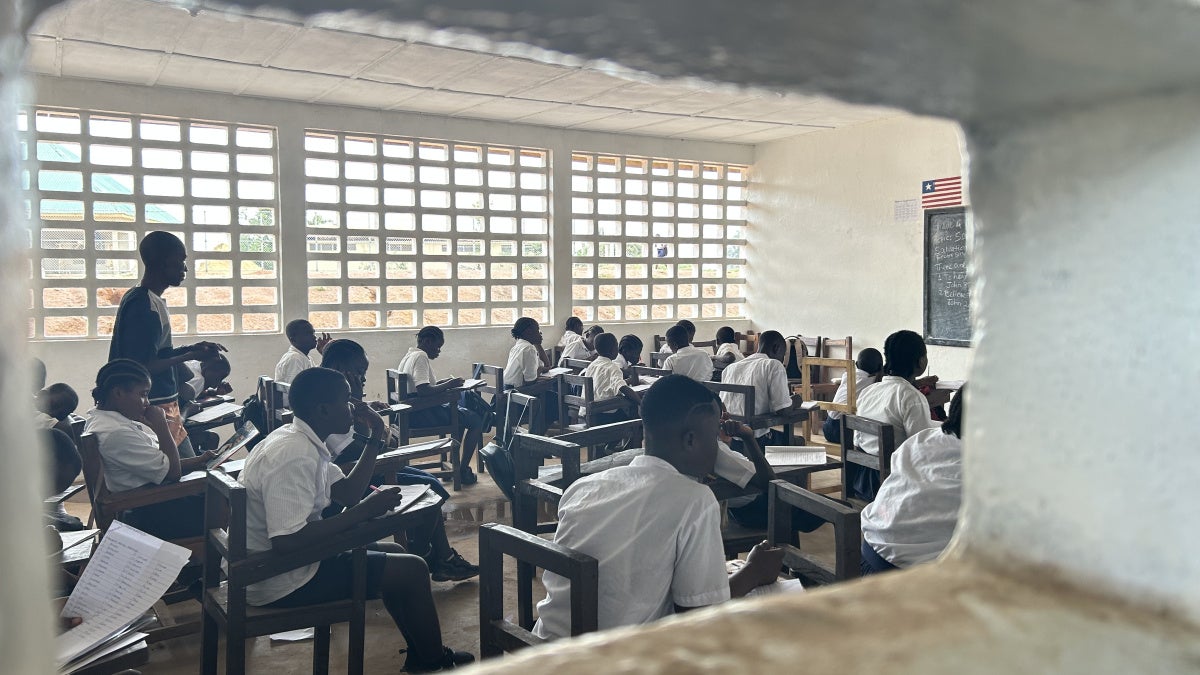
(Monrovia) – Registration fees and other costs to attend public schools in Liberia are a major barrier to education, forcing many children to delay enrollment, miss school, or drop out altogether, Human Rights Watch said in a report released today.
The 75-page report, “‘Without Education, There Will Be Nothing’: School Fees and Other Barriers to Education in Liberia,” documents that mandatory fees—despite a legal guarantee of free and compulsory education for grades 1 to 9—place a heavy financial burden on families and violate children’s right to education. Children in Liberia often enroll in school years late and are sent home when their parents are unable to pay their fees, or work to help pay them. Many drop out entirely or never attend school.
“The Liberian government has made important commitments to free and compulsory education, but school fees continue to keep children out of the classroom,” said Jo Becker, children’s rights advocacy director at Human Rights Watch. “Removing these fees would be a crucial step to expand access to education and improve children’s futures.”
Between November 2025 and January 2026, Human Rights Watch visited 21 schools and interviewed 118 parents, teachers, and school administrators across Montserrado, Margibi, Nimba, Bong, and Grand Bassa counties. Liberian child advocates also conducted peer-to-peer interviews with 61 children and youth.
A 14-year-old boy told Human Rights Watch that he left school to help his mother sell goods in the market: “Right now, I’m not in school because my parents can’t afford to send me. I really want to go back.”
Liberia has one of the highest out-of-school rates in the world. Roughly one-third of all school-age children, ages 3 to 17, and half of rural children have never attended school. Only 38 percent of children complete grade 6, and just 17 percent complete grade 9. These figures place Liberia among the worst-performing education systems globally and underscore the scale of exclusion children face. On average, a child who enters school at age 4 will complete just 4.2 years of schooling by age 18.
Despite laws requiring free education from grades 1 to 9, children at all levels—from early childhood education through senior secondary—are required to pay registration fees and other costs to attend public schools.
For many children, mandatory fees are not an abstract policy failure, but result in daily exclusion from education. Parents and children said that fees delay school entry and disrupt attendance. At the early childhood level, intended for children ages 3 to 5, 43 percent of children are at least 3 years over age. By secondary school, more than 60 percent of students are 4 or more years older than the official age for their grade. Students who begin school late are more likely to repeat grades, drop out, and fail to complete their education.
The burden of fees is particularly severe in a country where nearly half the population lives in poverty. In this context, fees shift the cost of education onto families, contrary to Liberia’s obligations under international and regional human rights law, including the African Charter on the Rights and Welfare of the Child. Parents reported taking on debt, going without food, and making extreme sacrifices to keep their children in school.
Human Rights Watch also highlighted the broader challenges to education quality, including overcrowded classrooms, inadequate infrastructure, low teacher salaries, and heavy reliance on volunteer teachers. In some schools, classes of 80 to 100 students are common, and volunteers—many unpaid for years hoping to get a paid position—make up a large share of the teaching workforce.
Liberia’s education system continues to face the long-term effects of civil wars, the Ebola epidemic, and the Covid-19 pandemic. Public investment in education remains low. The 2026 education budget accounting for about 11 percent of national spending and 2.73 percent of GDP, is significantly below the average of 4 percent for members of the Economic Community of West African States (ECOWAS) and the international benchmark of 4-6 percent of GDP.
The government has taken steps to improve access and quality, Human Rights Watch said. The Excellence in Learning in Liberia (EXCEL) project, a US$88.7 million initiative financed by a US$60 million World Bank loan and a US$28.7 million grant from the Global Partnership for Education, with additional government support, aims to expand access to quality education and includes US$18.5 million for school grants aimed at reducing or eliminating fees.
If fully implemented, these grants could significantly reduce financial barriers and help ensure that children enroll on time and remain in school. Human Rights Watch estimates that replacing registration fees with school grants for public schools—from early childhood through senior secondary education—would increase the education budget by roughly 4 percent, making the reform feasible.
The government should immediately eliminate registration fees at public primary and junior secondary schools and do so as quickly as possible for early childhood and senior secondary education, Human Rights Watch said. The government should also expand and sustain school grants, increase education funding in line with international benchmarks, and prioritize spending on early childhood through secondary education.
The government should also continue efforts to ensure sufficient paid and trained teaching staff, construct and rehabilitate schools and classrooms, and provide necessary materials and equipment, including restroom facilities, with priority to areas that are underserved.
Expanding access to free, quality public education would reduce poverty and inequality, strengthen Liberia’s human capital, and broaden opportunities for millions of children, Human Rights Watch said.
“Liberia has a clear opportunity to build on existing reforms and remove the financial barriers that keep so many children out of school,” Becker said. “Ensuring free, quality public education is one of the most effective investments the country can make.”
Facts Only
Human Rights Watch released a 75-page report on school fees and education barriers in Liberia.
The report documents mandatory fees in public schools despite legal guarantees of free education for grades 1 to 9.
Interviews were conducted with 118 parents, teachers, and administrators across Montserrado, Margibi, Nimba, Bong, and Grand Bassa counties.
61 children and youth were interviewed by Liberian child advocates.
A 14-year-old boy stated he left school to help his mother sell goods due to inability to pay fees.
Roughly one-third of Liberian children ages 3 to 17 have never attended school.
Only 38% of children complete grade 6, and 17% complete grade 9.
Nearly half of Liberia’s population lives in poverty.
The 2026 education budget accounts for 11% of national spending and 2.73% of GDP.
The EXCEL project, funded by the World Bank and Global Partnership for Education, aims to reduce school fees.
Human Rights Watch estimates replacing registration fees with school grants would increase the education budget by roughly 4%.
The report recommends eliminating fees, expanding school grants, and increasing education funding.
Executive Summary
Full Take
The Human Rights Watch report presents a compelling case for addressing systemic barriers to education in Liberia, but it also invites deeper scrutiny of the underlying assumptions and potential blind spots in the narrative. The strongest version of this argument—its steelman—is that financial barriers, particularly mandatory school fees, are a direct violation of Liberia’s legal and moral obligations to provide free education. The report effectively highlights the human cost, with testimonies from children and parents underscoring the immediate impact of these fees. However, the analysis could benefit from a more nuanced exploration of why these fees persist despite legal prohibitions. Are local administrators acting out of necessity due to underfunding, or is there systemic corruption at play? The report acknowledges the government’s efforts, such as the EXCEL project, but does not fully interrogate whether these initiatives are sufficient or merely symbolic.
Patterns detected: none
The root cause of this narrative appears to be a tension between policy intent and implementation, a common challenge in post-conflict and low-income countries. The report frames the issue as a failure of governance and resource allocation, but it could also be seen as a symptom of broader structural inequalities. The implications for human agency are profound: children are forced into labor or early marriage, perpetuating cycles of poverty. The second-order consequences—such as reduced human capital and social instability—are well-documented but deserve more emphasis.
Bridge questions: What would a successful elimination of school fees look like in practice, and what unintended consequences might arise? How do cultural attitudes toward education intersect with economic barriers? What role do international donors play in either enabling or hindering sustainable reforms?
Counterstrike scan: If this narrative were part of a coordinated influence campaign, the playbook might involve amplifying emotional testimonies to pressure the government while downplaying the complexity of funding constraints. However, the report’s reliance on empirical data and balanced recommendations suggests it is not aligned with such a pattern. The focus remains on systemic solutions rather than sensationalism.
Sentinel — Human
The text is a well-structured journalistic report that effectively synthesizes complex data and personal testimony regarding educational barriers in Liberia, exhibiting strong human editorial and narrative qualities.