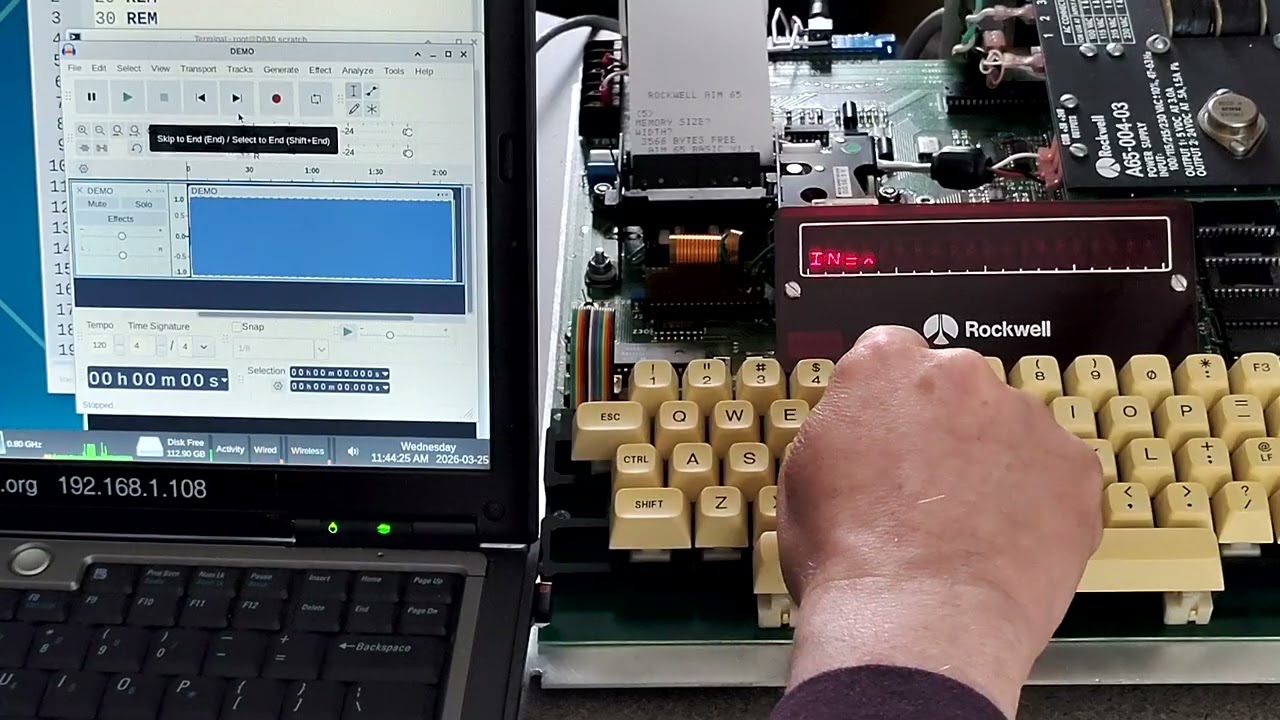
[Casey Bralla] got his hands on a Rockwell AIM 65 microcomputer, a fantastic example of vintage computing from the late 70s. It sports a full QWERTY keyboard, and a twenty character wide display complemented by a small thermal printer. The keyboard is remarkably comfortable, but doing software development on a one-line, twenty-character display is just not anyone’s idea of a good time. [Casey] made his own tools to let him write programs on his main PC, and transfer them easily to the AIM 65 instead.
Moving data wasn’t as straightforward in 1978 as it is today. While the Rockwell AIM 65 is a great machine, it has no disk drive and no filesystem. Programs can be written in assembler or BASIC (which had ROM support) but getting them into running memory where they could execute is not as simple as it is on modern machines. One can type a program in by hand, but no one wants to do that twice.
Fortunately the AIM 65 had a tape interface (two, actually) and could read and store data in an audio-encoded format. Rather than typing a program by hand, one could play an audio tape instead.
This is the angle [Casey]’s tools take, in the form of two Python programs: one for encoding into audio, and one for decoding. He can write a program on his main desktop, and encode it into a .wav
file. To load the program, he sets up the AIM 65 then hits play on that same .wav
file, sending the audio to the AIM 65 and essentially automating the process of typing it in. We’ve seen people emulate vintage tape drive hardware, but the approach of simply encoding text to and from .wav
files is much more fitting in this case.
The audio encoding format Rockwell used for the AIM is very well-documented but no tools existed that [Casey] could find, so he made his own with the help of Anthropic’s Claude AI. The results were great, as Claude was able to read the documentation and, with [Casey]’s direction, generate working encoding and decoding tools that implemented the spec perfectly. It went so swimmingly he even went on to also make a two-pass assembler and source code formatter for the AIM, as well. With them, development is far friendlier.
Watch a demonstration in the video [Casey] made (embedded under the page break) that shows the encoded data being transferred at a screaming 300 baud, before being run on the AIM 65.
Similar technique to store ZX-Spectrum programs in mp3 files today.
Back in 80s the programs also were downloaded over the air on radio broadcast somewhere in Europe.
why the hassle. in the documentation there is a small program that turns on the serial port to be used for software loading. its not even that long. i burned it on an eprom for my aim65 so it can be started with just a few key strokes.
i needed no llm fot that.
Facts Only
Casey Bralla obtained a Rockwell AIM 65 microcomputer, a late-1970s device with a QWERTY keyboard, 20-character display, and thermal printer.
The AIM 65 lacks a disk drive and filesystem, requiring programs to be entered manually or via audio tape.
Bralla developed two Python programs to encode and decode programs as audio files for transfer to the AIM 65.
The tools allow him to write code on a modern PC, encode it into a .wav file, and load it onto the AIM 65 via its tape interface.
The audio encoding format used by Rockwell for the AIM 65 is well-documented.
Bralla used Anthropic’s Claude AI to help generate the encoding and decoding tools.
He also created a two-pass assembler and source code formatter for the AIM 65.
A demonstration video shows the data transfer process at 300 baud.
Similar audio-based program storage techniques were used for the ZX-Spectrum and in 1980s European radio broadcasts.
A commenter mentions an alternative method using the AIM 65’s serial port for software loading, implemented via an EPROM.
Executive Summary
Casey Bralla acquired a Rockwell AIM 65 microcomputer, a vintage machine from the late 1970s featuring a QWERTY keyboard, a 20-character display, and a thermal printer. To streamline software development, he created Python tools to encode and decode programs as audio files, allowing him to write code on a modern PC and transfer it to the AIM 65 via its tape interface. The AIM 65 lacks a disk drive or filesystem, so programs were traditionally loaded via audio tapes or manual input. Bralla’s tools leverage the well-documented audio encoding format used by Rockwell, with assistance from Anthropic’s Claude AI to generate functional encoding and decoding software. He also developed a two-pass assembler and source code formatter to further ease development. A demonstration video shows the data transfer at 300 baud. The article notes that similar techniques were historically used for other vintage systems, such as the ZX-Spectrum, and even for radio broadcasts in Europe during the 1980s. A commenter suggests an alternative method using the AIM 65’s serial port for software loading, which they implemented via an EPROM.
The narrative highlights both the ingenuity of retrocomputing enthusiasts and the practical challenges of working with vintage hardware. While Bralla’s approach leverages modern tools and AI assistance, the commenter’s solution reflects a more traditional, hardware-based workaround. The discussion underscores the diversity of approaches within the retrocomputing community.
Full Take
The strongest version of this narrative celebrates the ingenuity of retrocomputing enthusiasts like Casey Bralla, who bridge modern technology with vintage hardware to overcome practical limitations. Bralla’s use of AI assistance to develop tools for the AIM 65 demonstrates how contemporary resources can revive and enhance outdated systems, making them more accessible for development. The article also acknowledges historical parallels, such as the ZX-Spectrum’s audio storage and 1980s radio broadcasts, framing Bralla’s work as part of a broader tradition of creative problem-solving in computing.
However, the narrative subtly contrasts Bralla’s AI-assisted, software-centric approach with the commenter’s hardware-based solution (using the serial port via EPROM). This juxtaposition invites reflection on the evolving relationship between human expertise and technological augmentation. The commenter’s dismissive tone—"why the hassle... i needed no llm for that"—highlights a tension between traditionalist and modernist perspectives within the retrocomputing community. It also raises questions about the role of AI in preserving or altering the authenticity of vintage computing experiences.
Root cause: The narrative assumes that modern tools and AI are inherently superior for solving vintage computing challenges, potentially overlooking the value of deeper hardware-level understanding. This echoes broader debates about technological dependency and the erosion of hands-on skills in favor of automation.
Implications: For human agency, Bralla’s approach democratizes access to vintage systems by lowering the barrier to entry, but it may also distance users from the raw, unmediated experience of working with the hardware. The commenter’s solution, while more technical, preserves the original constraints and rewards of the system. Second-order consequences could include a shift in how retrocomputing communities value different forms of expertise—whether through software abstraction or hardware mastery.
Bridge questions: How does the use of AI in retrocomputing change our relationship with historical technology? Does it enhance preservation or risk diluting the original experience? What trade-offs exist between accessibility and authenticity in vintage computing?
Counterstrike scan: If this were part of a coordinated influence campaign, the playbook might emphasize AI as a universal solution to legacy problems, framing traditional methods as outdated or unnecessary. However, the actual content does not match this pattern, as it presents both approaches neutrally and even includes a dissenting perspective. The narrative remains balanced and exploratory.
Patterns detected: none
Sentinel — Human
The article appears to be written by a human journalist based on its stylistic features, coherent narrative, and lack of coordination or fabrication indicators. However, a synthetic confidence score of 0.3 indicates some potential for AI involvement in the creation or editing process.