Tiger Woods has been arrested and charged with driving under the influence after a rollover crash near his Florida home, authorities said, as the 15-time major champion's golf career veered into fresh turmoil.
Mr Woods, 50, escaped injury but was detained after his vehicle clipped a truck while attempting to overtake on a residential road on Jupiter Island, flipping onto its side before sliding to a stop.
Martin County Sheriff John Budensiek said Mr Woods - who was arrested for driving under the influence in 2017 - showed signs of "impairment", although he passed a breathalyser test.
"When it came time for us to ask for a urinalysis test, he refused, and so he's been charged with DUI, with property damage and refusal to submit to a lawful test in the crash," Sheriff Budensiek said.
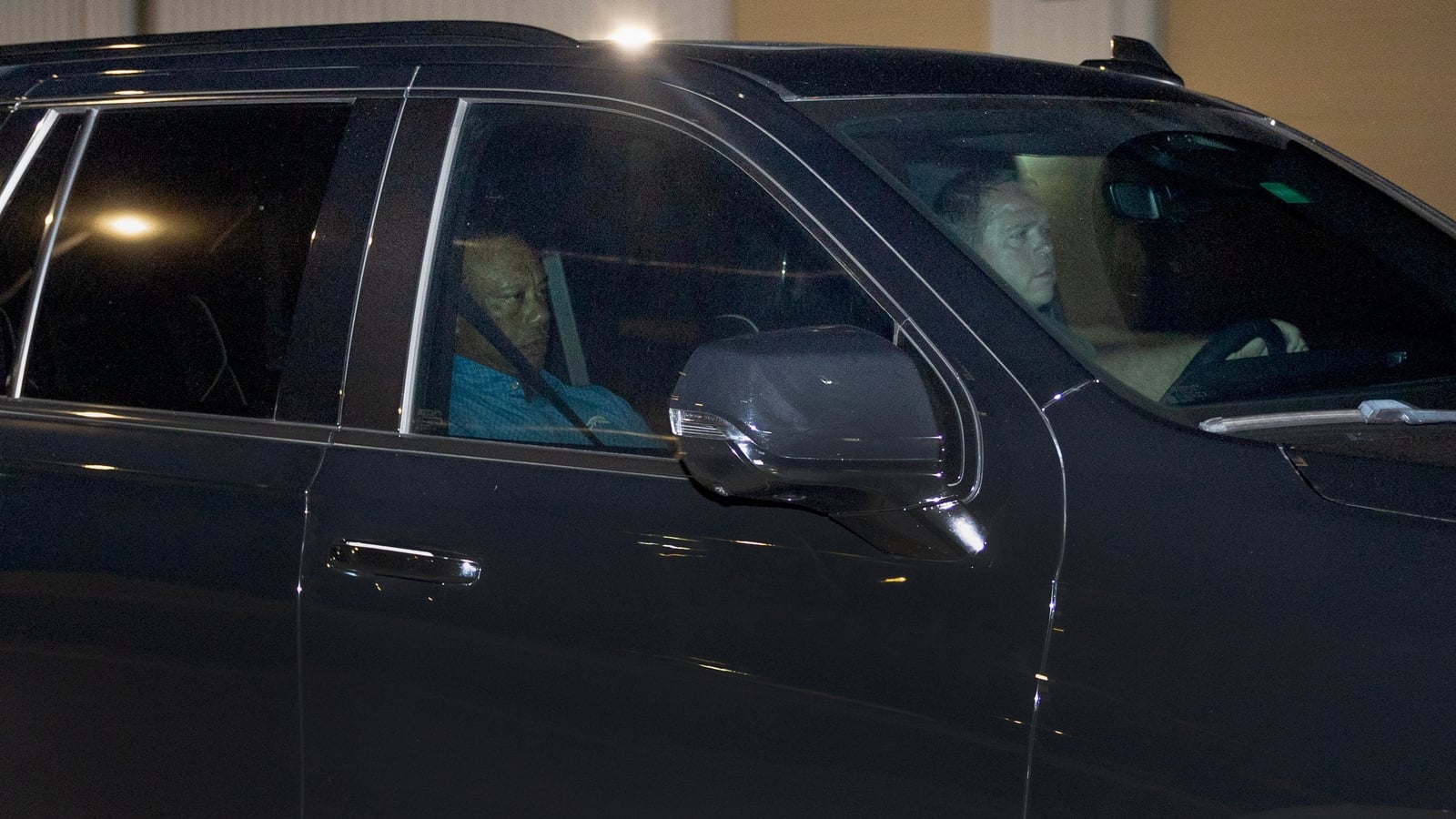
In line with Florida DUI laws, Mr Woods was detained at the county jail for eight hours and was photographed departing the facility in a car late last night.
A booking photo showed a red-eyed, stubbly-chinned Woods when he arrived at the jail about two hours after the crash.
Mr Budensiek said drug recognition experts who examined Mr Woods at the scene found the golfer "lethargic" and believed he was impaired with "some kind of medication or drug".
No drugs or medication were found in his vehicle and since Mr Woods refused the urine test, his right under Florida law, authorities "will never get definitive results as to what he was impaired on at the time of the crash," Sheriff Budensiek said.
'Could have been worse'
While neither Mr Woods nor the driver of the other vehicle was injured, Sheriff Budensiek said the incident on the two-lane road "could have been a lot worse."
"Had somebody been moving in the opposite direction, we would not be having a conversation saying there was no injuries," he said.
Mr Budensiek said he didn't know how fast the golfer was driving in the moments before the crash.
He said the driver of the truck had slowed to make a turn, then tried to move to the side of the road when he saw Mr Woods' fast-moving vehicle attempting to overtake him.
"When I show you the photos, they kind of speak for themselves ... you can see that (Woods) slid for a decent space before he came to a stop," said the sheriff, who said that after the crash Mr Woods climbed out of the passenger-side window of his Land Rover.
President Donald Trump expressed sympathy for Mr Woods in remarks to reporters in Miami following the incident.
"He's got some difficulty, there was an accident, and that's all I know," Mr Trump said. "Very close friend of mine. He's an amazing person, amazing man, but, uh, some difficulty."
Mr Woods was arrested in Jupiter in 2017 after police found him asleep at the wheel of his damaged car. He eventually pleaded guilty to reckless driving and said he had taken a mix of painkillers.
Five years ago Mr Woods was involved in a serious car crash in California that left him with severe right leg injuries that required pins inserted in his foot and ankle and a rod in his tibia as well as a follow-up surgery in 2023.
He returned from that crash at the 2022 Masters, where he struggled to walk all four rounds on the way to a 47th-place finish.
Mr Woods, whose clean-cut image was left in tatters after a 2009 sex scandal that upended his career, has been working to return from an Achilles tendon rupture last March and back surgery last October.
He competed earlier this week in the TGL simulator indoor golf league finals and had not ruled out playing in next month's Masters, where his five victories include his first major title in 1997 and his most recent in 2019.
"This body ... it doesn't recover like it did when it was 24, 25. It doesn't mean I'm not trying," said Mr Woods, who last competed in a PGA Tour level event at the 2024 British Open. "I keep trying."
Facts Only
Tiger Woods was arrested and charged with DUI after a rollover crash near his Florida home.
The crash occurred on a residential road in Jupiter Island when Woods' vehicle clipped a truck while overtaking.
Woods showed signs of impairment but passed a breathalyser test.
He refused a urinalysis test, leading to additional charges of property damage and refusal to submit to a lawful test.
Woods was detained for eight hours and released; a booking photo showed him with red eyes and stubble.
Authorities stated drug recognition experts believed Woods was impaired by medication or drugs, though no substances were found in his vehicle.
The crash caused no injuries, but the sheriff noted it could have been worse if another vehicle had been involved.
Woods was previously arrested for DUI in 2017 and pleaded guilty to reckless driving due to painkiller use.
He suffered severe leg injuries in a 2021 California crash, requiring multiple surgeries.
Woods had been recovering from an Achilles tendon rupture and back surgery, with plans to potentially compete in the Masters.
He last played in a PGA Tour event at the 2024 British Open.
President Donald Trump commented on the incident, calling Woods a "very close friend" and acknowledging his "difficulty."
Executive Summary
Tiger Woods, the 15-time major golf champion, was arrested and charged with driving under the influence (DUI) following a rollover crash near his Florida home. The incident occurred on a residential road in Jupiter Island when Woods' vehicle clipped a truck while attempting to overtake, flipping onto its side before sliding to a stop. Authorities noted Woods showed signs of impairment, though he passed a breathalyser test. He refused a urinalysis, leading to additional charges of property damage and refusal to submit to a lawful test. Woods was detained for eight hours and released, with a booking photo showing him appearing red-eyed and disheveled.
This is not Woods' first DUI-related incident; he was arrested in 2017 after being found asleep at the wheel, later pleading guilty to reckless driving due to a mix of painkillers. His history includes a severe 2021 car crash in California that required multiple surgeries, complicating his golf career. Despite ongoing physical challenges, including recent Achilles tendon and back surgeries, Woods had been working toward a potential return to competitive golf, including participation in the Masters. The crash raises questions about his health, recovery, and future in the sport, though no injuries were reported in this latest incident.
Full Take
The strongest version of this narrative presents Tiger Woods' arrest as a recurring pattern of impairment-related incidents, compounded by his history of injuries and pain management. The reporting leans on authoritative sources—law enforcement statements, prior legal records, and Woods' own admissions—to frame the event as part of a broader struggle with physical and personal challenges. The inclusion of Trump's sympathetic remarks adds a layer of humanization, while the detailed account of the crash and Woods' refusal to submit to testing introduces ambiguity about the exact cause of impairment.
Patterns detected: ARC-0024 Ambiguity (lack of definitive evidence due to refused testing), ARC-0043 Motte-and-Bailey (framing the incident as both a legal matter and a personal struggle without resolving the tension).
The root cause appears to be the intersection of celebrity culture, athletic decline, and the pressures of recovery. The narrative assumes Woods' impairments are tied to medication or pain management, echoing his 2017 arrest, but stops short of definitive conclusions. This reflects a broader societal fascination with the fall of icons, where personal struggles are scrutinized as much as professional achievements.
Implications for human agency: Woods' case highlights the challenges of aging athletes managing pain and public expectations. The costs are borne by Woods himself—legal consequences, reputational damage, and physical setbacks—while media and public attention benefit from the spectacle. Second-order consequences may include increased scrutiny of athlete health protocols and the ethics of pain management in sports.
Bridge questions: How might Woods' history of injuries influence perceptions of his impairment? What role does media play in amplifying or mitigating the stigma around athlete health struggles? Would evidence of a non-substance-related cause (e.g., fatigue) change the narrative?
Counterstrike scan: A coordinated influence campaign might exploit Woods' fame to push narratives about celebrity recklessness or the dangers of painkillers. However, the actual content aligns more with standard reporting on a high-profile incident, lacking the hallmarks of a deliberate manipulation effort. The focus remains on verifiable facts and context, without overt sensationalism.
Sentinel — Human
This analysis suggests that the article is likely human-written. While there are some signs of hedging language and variance in sentence length (common indicators of AI-generated content), these signals are relatively weak. The article also exhibits a passionate narrative with a clear human voice and stylistic fingerprint, further indicating human authorship.