The Executive Yuan has determined 13 strategic industries as the focus of Taiwan’s development this year, including key minerals, essential public infrastructure and urban renewal projects, government officials said.
The 13 strategic industries are: the semiconductor industry, artificial intelligence (AI), silicon photonics and quantum technologies, AI robotics, defense manufacturing, security and control, next-generation communications, critical minerals, biotech and healthcare, an Asian asset management hub, essential public infrastructure and urban renewal, cultural and creative industries, and the tourism industry, they said.
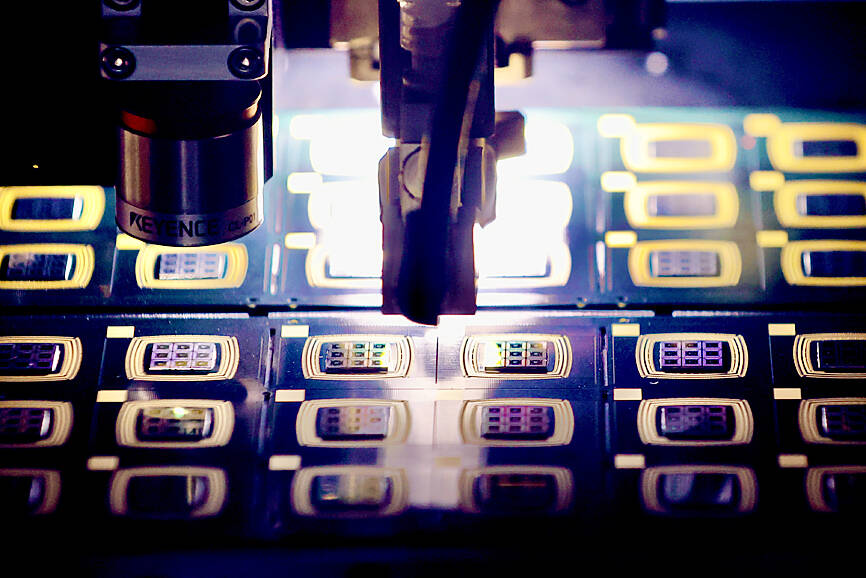
In the semiconductor sector, the nation’s overall output reached NT$6.5 trillion (US$203.9 billion) last year, the Executive Yuan said, adding that it ranked second in the world.
Photo: Ritchie B. Tongo, EPA-EFE
Building on the new top 10 AI initiatives and the five major “trusted industries” policies, Taiwan’s global AI ranking improved from 26th in 2023 to 16th last year, with the digital economy — including AI — now generating about NT$2 trillion in value, Cabinet data showed.
Construction of an advanced semiconductor research and development base in Hsinchu began last month to support production lines for advanced processes, officials said.
Efforts are also under way to promote self-sufficiency in materials and equipment, assisting companies in completing verification of semiconductor material and equipment production lines, they added, estimating that it would generate an additional output of about NT$20 billion.
Last month, the Executive Yuan also approved a quantum computing mainframe construction project that is aimed at establishing Taiwan’s first shared quantum computing core infrastructure by 2030, they said.
Meanwhile, referring to January’s Taiwan-US Economic Prosperity Partnership Dialogue, during which the two sides signed the Silicon Prosperity Declaration and the Joint Statement on Taiwan-US Economic Security Cooperation, the officials said that Taipei and Washington agreed to bolster cooperation in areas such as the mining, refining and exploration of critical minerals.
The Ministry of Economic Affairs would this year launch a critical minerals value-added application promotion project and establish a pilot production line within three years to meet 50 percent of domestic demand, laying an important foundation for enhancing the nation’s self-sufficiency in critical materials, they added.
As for essential public infrastructure and urban renewal, public construction spendings last year were estimated to be about NT$813.7 billion, the highest level in 18 years, they said.
With the amendment to Article 65 of the Urban Renewal Act (都市更新條例), the scope of the “original building floor area” eligibility has been expanded, with an estimated 270,000 aging buildings nationwide expected to be included, they added.
‘UNFRIENDLY’: Changing the nationality listing of Taiwanese residents to ‘China’ goes against EU foreign policy as well as democratic and human rights principles, MOFA said Taiwan yesterday called on Denmark to correct its designation of the nationality of Taiwanese residents as “China” or face retaliatory measures. The Danish government in 2024 changed the nationality of Taiwanese citizens on their residence permits from “Taiwan” to “China.” The decision goes against EU foreign policy and contravenes democratic and human rights principles, Ministry of Foreign Affairs (MOFA) spokesman Hsiao Kuang-wei (蕭光偉) said. Denmark should present a solution acceptable to Taiwan as soon as possible and correct the erroneous designation to preserve the longstanding friendship between the two nations, Hsiao said. The issue could damage Denmark’s image and business reputation in Taiwan,
KEY INDUSTRY: The vice premier discussed a plan to create a non-red drone supply chain by next year, which has been allocated a budget of more than NT$7.2 billion The government has budgeted NT$44.2 billion (US$1.38 billion) to cultivate Taiwan’s uncrewed aerial vehicle (UAV) industry over the next five years, which would make the nation a major player in the industry’s democratic supply chain in the Asia-Pacific region, Premier Cho Jung-tai (卓榮泰) said yesterday. Cho made the remarks during a visit to the facilities of Cub Elecparts Inc (為升電裝). Democratic Progressive Party (DPP) Legislator Chen Su-yueh (陳素月) and Chinese Nationalist Party (KMT) Legislator Hsieh Yi-fong (謝依鳳) also participated in the trip. Cub Elecparts has transitioned from the automotive industry to the defense industry, which is the top priority among the nation’s
Taiwan climbed to its highest position in global export rankings in more than three decades last year, buoyed by demand linked to artificial intelligence (AI) that lifted shipments of semiconductors and technology products, Ministry of Finance data released yesterday showed. Taiwan accounted for 2.4 percent of global exports last year, or about US$640 billion, ranking 12th worldwide, the data showed. That was up four places from a year earlier and marked the nation’s best ranking since 1994, the ministry said. Taiwan’s share of global exports rose by 0.5 percentage points from the previous year, the largest increase among major economies, reflecting the nation’s
FIRST TRIAL: Ko’s lawyers sought reduced bail and other concessions, as did other defendants, but the bail judge denied their requests, citing the severity of the sentences Former Taipei mayor Ko Wen-je (柯文哲) was yesterday sentenced to 17 years in prison and had his civil rights suspended for six years over corruption, embezzlement and other charges. Taipei prosecutors in December last year asked the Taipei District Court for a combined 28-year, six-month sentence for the four cases against Ko, who founded the Taiwan People’s Party (TPP). The cases were linked to the Core Pacific City (京華城購物中心) redevelopment project and the mismanagement of political donations. Other defendants convicted on separate charges included Chinese Nationalist Party (KMT) Taipei City Councilor Angela Ying (應曉薇), who was handed a 15-year, six-month sentence; Core Pacific
Facts Only
The Executive Yuan designated 13 strategic industries for Taiwan’s development, including semiconductors, AI, quantum technologies, and critical minerals.
Taiwan’s semiconductor industry output reached NT$6.5 trillion (US$203.9 billion) in 2023, ranking second globally.
Taiwan’s global AI ranking improved from 26th in 2023 to 16th last year, with the digital economy generating NT$2 trillion in value.
Construction of an advanced semiconductor R&D base in Hsinchu began last month.
A quantum computing mainframe project was approved, aiming to establish shared infrastructure by 2030.
Taiwan and the U.S. signed agreements to cooperate on critical minerals during the January Taiwan-US Economic Prosperity Partnership Dialogue.
The Ministry of Economic Affairs plans to launch a critical minerals project to meet 50% of domestic demand within three years.
Public construction spending in 2023 was NT$813.7 billion, the highest in 18 years.
Urban renewal policies now include 270,000 aging buildings nationwide.
Taiwan’s global export ranking rose to 12th in 2023, the highest since 1994, with exports totaling US$640 billion.
Denmark changed the nationality designation of Taiwanese residents to "China" in 2024, prompting Taiwan to demand corrections.
Former Taipei Mayor Ko Wen-je was sentenced to 17 years in prison for corruption, embezzlement, and mismanagement of political donations.
The government allocated NT$44.2 billion over five years to develop Taiwan’s drone industry.
Executive Summary
Full Take
The strongest version of this narrative highlights Taiwan’s strategic pivot toward technological self-sufficiency and economic resilience, framed as a response to geopolitical pressures and global supply chain vulnerabilities. The focus on semiconductors, AI, and critical minerals aligns with Taiwan’s role as a key player in the U.S.-led "democratic supply chain" initiative, reinforcing its position as a counterbalance to China’s influence. The diplomatic spat with Denmark over nationality designations underscores the broader struggle for international recognition, while the corruption conviction of Ko Wen-je serves as a reminder of domestic political challenges.
Patterns detected: ARC-0024 Ambiguity (in the framing of "democratic supply chain" as inherently virtuous without defining criteria), ARC-0043 Motte-and-Bailey (implied equivalence between economic security and moral superiority in the Denmark dispute).
Root cause: The narrative reflects a paradigm of economic nationalism intertwined with geopolitical alignment, where technological dominance is both a security imperative and a tool for diplomatic leverage. The unstated assumption is that Taiwan’s survival hinges on maintaining its edge in high-tech industries while securing Western partnerships—an echo of Cold War-era bloc politics.
Implications: For human agency, this means Taiwan’s citizens are both beneficiaries and stakeholders in a high-stakes economic strategy, but the focus on elite-driven industries risks sidelining broader societal needs. The second-order consequences include potential over-reliance on U.S. alignment, which could limit Taiwan’s diplomatic flexibility, and the risk of domestic polarization if corruption scandals erode trust in institutions.
Bridge questions: How might Taiwan balance its high-tech ambitions with equitable economic growth? What alternative frameworks for international recognition could mitigate reliance on Western validation? Would a shift in U.S.-China relations fundamentally alter Taiwan’s strategic calculus?
Counterstrike scan: A coordinated influence campaign would amplify the "democratic supply chain" framing to portray Taiwan as a bulwark against authoritarianism while downplaying domestic controversies like Ko’s conviction. The actual content aligns partially but avoids overt propaganda, focusing on verifiable economic and diplomatic developments. No structural alignment with a hypothetical attack playbook is detected.