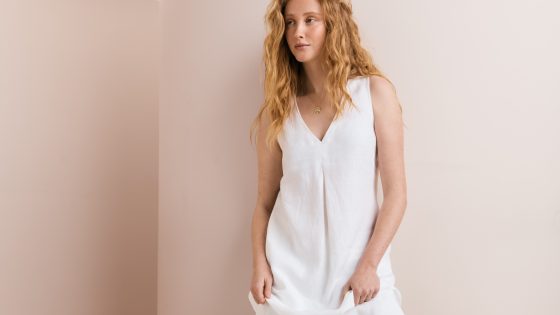
The new summer 2026 collection, which launched yesterday (26 March), offers a range of linen “effortless wardrobe staples”.
The range spans more than 20 styles across wide-legged trousers, shirts, tailored waistcoats, co-ords, culottes and dresses.
Prices range from £14 for a pair of casual shorts, and £20 for culottes and shorts, to £32 for a shirt dress and £36 for a utility jacket.
“This is an easy update for the season ahead while keeping summer style simple and affordable,” Tu said in a statement.
The collection is available to shop online at Tu and Sainsbury’s-owned Argos, as well as in selected Sainsbury’s supermarkets.
Advertisement
In its most recent trading update for the third quarter to 3 January 2026, Sainsbury’s said its clothing arm outperformed a challenging UK fashion market over the peak Christmas period.
Sainsbury’s CEO Simon Roberts said clothing sales volumes beat the wider supermarket clothing market, despite general merchandise sales falling 1.1% year on year to £607m for the quarter.
Have your say
or a new account to join the discussion.
Facts Only
Tu launched a new summer 2026 collection on 26 March.
The collection includes over 20 linen styles, such as wide-legged trousers, shirts, tailored waistcoats, co-ords, culottes, and dresses.
Prices range from £14 for casual shorts to £36 for a utility jacket.
The collection is available online at Tu and Argos, as well as in selected Sainsbury’s supermarkets.
Sainsbury’s reported its clothing arm outperformed the UK fashion market during the Q3 2026 Christmas period.
General merchandise sales for Sainsbury’s fell 1.1% year on year to £607 million in Q3 2026.
Sainsbury’s CEO Simon Roberts stated that clothing sales volumes beat the wider supermarket clothing market.
Executive Summary
Full Take
**STEELMAN:** The narrative presents Tu’s summer 2026 collection as an accessible, affordable update for seasonal fashion, backed by Sainsbury’s strong performance in clothing sales despite broader retail challenges. The framing emphasizes value and simplicity, appealing to cost-conscious consumers while highlighting the brand’s resilience in a competitive market.
**PATTERN SCAN:** The article leans on authority (Sainsbury’s CEO statement) and selective framing (emphasizing outperformance without deeper context on market conditions). The focus on affordability and simplicity could subtly exploit consumer anxieties about inflation or economic uncertainty, though this is not overtly manipulative. No clear distortion or bad faith is present, but the lack of comparative data (e.g., how much the clothing market declined overall) leaves room for uncritical acceptance of the "outperformance" claim.
**ROOT CAUSE:** The paradigm here is retail resilience through affordability and strategic positioning. The unstated assumption is that consumers prioritize price and simplicity in uncertain economic times, and that Sainsbury’s can leverage its supermarket footprint to drive clothing sales. This echoes historical patterns of discount retailers gaining market share during downturns.
**IMPLICATIONS:** For consumers, this means more budget-friendly options, but the emphasis on low prices may pressure margins for suppliers or labor. Sainsbury’s benefits from cross-selling fashion in supermarkets, while competitors without grocery tie-ins may struggle. Second-order effects could include further commodification of fashion, reducing perceived value in mid-tier brands.
**BRIDGE QUESTIONS:**
How does Tu’s pricing compare to fast-fashion competitors like Primark or H&M, and what trade-offs exist in quality or ethics?
If Sainsbury’s clothing sales outperformed the market, what specific strategies (beyond affordability) drove this success?
Could the focus on "effortless staples" reflect broader cultural shifts toward minimalism, or is it purely a cost-cutting tactic?
**COUNTERSTRIKE SCAN:** A coordinated influence campaign might amplify the "affordable resilience" narrative to position Sainsbury’s as a recession-proof brand, downplaying labor or sustainability concerns. However, the article’s tone is straightforward and lacks the hallmarks of orchestrated persuasion (e.g., emotional triggers, forced binaries). The content aligns with typical retail reporting rather than a manipulative playbook.
Patterns detected: none