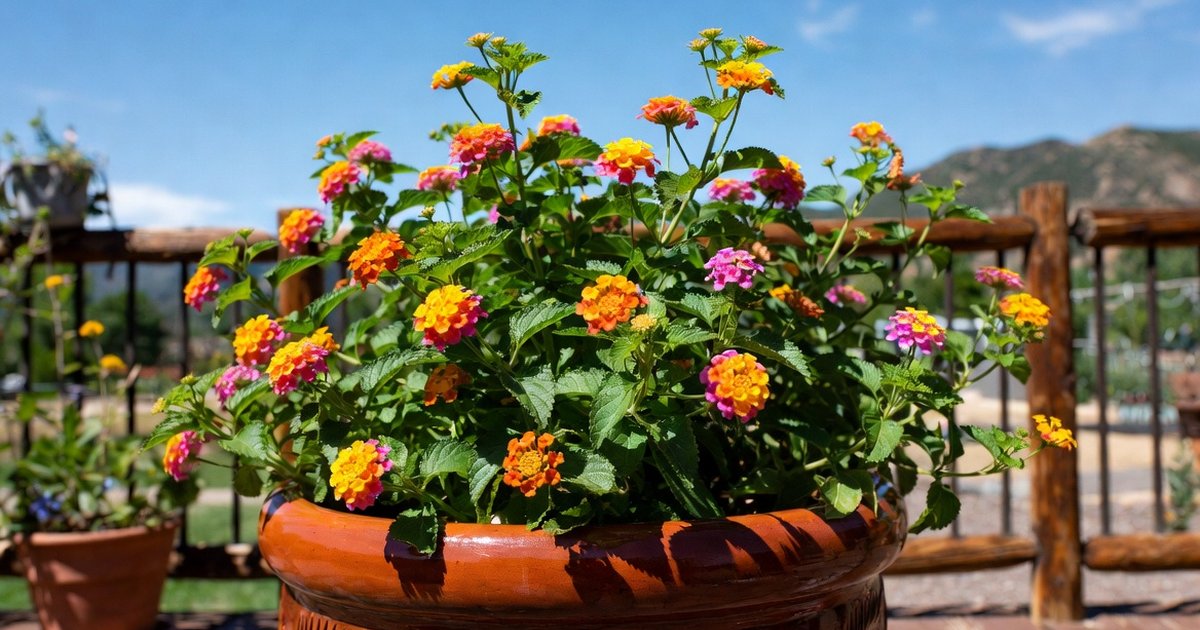
Lantana (Lantana camara and hybrids) is a colorful, heat-loving flowering plant famous for its clusters of tiny, multi-colored flowers (often yellow, orange, pink, red, or bicolor) that attract butterflies, bees, and hummingbirds. In Fort Collins, Colorado (USDA Zone 5b), it is grown as a summer annual because it is not winter-hardy here.
Growing Conditions in Fort Collins
Lantana thrives in the hot, sunny summers of Colorado but needs protection from cold.
- Hardiness: Perennial in Zones 8–11. In Zone 5b, treat as an annual — it will be killed by the first hard frost (usually mid-to-late September).
- Planting time: Late May to early June, after all danger of frost has passed and soil has warmed (night temps consistently above 55°F).
- Sun: Full sun (6–8+ hours) is essential for abundant blooming and compact growth. It tolerates intense Colorado sunlight very well.
- Soil: Well-draining, average to poor soil. Avoid rich, heavily fertilized soil, which can produce more leaves than flowers. Great for containers, hanging baskets, or ground beds.
- Water: Moderate to low once established. Drought-tolerant and prefers to dry out slightly between waterings. Overwatering is a common mistake in Colorado gardens.
Care Tips
- Growth habit: Mounding or trailing depending on variety. Most grow 12–24 inches tall and wide. Popular trailing types work well as “spillers” in pots (pairs nicely with sweet potato vine and upright plants like Juncus).
- Fertilizer: Light feeder. Use a bloom-boosting fertilizer (higher phosphorus) sparingly every 4–6 weeks.
- Deadheading: Not strictly necessary, but removing spent flower clusters encourages more blooms.
- Pests: Generally tough, but watch for whiteflies, spider mites, or aphids in hot, dry conditions.
- Overwintering (optional): Can be brought indoors as a houseplant in a sunny window, or cuttings can be rooted for next year. Most gardeners simply replace plants each spring as they’re widely available and inexpensive.
Lantana is an excellent choice for hot, sunny spots, pollinator gardens, and container combinations in Fort Collins. Its long blooming season (all summer until frost) makes it very rewarding.
Would you like a specific variety (e.g., ‘Bandana’, ‘Havana’, trailing types), companion planting ideas, or troubleshooting tips?
Facts Only
*Lantana* (*Lantana camara* and hybrids) is a flowering plant attracted to butterflies, bees, and hummingbirds.
In Fort Collins, Colorado (USDA Zone 5b), it is grown as a summer annual because it is not winter-hardy in that zone.
The plant thrives in hot, sunny summers of Colorado.
Hardiness: Perennial in Zones 8–11.
Planting time: Late May to early June, after frost danger has passed and soil warms above 55°F.
Sun requirement: Full sun (6–8+ hours) is essential for abundant blooming.
Soil: Requires well-draining, average to poor soil.
Water: Drought-tolerant and prefers to dry out slightly between waterings.
Growth habit: Most plants grow 12–24 inches tall and wide, mounding or trailing.
Fertilizer: Use a bloom-boosting fertilizer sparingly every 4–6 weeks.
Pests: Watch for whiteflies, spider mites, or aphids in hot, dry conditions.
Overwintering: Can be brought indoors or cuttings can be rooted for next year.
Executive Summary
Lantana (*Lantana camara* and hybrids) is a heat-loving flowering plant known for its clusters of multi-colored flowers that attract pollinators. In Fort Collins, Colorado (USDA Zone 5b), it is typically grown as a summer annual because it is not winter-hardy in that zone.
Lantana requires full sun (6–8+ hours) for optimal growth. Planting should occur in late May or early June, after the risk of frost has passed and soil temperatures are consistently above 55°F. The plant thrives in well-draining soil and is drought-tolerant, preferring to dry out slightly between waterings; overwatering is noted as a common mistake in the Colorado gardening context.
Care involves moderate fertilization using bloom-boosting fertilizers every four to six weeks. The growth habit is mounding or trailing, with trailing varieties being suitable for use as "spillers" in containers. Pest management generally requires monitoring for whiteflies, spider mites, or aphids in hot, dry conditions. The plant can be maintained as a houseplant or cuttings can be rooted for future seasons.
Full Take
The presented information frames gardening as a highly specific, conditional process dependent on localized climate and soil quality. The emphasis on "annual" status in Zone 5b immediately establishes a boundary condition: the plant’s life cycle is subservient to the predictable, often harsh, temporal boundaries of the local environment. This highlights how regional climate dictates agricultural practice, shifting the gardener’s agency from choosing a plant to managing adaptation.
The advice regarding water management—specifically the explicit warning against overwatering in Colorado gardens—reveals a systemic emphasis on managing scarcity. This is not merely a horticultural tip but a cognitive exercise in recognizing and correcting the tendency toward abundance, suggesting that success is achieved by mastering the constraint of arid conditions.
The instruction to use "light feeder" fertilizer sparingly and the suggestion to use trailing plants as "spillers" in containers reflect a form of aesthetic optimization. These practices subtly guide the reader toward a desired visual outcome that aligns with established, often commercially preferred, garden arrangements. The potential for "overwatering is a common mistake" functions as a subtle authority game, positioning the author as the sole arbiter of success and failure, implicitly reinforcing a hierarchy where specific, localized conditions are assumed to hold absolute, unquestionable truth.
Sentinel — Human
The content is highly coherent and grounded in verifiable facts, structured like a typical human-written gardening guide, suggesting a low risk of synthetic origin.