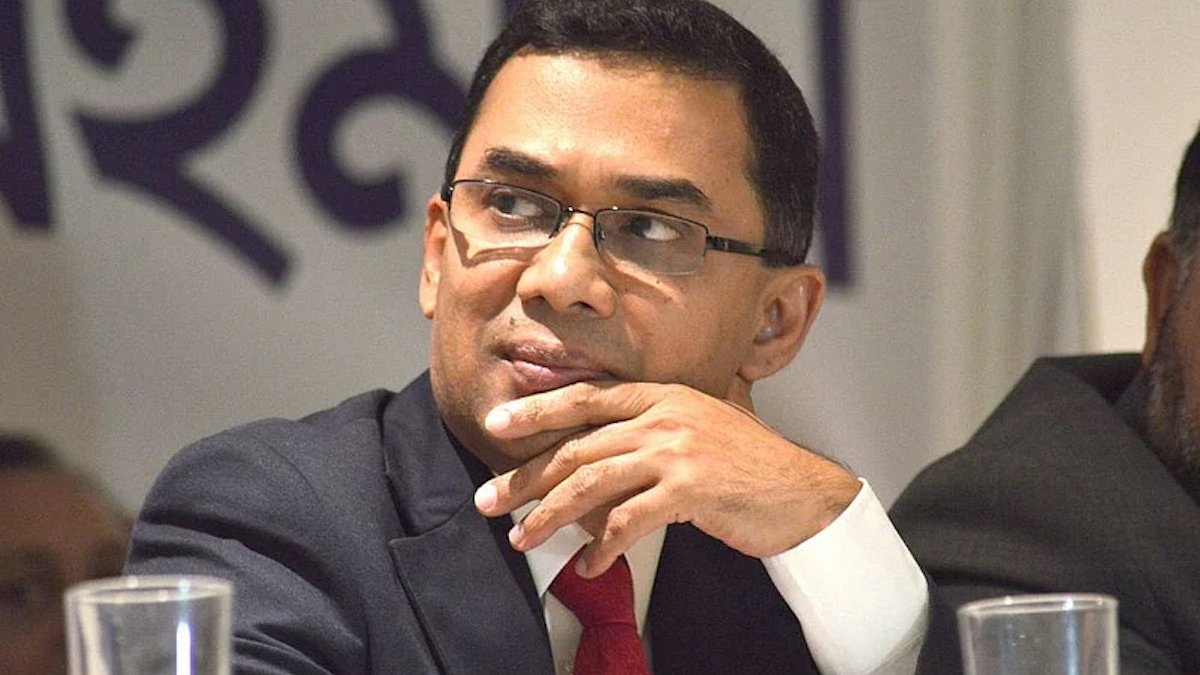
When Tarique Rahman, Bangladesh’s prime minister, chose the World Economic Forum’s prestigious Annual Meeting of the New Champions in Dalian for his first major international address since taking office, the selection of the topic was a highly deliberate statement of strategic intent.
He did not lead with predictable requests for trade concessions, investment incentives, or the fluid politics of the country’s democratic transition. Instead, he chose climate change.
“Bangladesh believes climate action is not a cost,” he told the assembled global delegates. “For delta nations, it is a much-needed investment for prosperity, stability and a shared future.”
For an administration five months into a mandate built entirely on restoring institutional confidence, this was a structural claim about how Bangladesh intends to compete for capital, partnerships and geopolitical standing in an era in which climate vulnerability has become inseparable from macroeconomic strategy.
The underlying argument advanced by Dhaka is simple and assertive. Bangladesh is no longer content to be treated as a passive case study in ecological vulnerability. It intends instead to be read as a sovereign state capable of managing risk at an unprecedented scale, acting as a viable model that other deltaic and coastal nations can actively draw upon.
Rahman’s message in Dalian was built on substance rather than sentiment. He pressed for the Loss and Damage Fund to move rapidly from pledge to disbursement, for international climate finance to become significantly more concessional and accessible to vulnerable states, and for adaptation to be weighted equally alongside mitigation.
In doing so, he pointed directly to what Dhaka and other developing economies argue is a profound shortfall in the US$300 billion New Collective Quantified Goal agreed at COP29.
These are not new complaints from the Global South, but they carry particular weight from a government that, in its first months, has moved swiftly to make the case concrete at home.
Dhaka has put forward a stated commitment to dredge and re-excavate its vast river systems to restore natural flow and reduce systemic flood risk. It has initiated a national tree-planting drive, including the highly visible “One Student, One Tree” initiative, and a policy push to lift the share of renewables in the national power mix.
Each of these domestic initiatives is designed as much as an accountability marker as a diplomatic talking point. It is a way of signaling that Dhaka intends to be judged entirely on delivery, not just on advocacy.
That specific combination — being vocal on international financial architecture while remaining precise on domestic implementation — distinguishes Bangladesh’s new positioning from the more familiar, traditional posture of climate-vulnerable states appealing to the international community for sympathy.
It is also precisely why the Dalian venue mattered. Delivering this message from China, only days ahead of formal bilateral meetings with Premier Li Qiang and President Xi Jinping, allowed Rahman to make his case directly to an audience that includes not just Western climate financiers but Beijing’s own extensive network of infrastructure and development finance.
It is a relationship Bangladesh’s government has signaled it wants to deepen significantly, without appearing to trade away balance in its wider, delicate foreign policy.
None of this is without real institutional difficulty, and the administration has been candid about those constraints. Delivering river dredging and tree-planting programs at this scale requires massive financing, deep technical capacity, and rigorous coordination across multiple competing ministries.
These are capabilities that any government, let alone one only a few months removed from an interim administration, has to build from a standing start. Rahman’s team has treated this as a sequencing challenge rather than a reason for caution.
Climate commitments are being announced early, with their implementation mapped onto the national budget to ensure funding for social safety nets like the Family Card program and the farmers’ card, as well as investments in education and public health.
This integrated approach makes progress visible through regular, transparent budget implementation, rather than burying it in subsequent dense Nationally Determined Contribution filings.
For the wider region, that visibility indeed matters immensely. Coastal states pressing similar claims receive a working example to cite in upcoming international COP31 negotiations.
Rahman frames this not as a plea for charity, but as a sharp commercial proposition: delta nations investing in resilience are a better bet for global capital than those waiting passively for external compensation.
However, any analytical observer knows that for a government promising competence after a period defined by its total absence, choosing to be judged on climate delivery, a metric unusually hard to fake, is itself a powerful signal of confidence in what it intends to build.
That is the wager Rahman has made, and vulnerable states will watch it very closely.
The writer is Deputy Press Secretary to the Prime Minister, Government of the People’s Republic of Bangladesh.
Facts Only
* Tarique Rahman made a major international address at the World Economic Forum in Dalian.
* The topic of the address was climate change.
* Rahman stated that climate action is a needed investment for delta nations for prosperity, stability, and a shared future.
* Rahman pressed for the Loss and Damage Fund to expedite disbursement.
* He advocated for international climate finance to be more concessional and accessible.
* He demanded that adaptation be weighted equally with mitigation.
* The address pointed to a shortfall in the US$300 billion New Collective Quantified Goal from COP29.
* Bangladesh committed to dredging river systems to reduce flood risk.
* Bangladesh initiated a national tree-planting drive, including the "One Student, One Tree" initiative.
* Bangladesh is pushing policies to increase the share of renewables in the national power mix.
* Domestic initiatives are intended as accountability markers alongside diplomatic talking points.