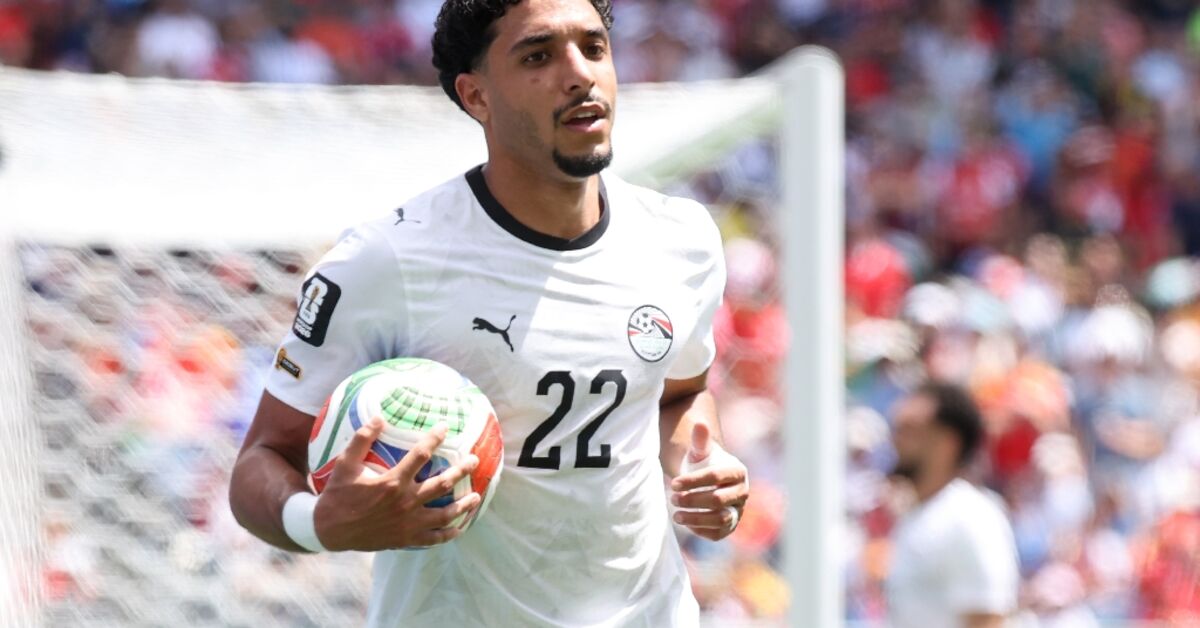
Omar Marmoush once rejected the chance to play for Canada, but in Vancouver on Sunday will aim to become a national hero back home in Egypt by making World Cup history.
The Pharaohs are powerhouses of African football with a record seven continental titles but are yet to win a match in eight games at the World Cup.
A meeting with New Zealand, ranked 56 places below Egypt in the FIFA rankings, offers a golden chance for an elusive World Cup victory and with it progress beyond the group stages for the first time.
For Marmoush it is also an opportunity to make his mark on the global stage.
Overshadowed by Mohamed Salah's superstar status in the national team, Marmoush has also had to play second fiddle at club level to Erling Haaland since joining Manchester City 17 months ago.
"It’s difficult but at the same time it makes you better, knowing that when you’re on the pitch you have to give your best. You have to perform because the next person is there, waiting to take your spot," Marmoush said in a recent interview with GQ Middle East.
"I trained hard to get here, you know? My whole career led up to this point – to compete and play with the best players in the world, trying to win titles."
The Cairo native left his club, Wadi Degla, and his homeland at the age of 18 to make his career in Europe with German club Wolfsburg.
After spells on loan at St. Pauli and Stuttgart, he rose to prominence as a Bundesliga star at Eintracht Frankfurt and earned a 70-million-euro ($80 million) move to City.
During those early years in Germany, his progress caught the attention of the Canadian Soccer Association.
Marmoush's parents obtained Canadian citizenship after working there prior to his birth.
"The Canadian national team contacted me... the head coach called me personally," he told Egyptian talk show Sahibat Al Saada.
"But when I received the call, my decision was already made: my national team is Egypt; I put Egypt above everything else."
- 'Dream big' -
He may not yet enjoy the status of Salah, but Marmoush is vital to Egypt's prospects of World Cup progress.
His development has eased some of the goalscoring burden on Salah, who at 34 had a disappointing final season at Liverpool after a glittering nine-year spell.
"It’s a team that defends and counters, featuring two fantastic players in Salah and Marmoush -- both of whom are incredibly fast," said Belgium coach Rudi Garcia after a 1-1 draw in their Group G opener.
On paper, Belgium provided Egypt's toughest test of the group stages.
New Zealand have also never won a World Cup match, while their final group opponents Iran have had to contend with a series of logistical and emotional distractions as a result of the conflict between co-hosts the United States and the Islamic Republic.
Egypt, the Arab world's most populous nation and so long an underachiever on the global stage, craves a World Cup win to celebrate.
"I think the World Cup is a football moment where you can dream to go as far as possible," added Marmoush.
"We always dream big. It’s great that we have so many MENA (Middle East and North African) teams at the tournament this year, but it’s not just about numbers.
"We want to go there and perform. Here we are playing on the biggest stage in world football, let’s show them what we've got!"
Facts Only
* Omar Marmoush left his club, Wadi Degla, at age 18 to play in Europe with Wolfsburg.
* Marmoush’s parents obtained Canadian citizenship after working there prior to his birth.
* The Canadian national team and head coach contacted Marmoush regarding opportunities.
* Marmoush chose to prioritize the Egyptian national team over other opportunities.
* Marmoush made a move to Manchester City, earning €70 million ($80 million).
* Belgium's coach Rudi Garcia noted that Egypt featured two fast players, Salah and Marmoush.
* Egypt has seven continental titles but has not won a World Cup match in eight games at the World Cup.
* New Zealand has never won a World Cup match.
* Egypt seeks a World Cup win to celebrate and demonstrate performance on the global stage.
Executive Summary
Full Take
The narrative leverages national aspiration—specifically Egypt's desire for a World Cup victory—to frame an individual trajectory (Marmoush) as synonymous with national success. This creates an emotional bridge between personal achievement and collective destiny. The dynamic of Marmoush being "overshadowed" by Salah and Haaland serves as a powerful, emotionally resonant anchor, transforming a sporting competition into a proxy for broader societal or continental ambition.
The system implicitly positions the pursuit of a global trophy as the ultimate measure of worth, setting an unattainable standard that is then focused through the lens of national identity. The call to "dream big" and perform on the "biggest stage" functions to reinforce the idea that individual effort must align perfectly with the state's collective ambition. This pattern exploits moral panic related to underachievement, weaponizing the desire for recognition to motivate engagement.
The underlying assumption is that external performance (World Cup success) justifies internal focus, potentially diverting attention from structural issues or alternative definitions of success within the national context. The real implication involves how public discourse manages the tension between celebrated individual careers and the collective weight placed on national representation in global competition.
Sentinel — Human
The text exhibits strong human stylistic markers and specific sourcing indicators, suggesting it originated from a human journalist rather than purely synthetic generation.