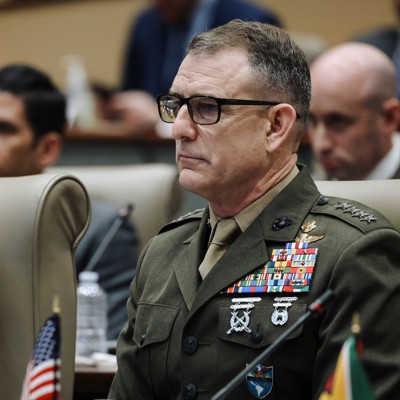
Gen. Francis Donovan repeated what others have said: that he wouldn’t follow an unlawful order.
Questions about following illegal orders—a frequent theme of the second Trump administration—came up again at a Capitol Hill hearing on Tuesday.
Just days after Defense Secretary Pete Hegseth declared that the U.S. war on Iran would feature “no quarter, no mercy for our enemies”—on its face, a violation of international law—the leader of U.S. Southern Command was pressed by House lawmakers who had questions about attacks on alleged drug-running boats off South America.
“Has an order been issued to you on ‘no quarter,’ no survivors?” Rep. Eugene Vindman, D-Va., asked Marine Gen. Francis Donovan, alluding to the Sept. 2 “double-tap” attack on the survivors of an initial strike.
The Law of Armed Conflict considers survivors of a strike to be “out of the fight” and thus off the table as targets.
Donovan said he had not been given any direct orders to offer “no quarter,” a term the military uses to describe sparing survivors of an attack who are no longer able to defend themselves.
Asked whether he would consider such an order unlawful, Donovan responded that he would not follow an unlawful order.
“Okay, that’s an unlawful order,” Vindman said.
It was a familiar line of questioning, going back to the early days of the administration, when Hegseth and Army Secretary Dan Driscoll were asked about their willingness to follow unlawful orders. It was an unusual query for a confirmation hearing, but one that lawmakers insisted on in light of allegations by one of Trump’s former defense secretaries that he had suggested shooting at unarmed protestors.
In his own testimony on Tuesday, Joseph Humire, who is serving unconfirmed in as the Pentagon’s top civilian for homeland defense, said there have been 45 strikes, killing 157 aboard 47 vessels. Legal experts have from the beginning debated whether any of these strikes have been legal, as the Pentagon has offered little evidence that the targets were actively trafficking drugs at the time they were killed.
Unlawful orders came up again later in the hearing, as Rep. Chrissy Houlahan, D-Pa., pressed Donovan and his U.S. NORTHCOM counterpart, Air Force Gen. Gregory Guillot, in response to recent Trump comments that he had considered federalizing the November midterm election.
On March 10, the Democratic National Committee sued the administration to compel a response to whether there are considerations to deploy the military or station armed federal agents outside polling places.
Donovan and Guillot were much more clear when asked whether they would deploy troops to stand outside polling locations on election day, an illegal action according to federal law.
“Congresswoman, I'm aware that doing so is against the law and I will not follow an unlawful order,” Guilott told Houlahan, while Donovan followed up with, “I will commit to the same.”
Humire said that he was not aware of any direction to deploy troops, but said he would “reserve the decision space” for the president.
“I hope, Mr. Humire, that you take a look at the law and follow it,” Houlahan said.
Help us report on the future of national security. Contact Meghann Myers: mmyers@defenseone.com, meghannmyers.55 on Signal.
NEXT STORY: Why the ‘narrow,’ ‘short-term’ sanctions reversal for Russia is neither
Facts Only
Defense Secretary Pete Hegseth stated on September 2 that a U.S. war on Iran would involve "no quarter, no mercy for our enemies."
Rep. Eugene Vindman (D-Va.) questioned Marine Gen. Francis Donovan, head of U.S. Southern Command, about whether he had received orders to offer "no quarter" during a Capitol Hill hearing.
Donovan confirmed he had not received such orders and would not follow an unlawful order.
The Law of Armed Conflict prohibits targeting survivors of a strike who are no longer able to defend themselves.
Joseph Humire, acting Pentagon official for homeland defense, reported 45 strikes resulting in 157 deaths aboard 47 vessels, with legal debates ongoing about their legality.
Rep. Chrissy Houlahan (D-Pa.) questioned Donovan and Air Force Gen. Gregory Guillot about potential troop deployments to polling places during elections.
Both generals stated they would not follow orders to deploy troops to polling places, citing federal law.
Humire said he was unaware of any plans to deploy troops but reserved decision-making authority for the president.
The Democratic National Committee sued the administration on March 10 to compel a response regarding potential military deployment at polling places.
Executive Summary
During a Capitol Hill hearing, lawmakers questioned U.S. military leaders about their willingness to follow unlawful orders, particularly in the context of recent statements by Defense Secretary Pete Hegseth advocating for "no quarter" in a potential war with Iran. Marine Gen. Francis Donovan, head of U.S. Southern Command, confirmed he had not received such orders and would refuse to follow them if given. The discussion also addressed concerns about the legality of recent strikes on alleged drug-running vessels, with legal experts debating whether the targets were actively engaged in drug trafficking. Additionally, lawmakers pressed officials on the possibility of deploying troops to polling places during elections, which would violate federal law. Both Gen. Donovan and Air Force Gen. Gregory Guillot affirmed they would not comply with such orders. Joseph Humire, a Pentagon official, stated he was unaware of any plans to deploy troops but reserved decision-making authority for the president. The hearing underscored ongoing tensions between military leadership and political directives, particularly regarding adherence to domestic and international law.
The exchange reflects broader anxieties about the potential for unlawful military actions under the current administration, with lawmakers seeking reassurances that military leaders would uphold legal and ethical standards. The hearing also highlighted unresolved questions about the legality of recent military operations and the boundaries of executive authority.
Full Take
The strongest version of this narrative highlights legitimate concerns about the erosion of legal and ethical norms in military operations, particularly under political pressure. Lawmakers are right to scrutinize statements like "no quarter," which explicitly violate international law, and to demand accountability from military leaders. The generals' responses—affirming they would refuse unlawful orders—are reassuring, reinforcing the principle of civilian control of the military while upholding legal constraints. However, the presence of an unconfirmed Pentagon official like Humire, who defers to presidential authority, introduces ambiguity about whether institutional safeguards are sufficient.
Patterns detected: **ARC-0024 Ambiguity** (Humire's deferral to presidential "decision space" leaves room for interpretation), **ARC-0043 Motte-and-Bailey** (Hegseth's rhetoric oscillates between aggressive posturing and plausible deniability under legal scrutiny).
The root cause here is a tension between executive overreach and institutional resilience. The administration's rhetoric and actions suggest a willingness to test legal boundaries, whether in warfare or domestic elections. The historical echo is clear: democracies face recurring threats when political leaders normalize extra-legal measures, framing them as necessary for security or order. The cost is borne by civilian trust in institutions, while the beneficiaries are those who consolidate power by exploiting fear or crisis.
Implications for human agency: If military leaders consistently resist unlawful orders, it preserves a critical check on authoritarian tendencies. But if political appointees like Humire prioritize loyalty over legality, the system's integrity weakens. Second-order consequences could include normalized disregard for international law or domestic electoral interference, eroding global and domestic stability.
Bridge questions: What mechanisms exist to ensure accountability for officials who defer to unlawful orders? How might the military's internal culture adapt if political pressure to violate norms persists? What would it take for Congress to codify clearer protections against executive overreach in these areas?
Counterstrike scan: A coordinated influence campaign would amplify Hegseth's "no quarter" rhetoric while framing opposition as weak or unpatriotic, using emotional exploitation (ARC-0012) to rally support. The actual content does not fully match this pattern, as lawmakers and military leaders push back against unlawful directives. However, the presence of ambiguous statements from officials like Humire could be exploited to sow doubt about institutional resolve.
Sentinel — Human
The article exhibits strong indicators of human authorship, including natural sentence variance, specific attributions, and a distinct narrative voice. No significant stylometric or structural red flags suggest synthetic generation.