Raymond J. de Souza: Canada's long, sad history of non-policing police
Law enforcement loathe to tangle with determined protesters
The Toronto police have announced that henceforth, and forthwith, to better serve and protect, they will commence … policing!
Pro-Hamas, anti-Israel protesters will no longer be permitted to parade through Jewish neighbourhoods hurling antisemitic invective at the residents. As this deliberately aggressive harassment has been going on for more than two years, the minimal comfort offered by the Toronto police comes rather late in the day, but it is something. Protesters will retain the right to air their grievances — against Israel, against Jews — on the main streets and intersections. No longer can they disturb the peace on residential streets.
For 30 months now my Jewish friends have professed shock at the eruption of antisemitism in Canadian cities — Toronto and Montreal principally — which has included not only incitement to violence but actual violence. It may be that the shots fired at two Toronto synagogues recently led to the new police-doing-policing strategy.
The Jewish community has expressed surprise and acute distress at the previous no-policing approach of the police. They were right to be distressed but wrong to be surprised. It is older than Canada.
Consider an early example. Exactly 200 years ago, the Types Riot devastated the offices of William Lyon Mackenzie’s newspaper.
In the 1820s, Mackenzie (grandfather of Canada’s longest-serving prime minister, William Lyon Mackenzie King), used his newspaper, the Colonial Advocate, to argue for reform against the existing authorities in Upper Canada, which he later called the “Family Compact.” Fiercely loyal to the British crown and suspicious of democracy as an invitation to mob rule, the Family Compact leaders of church, state and business controlled most aspects of common life. They did not look kindly upon Mackenzie and his ilk, who were agitating for democratic reforms 40 years before Confederation. Violence to preserve the existing order was not out of the question.
In 1826, several young law (!) students and associates of the Family Compact broke into and ransacked the Colonial Advocate offices. They smashed what they could inside, destroying the printing press. They then carried out the pieces of lead type and threw them into Lake Ontario — hence the Types Riot.
Workers at the Colonial Advocate appealed to passersby for help, but none was forthcoming. Senior members of the Family Compact were on the scene and, far from summoning the police, let the rioters have their way. The attorney general declined to bring any criminal charges, leaving Mackenzie to pursue claims in civil courts, where he did prevail.
That was 1826. Canada subsequently developed a storied history of law, of peace, order and good government, the symbol of which was the North West Mounted Police tending to the tranquillity of order on the frontier.
In recent years, high-profile events — the APEC protests in Vancouver in 1997, the G20 protests in Toronto in 2010 — brought the police hammer down on protesters. But that was the government protecting itself, or its guests, or its reputation. The recent norm in Canada is that government does not protect property.
In the 1990 Oka Crisis, Indigenous blockades did lead to police action, and a violent response killed a Quebec police officer. A standoff ensued for months, with the Canadian Armed Forces involved. Eventually the federal government purchased the municipal land in question, defusing the crisis by halting the proposed developments.
The lesson learned though was clear. Police ought not to tangle with determined protesters.
In 2006, a similar dynamic played out in Caledonia, where Indigenous protesters blocked workers from entering a local subdivision under construction. For months there was lawlessness, including property violence — the burning of an electrical transformer, the torching of a bridge, the throwing of a vehicle from an overpass. The Ontario Provincial Police stood down, stood by and stood aside. Ultimately, as detailed in the book Helpless by the late, legendary Post columnist Christie Blatchford, the government failed to govern. Eventually, the provincial government would buy the disputed land and halt the development.
In 2020 there were railway blockades in British Columbia that continued — and spread to Ontario — even though judicial orders mandated that police end them. The police simply did not.
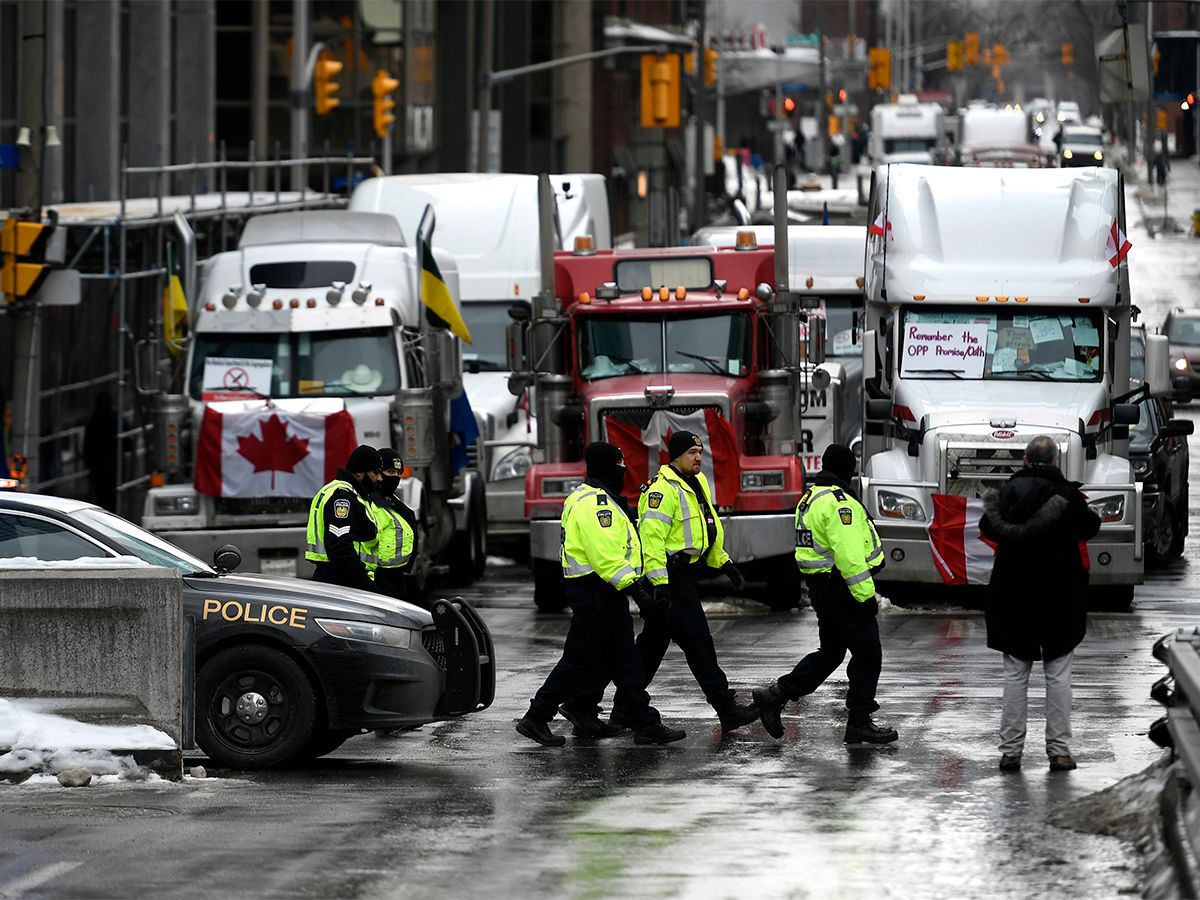
More famously, the trucker convoy that occupied downtown Ottawa in 2022 proved too much for the police to contain. Yet again, the police were reduced to bystanders — even though they had the means to deal with the lawbreaking.
Two years ago the Federal Court ruled that the federal government did not need the Emergencies Act to enforce the laws. Twenty years ago the rule of law was effectively suspended in Caledonia. Two hundred years ago police neglect prevailed during the Types Riot.
It’s a long story, and a sad one. Is it beginning to change in Toronto? There is reason to be sceptical. There is a lot of history to overcome.
National Post
The big issues are far from settled. Sign up for the NP Comment newsletter, NP Platformed
Postmedia is committed to maintaining a lively but civil forum for discussion. Please keep comments relevant and respectful. Comments may take up to an hour to appear on the site. You will receive an email if there is a reply to your comment, an update to a thread you follow or if a user you follow comments. Visit our Community Guidelines for more information.
Facts Only
Toronto police have announced they will no longer allow pro-Hamas, anti-Israel protesters to march through Jewish neighborhoods, though demonstrations will still be permitted on main streets.
Antisemitic harassment, including recent shootings at two Toronto synagogues, has targeted Jewish communities for over two years.
In 1826, the Types Riot involved law students and Family Compact associates ransacking William Lyon Mackenzie’s *Colonial Advocate* newspaper office, destroying its printing press and throwing lead type into Lake Ontario.
Authorities, including the attorney general, declined to press criminal charges after the Types Riot, leaving Mackenzie to pursue civil remedies.
During the 1990 Oka Crisis, Indigenous blockades led to a violent standoff, resulting in the death of a Quebec police officer and eventual federal land purchase to resolve the dispute.
In 2006, Indigenous protesters in Caledonia blocked a subdivision construction site, engaging in arson and property destruction while the Ontario Provincial Police largely stood down.
The 2020 railway blockades in British Columbia and Ontario continued despite court orders mandating police intervention.
The 2022 trucker convoy occupied downtown Ottawa for weeks, with police initially failing to enforce laws or judicial orders.
A 2022 Federal Court ruling stated the federal government did not need the Emergencies Act to enforce laws during the trucker convoy.
The 1997 APEC protests in Vancouver and 2010 G20 protests in Toronto saw aggressive police crackdowns on demonstrators.
Christie Blatchford’s book *Helpless* documented the government’s failure to govern during the Caledonia standoff.
The Toronto police’s new policy follows a long history of selective enforcement, often avoiding confrontation with determined protesters unless government interests are directly threatened.
Executive Summary
For over two years, pro-Hamas, anti-Israel protesters in Toronto have targeted Jewish neighborhoods with antisemitic harassment, including recent shootings at synagogues. The Toronto police have now announced they will enforce restrictions, barring protesters from residential streets while still permitting demonstrations on main thoroughfares. This shift follows prolonged inaction, leaving Jewish communities distressed by the lack of protection. Historically, Canadian law enforcement has shown reluctance to intervene in determined protests, from the 1826 Types Riot—where authorities ignored an attack on a reformist newspaper—to modern cases like the 2020 railway blockades and the 2022 trucker convoy, where police often stood down despite court orders. While exceptions exist, such as heavy-handed responses during the 1997 APEC and 2010 G20 protests, the pattern suggests a selective approach: aggressive enforcement when government interests are at stake, but passivity when property or marginalized communities are targeted. The recent policy change in Toronto may signal a shift, though skepticism remains given this deep-seated history of inconsistent policing.
The article contrasts Canada’s self-image of "peace, order, and good government" with repeated failures to uphold the rule of law, particularly when facing organized protests. Indigenous land disputes, such as the Oka Crisis and Caledonia standoff, saw violent escalation followed by government concessions rather than enforcement. Similarly, the trucker convoy paralyzed Ottawa for weeks before police acted, despite judicial mandates. The author argues this reflects a systemic reluctance to confront determined protesters, prioritizing de-escalation over legal consistency. Whether Toronto’s new stance marks a durable change or another temporary adjustment remains uncertain.
Full Take
**Steelman:** The strongest version of this narrative highlights a consistent pattern in Canadian policing: a reluctance to enforce laws against determined protesters, particularly when doing so risks escalation or political backlash. The author effectively traces this tendency from the 19th century to modern cases, showing how authorities often prioritize de-escalation over the rule of law—unless the protests threaten state power directly (e.g., APEC, G20). The recent shift in Toronto, while late, could signal a recognition that unchecked harassment crosses a line. The historical context lends weight to the argument that this isn’t merely incompetence but a systemic preference for avoiding conflict, even at the cost of justice.
**Pattern Scan:** The piece employs a **false framing** of binary choices (ARC-0024), implying that policing either means brutal crackdowns (APEC/G20) or total inaction (Caledonia, trucker convoy), with no middle ground. It also leans into **emotional exploitation** (ARC-0012) by framing the issue through the lens of Jewish distress and historical grievances, which, while valid, risks oversimplifying complex policing trade-offs. The repeated juxtaposition of Canada’s self-image with its failures could edge into **moral panic** (ARC-0015), though the historical examples are well-documented. The absence of counter-perspectives—e.g., police justifications for restraint or Indigenous grievances in Oka/Caledonia—hints at **selective framing** (ARC-0031), though the focus on policing consistency is fair.
**Root Cause:** The paradigm here is a tension between liberal democracy’s ideals (equal protection under law) and its practical limitations (fear of backlash, resource constraints, political calculations). The unstated assumption is that policing should be apolitical, yet the examples show it’s deeply entwined with power dynamics—enforcing order for elites (G20) but hesitating when marginalized groups or contentious causes are involved. This echoes broader debates about whose safety the state prioritizes.
**Implications:** For human agency, this pattern undermines trust in institutions, particularly for communities (Jewish, Indigenous, or otherwise) that feel abandoned by law enforcement. The costs fall disproportionately on those without political leverage to demand protection. Second-order effects include normalized lawlessness in protests and eroded faith in the rule of law as universal rather than conditional.
**Bridge Questions:**
If policing is inherently political, how can societies design accountability mechanisms to prevent selective enforcement?
What alternative models (e.g., community-based security, mediation) might address protest-related conflicts without repeating these failures?
Does the Toronto policy shift reflect a principled correction or a reactive patch for a specific group’s grievances?
**Counterstrike Scan:** A coordinated influence campaign pushing this narrative might amplify emotional triggers (antisemitism, Indigenous land rights) to polarize audiences, framing policing as either tyrannical or impotent to erode trust in institutions. The actual content doesn’t fully match this—it’s more a critique of systemic inconsistency than a manipulative attack. However, the lack of nuance around Indigenous protests (e.g., omitting context for Oka/Caledonia) could be exploited by bad actors to dismiss legitimate grievances. The piece stops short of that, but the pattern is worth noting.
**Patterns detected:** ARC-0024 False Framing (binary policing choices), ARC-0012 Emotional Exploitation (focus on Jewish distress), ARC-0031 Selective Framing (omitting Indigenous perspectives).