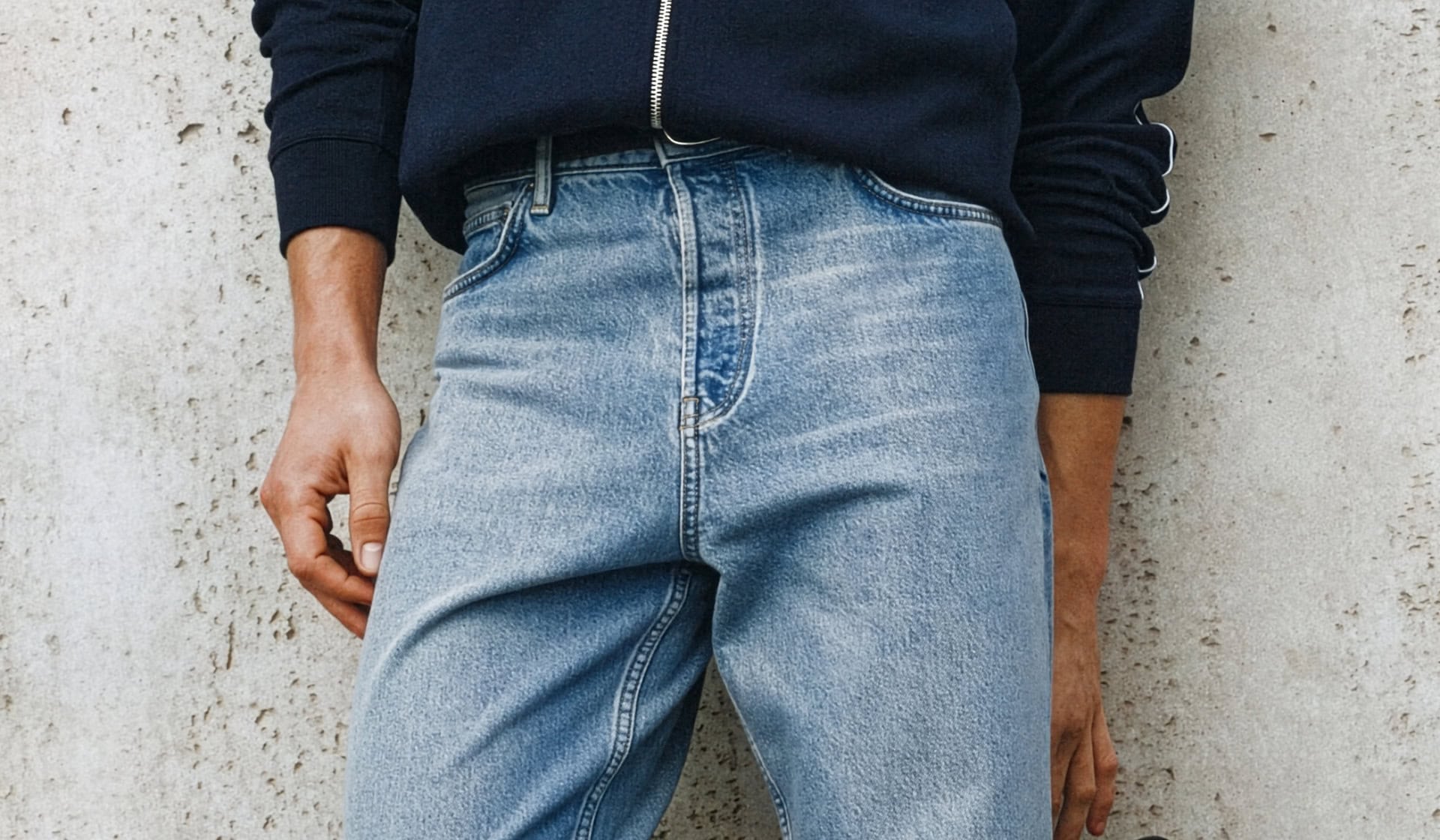
Denim jeans: the workhorse of every well-stocked wardrobe. They’re a smart casual staple, a weekend warrior, and everything in between. They’re trousers you bike to work in, the garment you reach for when nipping out on errands. They’ve even got your back in certain semi-formal settings, for which dress pants would be overkill.
Despite their everyday appeal, choosing the perfect pair shouldn’t be taken lightly. Get them right and they’re one of the most versatile pieces of clothing in a man’s wardrobe. Get them wrong, on the other hand, and you’re in Jeremy Clarkson territory.
But before you splurge on £400 Japanese selvedge, first consider that it’s possible to acquire high-quality denim for less than the cost of your mortgage. There’s plenty of variety on both the high street and online, provided you know where to look. Which is why we’ve decided to give you a rundown of our favourite spots for affordable denim.
Purchase Considerations
Fit
Fit is king when it comes to most garments, but with jeans it’s crucial. Take the time to find the right cut, whether that means spending extra minutes in the changing room, or ordering in a selection of sizes and fits when buying online. Straight is always your safe space, but if your frame requires it, you can go for a slim or relaxed leg. Avoid extreme fits if you value versatility and don’t want to look back on old photos and cringe.
Ensure the waist is snug, there’s movement in the leg and a balance of material around the thigh and shin. There shouldn’t be too much excess fabric bunching around the footwear, but legs can always be shortened or pinrolled accordingly. It’s also worth noting that raw denim should fit tight to the point of being almost uncomfortable in the waist and seat at first. This is to compensate for the fact that it will stretch out dramatically within the first few days of wear.
If you’ve settled on a style but can’t find the fit, a tailor is your best friend. There really is no excuse when it comes to fit.
Quality
You can tell straight away if a pair of jeans is worth it. Avoid anything with an unforgivable amount of elasticity, which often corresponds with denim that feels strangely thin. Of course, 100% cotton is ideal, but if you want some stretch, allow for 5% knocked off in exchange for a material that will give a little.
Look for straightforward stitching on the front and back with minimal branding. Rivets indicate strength in the jeans’ engineering, and it’s worth considering whether you want a button or zip fly. The former will last longer, but you can’t beat the ease of the latter when you’re caught short.
Wear and tear with well-worn jeans is unavoidable, so it’s good to know a new pair won’t break the bank.
The Best Brands For Affordable Denim
ASKET
No wardrobe can be considered complete without a pair of slim or straight, raw denim jeans. These indigo wonders may be uncomfortable initially, but stick with them and you’ll be rewarded.
Over time, they’ll mould to your body and develop their own individual fading, resulting in a pair of jeans that are totally unique to you.
This sort of thing doesn’t tend to come cheap, which is why Swedish basics label ASKET’s raw denim jeans – in quality 13oz Japanese heritage – are such a treat to both wallet and wardrobe, coming in at a third less than comparable versions on the market.
Arket
Purveyor of Scandinavian minimalism, Arket should be your first port of call if you’re looking for a tightly curated range of simple, high-quality denim jeans—there is such thing as choice overload, after all.
Its slim cotton-stretch versions are phenomenal value and come in a range of washes designed to complement the traditionally neutral-dominated male palette. They also do fantastic straight jeans in an organic and recycled cotton blend.
M&S
If it’s good enough for male model David Gandy, it’s good enough for us mere mortals. People may scoff at a brand aimed at a more mature audience, but if you’re in search of timeless, quality pieces with minimal branding, you can do much worse.
The selvedge M&S Collection, from the world-renowned Kurabo mill in Japan, is a steal. Perfect for wearing with a dark leather boot or Derby shoe.
Uniqlo
The one-stop shop for utilitarian, millennial style. Uniqlo’s range of denim is diverse and all-encompassing, with a wide selection of fits, styles and washes, tending to even the most niche of denim needs.
If slim isn’t your bag or your frame doesn’t allow it, try a pair of regular-fit Uniqlo jeans and a turned-up cuff. Be sure to check out the brand’s selvedge offerings – they tend to fly off the shelves, and for good reason: where else can you get real selvedge denim for under £40?
Carhartt
Denim was originally intended for blue-collar applications, and when it comes to workwear, few labels carry the same clout as Carhartt. The American brand has been doing its thing for over a century and has even branched out into contemporary, street-friendly staples through its Work In Progress (W.I.P) line.
Most styles are designed with a casual, low rise and tapered fit, making them a great weekend option. Team with rugged work boots and a sturdy chore jacket.
Levi’s
San Francisco’s Levi’s is a name synonymous with denim. If it hadn’t been for this pioneering label, jeans as we know and love them today would simply not exist.
Considering this, you might expect Levi’s offerings to be at the upper end of the pricing spectrum. However, the heritage label’s clothing is surprisingly affordable.
Take the 501, for example—an icon within the world of menswear—they can be yours for as little as £65.
GAP
There was a point when GAP became so big that it was easy to discount its products. But unlike many of the fast-fashion brands that followed it, you can still rely on quality materials and construction at GAP, and that certainly includes its denim.
With many of its jeans around £50 and under, that kind of price-to-quality ratio is hard to come by. The collection is unflashy, just a solid range of fits and washes with a few styles harking back to the brand’s heyday in the 90s and 00s.
Everlane
American brand Everlane prides itself on crafting timeless, modern essentials. Falling firmly within that remit are jeans – a garment that will slot seamlessly into any capsule wardrobe.
The trouble is, Japanese denim isn’t usually all that cheap. Still, thanks to Everlane, you can clad yourself in Nippon’s finest and still come away with some change.
Abercrombie & Fitch
Abercrombie & Fitch has come a long way from its logo-heavy past, and its denim offering is now one of the most quietly impressive on the high street. The focus is firmly on fit, fabric and wearability, with a range of cuts that feel current without tipping into trend-chasing territory.
There’s a strong emphasis on classic silhouettes, from relaxed straight-leg styles to clean slim fits, all made using sturdy cotton denim with just the right amount of structure. Washes are well judged too, covering everything from crisp rinses to properly worn-in fades that don’t look forced.
Prices sit comfortably in the accessible bracket, but the overall look and feel punches above that. If you’ve not checked in with A&F recently, now would be a good time to start.
Shop now at Abercrombie & Fitch
COS
COS approaches denim in much the same way it does everything else: clean, considered and quietly elevated. The brand sits a step above the typical high street, offering refined takes on everyday pieces with an emphasis on cut, fabric and proportion.
Jeans here lean towards more contemporary silhouettes, with relaxed, wide and softly tapered fits that feel directional without being difficult to wear. Fabrics are robust and well finished, while the washes stay firmly on the understated side, making them easy to slot into a minimalist wardrobe.
Prices are slightly higher than your average high-street fare, but the step up in design and quality is clear. If you like your denim simple, modern and a little more fashion-aware, COS is a solid shout.
Weekday
If you’re after affordable denim with a modern edge, Weekday is hard to ignore. The Swedish brand has built a reputation for delivering trend-aware fits at wallet-friendly prices without compromising quality too heavily.
Loose, straight and relaxed silhouettes are where it really excels, offering contemporary shapes that feel fresh but still wearable day to day. The denim itself is solid for the price point, with a good weight and structure that holds up well over time.
It’s not trying to be heritage or artisanal, and that’s part of the appeal. For well-cut, up-to-date jeans that won’t drain your bank account, Weekday more than delivers.
Facts Only
Denim jeans are a versatile wardrobe essential for casual and semi-formal wear.
Fit is crucial, with straight cuts being the safest option, though slim or relaxed fits may suit different body types.
Raw denim should initially fit tightly to account for stretching over time.
Quality indicators include 100% cotton or minimal stretch (5%), sturdy stitching, and rivets.
Button flies last longer, while zip flies offer convenience.
ASKET offers raw denim jeans made from 13oz Japanese heritage denim at a lower price than competitors.
Arket provides Scandinavian minimalist denim with slim and straight fits in organic and recycled cotton.
M&S offers selvedge denim from Japan’s Kurabo mill, favored by model David Gandy.
Uniqlo provides a wide range of fits and styles, including selvedge denim under £40.
Carhartt specializes in workwear-inspired denim with casual, tapered fits.
Levi’s 501 jeans are available for as little as £65.
GAP offers quality denim around £50, with classic fits and washes.
Everlane provides Japanese denim at accessible prices.
Abercrombie & Fitch has shifted to minimal branding and classic silhouettes in its denim line.
COS offers refined, contemporary denim with understated washes.
Weekday delivers trend-aware, affordable denim with relaxed and straight fits.
Executive Summary
Full Take
This article presents a consumer guide to affordable denim, framing quality and fit as paramount while showcasing brands that balance cost and craftsmanship. The strongest version of this narrative is its practical advice—emphasizing fit, fabric, and construction—paired with a curated list of brands that democratize access to well-made jeans. However, the piece leans heavily on brand endorsements without critical scrutiny of labor practices or sustainability claims, which could be seen as a form of borrowed credibility (ARC-0012). The focus on Scandinavian and Japanese denim, for example, implies superior quality without addressing the environmental or ethical costs of global supply chains.
The root cause of this narrative is the tension between affordability and perceived quality in fast-fashion culture. The article assumes that "high-quality" denim is inherently better, yet it doesn’t interrogate whether the pursuit of premium materials at lower prices might perpetuate exploitative production cycles. The paradigm here is consumerism as empowerment—buying "smart" within a system that still prioritizes profit over people.
Implications for human agency are mixed. On one hand, the guide empowers readers to make informed purchases; on the other, it reinforces the idea that self-worth is tied to owning "the right" jeans. Second-order consequences include the potential normalization of overconsumption, even if the products are slightly more durable.
Bridge questions: How do labor conditions in denim production align with these brands’ affordability claims? What trade-offs exist between cost, quality, and ethical sourcing? Would a focus on repairing or upcycling existing jeans be a more sustainable alternative?
Counterstrike scan: If this were part of a coordinated campaign, it might use subtle authority games (ARC-0012) to steer consumers toward specific brands under the guise of "expert" advice. However, the content doesn’t exhibit overt manipulation—it’s more a reflection of mainstream consumer journalism than a deliberate influence operation. The lack of critical engagement with sustainability or labor issues is notable but not necessarily malicious.
Sentinel — Human
The text reads as a human-written piece, blending objective consumer advice with subjective brand recommendations, demonstrating a natural, engaging editorial voice.