Support CleanTechnica's work through a Substack subscription or on Stripe.
In this article, I want to talk about the Iran war and its effects on the global auto industry.
I encourage you to read this excellent article by Jennifer Sensiba: “The April Oil Crisis Most Don’t Know is Coming.” The Strait of Hormuz has been closed since the start of the war, and recently, Yemen threatened to make the situation worse by closing down the other major trade route in the region, the Bab el-Mandeb Strait. I don’t have a crystal ball, so I can’t predict whether these issues will be resolved quickly or drag on for years like many wars in the Middle East have in the past. According to this article from the Federal Reserve Bank of Dallas, this disruption will impact 20% of the world’s oil supply and is 3 to 5 times larger than previous disruptions in 1973, 1979, 1980, and 1980. It predicts oil prices will rise to about $100 or so while the Strait of Hormuz is closed. If the Bab El-Mandeb Strait is also closed, another 4% of the world’s oil will be stopped. In observing many oil disruptions over the last 50 years, I’ve come to the following conclusions:
- Oil supply is inelastic in the short term but elastic in the longer term. In the short term, there is little oil producers can do to increase the output of their wells, but in the longer term, they can increase drilling substantially in response to higher prices.
- Oil demand has traditionally been inelastic in both the short term and the longer term. Why? Because in the past, there were few alternatives to oil. I think today, demand will still be pretty inelastic in the short term, but elastic in the long term. Around the world, electric cars, buses, and motorcycles have shown they can replace gas and diesel vehicles. Right now the penetration rate is very low, but I think that will change, as I discuss in the rest of the article.
- Consumers overreact to sudden price spikes and availability scares. I remember my father (at my insistence), tried to buy a diesel Volkswagen Rabbit in 1980 and it was difficult to find one since the Iran–Iraq war was causing gas prices to spike. That was resolved pretty quickly, but people remember high prices for a few years after the crises passes, then they forget about it and return to buying big trucks.
I will break down the situation by region as an update to this article I wrote two years ago on the global auto industry.
China
Chinese electric vehicle sales have been a bit soft in 2026 as they recover from the government reducing subsidies by about $5,000 a vehicle on January 1st, 2026. It is no secret that the Chinese auto industry has a great deal of overcapacity in both gas and electric vehicles. Their plan has been to solve this by increasing exports of all types of vehicles and also closing some factories. This has been going pretty well over the past year, and I agree with Michael Barnard that it is gaining momentum. So, Chinese automakers might be in the enviable position of having increased demand for electric vehicles both domestically and internationally due to higher oil prices. But their gas and hybrids will likely also be popular in areas without good charging infrastructure, simply because they offer good value to consumers.
United States
The United States EV market has been a roller coaster ride over the last year. Sales got a huge boost in the 3rd quarter as many rushed to get the $7,500 tax credit before it expired. Sales dropped considerably in the 4th quarter and first two months of this year as most people who had been considering a new electric car in the near term bought one in the 3rd quarter. Tesla announced its $5,000 cheaper Standard Model 3 and Model Y to a very lukewarm reception in the US (although it has been received more favorably in other parts of the world). Nissan introduced its new LEAF and Chevy released its improved Bolt and has offered excellent discounts on its Equinox EV. But even with improved models and big discounts, EV sales have been soft this year. As detailed in this article, search interest in electric vehicles has more than doubled in the last few weeks as the news of the Iran war has sunk in and people have noticed that gas prices have spiked a dollar in a month!
As sales of existing electric vehicles rise, the big question is whether US automakers like GM, Ford, and Stellantis will revive their plans to build improved EVs in the US or continue to bet on big trucks. Of course, the same applies to Toyota (which never had big EV plans), Honda, Nissan, and Subaru. I think Hyundai and Kia have done a better job of steering an even keel. Of course, Tesla continued to make electric cars through all this market chaos. It kept production high because it thought it would have unsupervised FSD ready. That hasn’t happened yet, but those electric cars will be more popular because of the higher gas prices.
Europe & The Rest Of The World
Europe will accelerate its move to electric vehicles. It will be less dependent on regulation and driven by market forces.
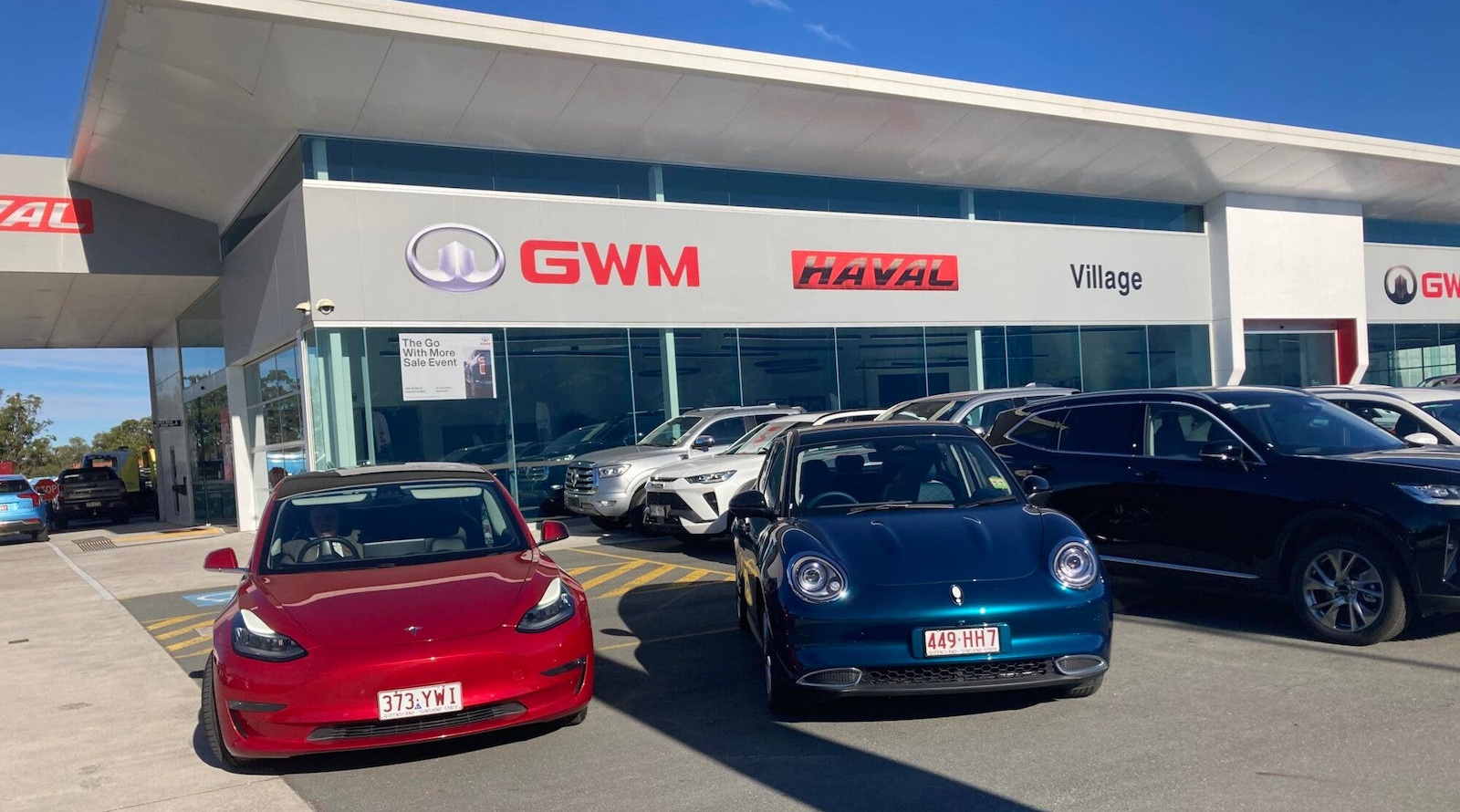
This story from Australia shows how many markets may dramatically increase their demand for electric cars. In countries that don’t have a domestic auto industry, people don’t get as much propaganda about how bad electric cars are by forces trying to sell gas cars and gas.
Conclusion
I don’t want to hope for a long war with Iran, because that will have many bad effects, but a small silver lining is it will encourage more sales of electric cars. Even if the conflict is quickly resolved, the big increase in prices and shortages will cause many people around the world to consider the savings and security of electric cars as opposed to being vulnerable to the price volatility of gas prices. Unfortunately, it will also encourage more oil drilling around the world, but if enough people transition to electric vehicles over the next 10 to 20 years, there won’t be much demand for that additional oil.
If you want to take advantage of my Tesla referral link to get up 3 months Full Self Driving, here’s the link: https://ts.la/paul92237 — but if another owner helped you more, please use their link instead of mine.
Disclosure: I am a shareholder in Tesla [TSLA] and XPeng [XPEV]. But I offer no investment advice of any sort here.
Sign up for CleanTechnica's Weekly Substack for Zach and Scott's in-depth analyses and high level summaries, sign up for our daily newsletter, and follow us on Google News!
Have a tip for CleanTechnica? Want to advertise? Want to suggest a guest for our CleanTech Talk podcast? Contact us here.
Sign up for our daily newsletter for 15 new cleantech stories a day. Or sign up for our weekly one on top stories of the week if daily is too frequent.
CleanTechnica uses affiliate links. See our policy here.
CleanTechnica's Comment Policy
Facts Only
Strait of Hormuz is closed since the start of the Iran war
Bab el-Mandeb Strait threatened to be closed
Disruption could impact 20% of the world’s oil supply
Oil prices may rise to about $100 per barrel while the Strait of Hormuz is closed
If both Straits are closed, another 4% of the world’s oil will be stopped
Chinese electric vehicle sales have been soft in 2026 due to government subsidy reduction
US EV market has experienced a roller coaster ride over the past year
Sales dropped considerably in the 4th quarter and first two months of this year after the expiration of tax credits
Tesla announced its $5,000 cheaper Standard Model 3 and Model Y to a lukewarm reception in the US
Nissan introduced its new LEAF and Chevy released its improved Bolt with excellent discounts
Executive Summary
In the article, the author discusses the potential impact of the Iran war on global auto sales, particularly focusing on electric vehicles (EVs). The closure of the Strait of Hormuz and the threat to close the Bab el-Mandeb Strait could disrupt 20% of the world's oil supply, causing oil prices to rise. The author suggests that this disruption could lead to increased demand for EVs, as consumers seek alternatives to gasoline vehicles due to higher fuel costs.
The article provides insights into the current state of the auto industry in China, the United States, and Europe, highlighting trends in electric vehicle sales, government subsidies, and manufacturer strategies. The author also shares personal observations about consumer behavior during past oil crises and predicts that demand for EVs will become more elastic over time as alternatives to gasoline vehicles become more widespread.
Full Take
Patterns detected: ARC-0024 Ambiguity (the article does not specify the duration of the Iran war), ARC-0036 Slippery Slope (the author suggests that increased oil prices will encourage more oil drilling around the world, which could lead to higher emissions and environmental damage).
The article presents a thoughtful analysis of the potential impact of the Iran war on global auto sales, particularly focusing on electric vehicles. By providing historical context and personal observations, the author offers insights into consumer behavior during past oil crises and predicts that demand for EVs will become more elastic over time as alternatives to gasoline vehicles become more widespread.
However, the article does not specify the duration of the Iran war, making it difficult to determine the severity and longevity of the potential disruption to global oil supplies. Furthermore, while the author acknowledges the environmental implications of increased oil drilling, they do not discuss potential solutions or alternatives to mitigate these impacts.
Questions for readers: What other factors could impact the demand for electric vehicles in the long term? How can governments and manufacturers work together to reduce emissions and promote sustainable transportation solutions?