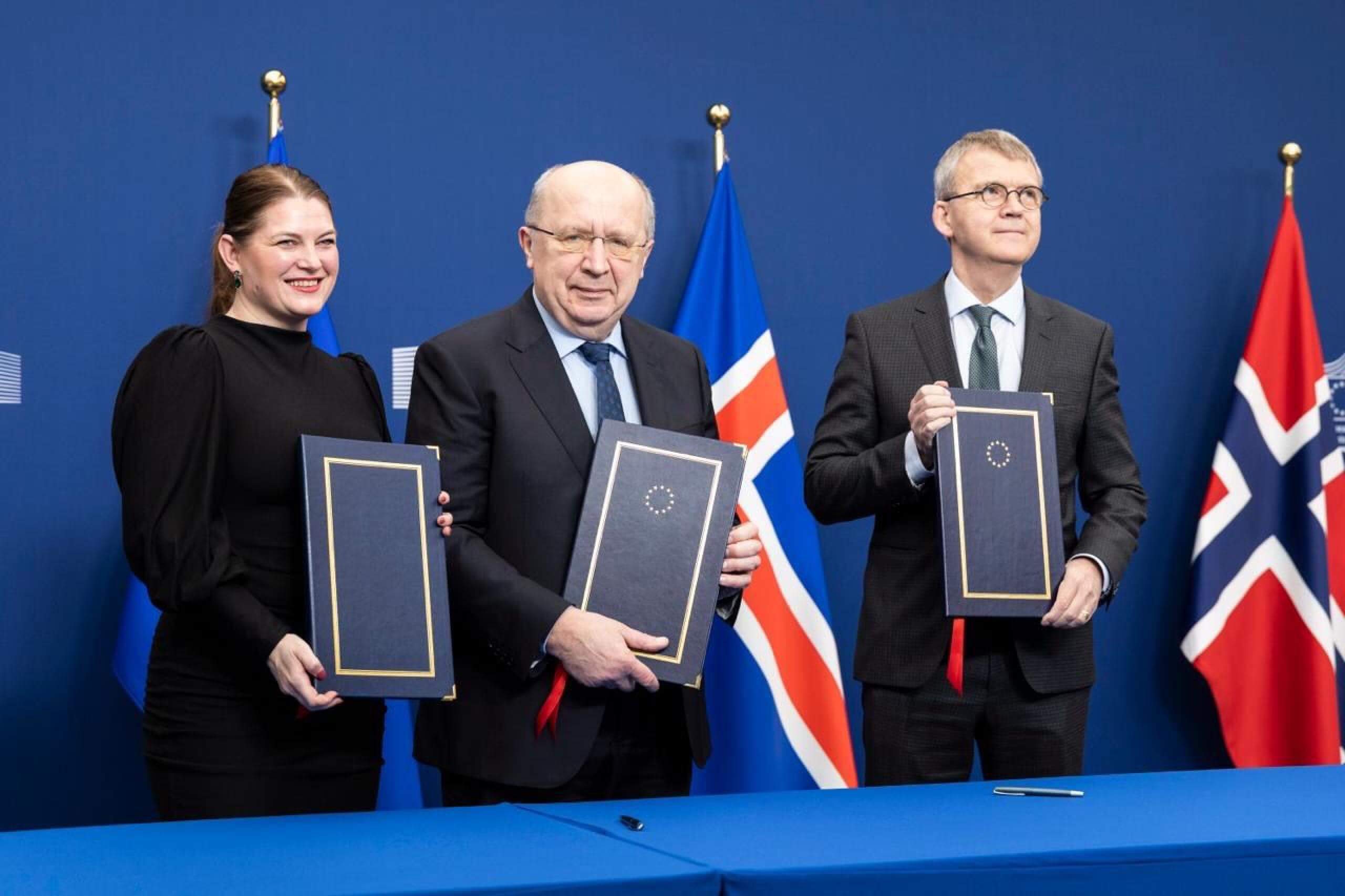
In a move to fortify European strategic autonomy and Arctic communication resilience, the European Union has officially signed an agreement with Norway and Iceland, integrating both nations into the EU’s flagship secure satellite programs.
You are currently viewing a placeholder content from Vimeo. To access the actual content, click the button below. Please note that doing so will share data with third-party providers.
More InformationYou are currently viewing a placeholder content from YouTube. To access the actual content, click the button below. Please note that doing so will share data with third-party providers.
More InformationYou need to load content from reCAPTCHA to submit the form. Please note that doing so will share data with third-party providers.
More InformationYou need to load content from Turnstile to submit the form. Please note that doing so will share data with third-party providers.
More Information
Facts Only
The European Union has signed an agreement with Norway and Iceland.
The agreement integrates Norway and Iceland into the EU’s secure satellite programs.
The move aims to fortify European strategic autonomy.
The agreement also seeks to enhance Arctic communication resilience.
Norway and Iceland are non-EU nations.
The EU’s flagship secure satellite programs are involved in the integration.
The agreement involves data-sharing considerations with third-party providers for embedded media content.
The embedded content includes Vimeo, YouTube, reCAPTCHA, and Turnstile.
Executive Summary
Full Take
**STEELMAN:** The EU’s integration of Norway and Iceland into its secure satellite programs is a pragmatic step toward bolstering European strategic autonomy, particularly in the Arctic—a region of increasing geopolitical and military importance. By leveraging the expertise and infrastructure of these NATO-aligned nations, the EU can enhance its communication resilience without over-relying on external actors like the U.S. or China. The move also signals a recognition of the Arctic’s role in global security, where secure satellite networks are critical for both defense and civilian operations.
**PATTERN SCAN:** The framing of this agreement as a win for "strategic autonomy" could subtly obscure the EU’s continued dependence on non-member states for critical capabilities. While the narrative emphasizes sovereignty, the reality is one of interdependence—raising questions about whether true autonomy is achievable without full internal control. The embedded media placeholders, which require data-sharing with third-party providers, introduce a minor but notable tension: the EU’s push for secure communications is juxtaposed with the casual surrender of user data to external platforms. This isn’t necessarily manipulative, but it highlights an unexamined contradiction in the broader narrative of digital sovereignty.
**ROOT CAUSE:** The underlying paradigm here is the EU’s attempt to navigate a multipolar world where technological and military dominance is increasingly contested. The assumption is that strategic autonomy can be achieved through selective partnerships, even if those partnerships dilute the very autonomy they seek to secure. Historically, this echoes Cold War-era alliances, where smaller nations were folded into larger defense architectures under the banner of collective security—often at the cost of some sovereignty.
**IMPLICATIONS:** For human agency, this agreement could mean greater stability in Arctic communications, benefiting indigenous communities, researchers, and military personnel alike. However, the costs may include deeper entanglement in EU defense structures for Norway and Iceland, potentially limiting their policy flexibility. Second-order consequences could involve heightened tensions with Russia or China, both of whom have Arctic ambitions, or even friction within NATO if EU-led initiatives are perceived as duplicating or undermining alliance efforts.
**BRIDGE QUESTIONS:**
If strategic autonomy requires external partnerships, at what point does the term lose its meaning?
How might this agreement reshape the balance of power between the EU, NATO, and Arctic Council nations?
What safeguards exist to ensure that secure satellite networks aren’t weaponized in ways that undermine the very resilience they’re designed to protect?
**COUNTERSTRIKE SCAN:** A coordinated influence campaign pushing this narrative might emphasize the EU’s strength and unity while downplaying the contradictions of relying on non-EU states. It could also exploit fears of Russian or Chinese Arctic expansion to justify further centralization of EU defense policy. However, the actual content doesn’t exhibit these hallmarks—it presents the agreement as a straightforward strategic move without overt emotional or distortive framing. The embedded media placeholders are the only element that could be weaponized (e.g., to normalize data-sharing as a trade-off for security), but this appears incidental rather than intentional.
Patterns detected: none