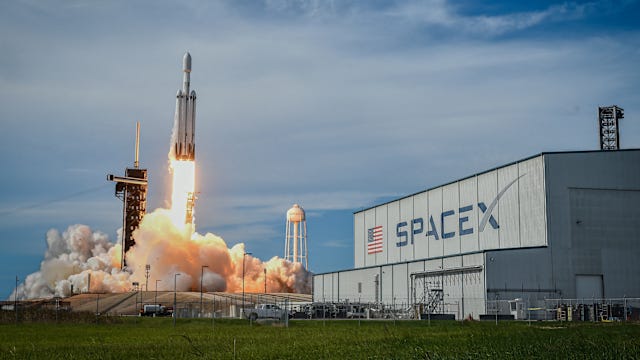
SpaceX IPO, TeraFab, Orbital compute, Elon Musk's promises have only just begun. Tesla to merge in 2027.
Good Morning,
With NASA’s Artemis II mission (April 1st to 11th, 2026) going around the Moon right now, there’s a lot of buzz for the aspirational Lunar economy that’s coming. But what does this have to do with AI?
From historic space missions to historic IPOs, SpaceX’s IPO and the inclusion of xAI and likely next year in 2027, Tesla merging into the company as well, is going be a sight to behold. This could also help fund Elon Musk’s AI and vast orbital datacenter ambitions.
The Space race has AI characteristics now. The race to energy, compute and new resources.
Why it Matters?
These three IPOs: SpaceX, OpenAI and Anthropic in the next year could help define the future of AI for the next decade.
The size of the IPOs and the hype behind them is unprecedented in the history of technology. The Elon Musk vs. Sam Altman story is about to get a lot more interesting.
I remember when it was a rarity for a company to be worth over $2 Trillion dollars (that wasn’t too long ago). And yet, SpaceX boosted its target IPO valuation above $2 trillion, Bloomberg News reported on Thursday. SpaceX with xAI is projected to generate only between $24 billion and $30 billion in total revenue for 2026. The bulk of that as of early 2026 is made by Starlink. That would suggest a price-to-sales ratio of easily over 64, more than twice Nvidia’s historical peak in 2024. That’s being optimistic. This would also mean SpaceX would be valued above every S&P 500 company except Nvidia, Apple, Alphabet, Microsoft, and Amazon.
Tesla likely to Merge with SpaceX Post IPO
If we assume Tesla will be merged into SpaceX in 2027, that could in theory be a company worth over $3 Trillion. Tesla’s market cap at the time of writing is still over $1 Tr. Then there are the stark ambitions of TeraFab, a mega $20–$25 billion joint venture between Tesla, SpaceX, and xAI, to create a massive, vertically integrated AI chip manufacturing factory.
SpaceX is aiming to raise approximately at least $75 billion in its initial public offering. SpaceX is targeting a June, 2026 IPO data, that will be tough to make that would put them around six months ahead of OpenAI likely in December, 2026 or early 2027. Anthropic is likely to IPO in November, 2026. Even as Elon Musk’s companies struggle to remain competitive, perhaps SpaceX has a role to play as some kind of a future catalyst.
The complexity and feasibility of both TeraFab and orbital datacenters at scale deserve their own deep dives and is way beyond the scope of this article. The magnitude of their vision dwarfs Tesla robotaxis and Optimus robots, neither of which have manifested in a timely fashion thus far.
The enormity of Musk’s projections for TeraFab, Orbital Datacenters, Humanoid robotics and a viable (“self-growing”) Lunar colony and Mars plans are truly from the dreams of which science fiction are made of. He’s not alone, as Blue Origin should IPO next year (2027 or early 2028) soon as well. The speculative nature of Elon Musk’s vision for SpaceX, that was founded in 2002, is not extremely realistic. This is not a startup, this is a 25-year first-mover rocket company that suddenly has a lot of moving parts. The proceeds of the June or later 2026 IPO of SpaceX will presumably fund the following:
Starship & Starlink Scaling
Orbital datacenters
xAI datacenters and compute
TeraFab
Scaling Optimus humanoid robots
A Lunar Colony / Outpost
The eventual colonization of Mars
SpaceX’s Y & Zs 💥
SpaceX’s IPO narrative is making Tesla robotaxis look like a walk in the park. With such lofty goals, SpaceX is surrounding itself with execution risks.
SpaceX IPO Valuation is going get some scrutiny, barely any ARR. A lot of debt, high cash-burn rates.
The valuation compared to Amazon is fairly nonsensical whether the IPO is $1.75 Bn. or more.
To give you a comparison though, Amazon also a $2 Trillion dollar company but made $717 Bn. in 2025, let’s say SpaceX will make $31 Bn. in 2026, that’s 23x less revenue for the same market cap? This while Amazon has AWS, advertising revenue and many other diversified streams including E-commerce, Third-party sellers, Subscriptions, etc… It’s not clear how SpaceX will ever make money as more rocket companies are becoming viable in even the next five years not just Rocket Lab. All of this while xAI burns at least $1 Bn. a month.
I teamed up with Matej Pretković from Croatia, who writes:
Cyclop SpaceTech
A research-driven Newsletter that explores early stage companies, startups, market trends, industry leaders and recent news in the space industry.
Cyclop SpaceTech provides:
In-depth analysis of companies and startups at all stages
Market and technology trend reports
Insights into emerging products and services
Connections to industry experts and thought leaders
Identification of the critical problems space tech must solve next
Matej Pretković is the Founder and CEO of Cyclop Corp, a Zagreb-based consulting and research company supporting the European space economy with independent research and investment facilitation for space-related startups.
The motto of xAI is to “understand the universe”, and we’ll learn a lot more about orbital datacenters in the lead up to this IPO in June or later. Blue and Starcloud have also applied to put a lot of satellites into space, among others.
Can a $75 Billion cash infusion make Tesla great again and turn SpaceX into an orbital compute giant with a terrestrial integrated Fab and enable it to become an energy & robotics leader in the 2030s and 2040s?
TeraFab looks like a fun idea on paper:
“Tesla, SpaceX, and xAI are launching the most epic chip-building effort ever - combining logic, memory and advanced packaging under one roof.” - says the TeraFab project
Elon Musk hopes the SpaceX IPO revenue can help fund orbital datacenters and the very expensive TeraFab projects. The U.S. Government is pushing corporations to make settlements and Fabs on the Moon before China. Presumably they will get funding help to do this.
Solar Arrays in Space ☀️
As global data-center power consumption (the energy for AI Infra) is expected to roughly double to nearly 1,000 terawatt-hours by the end of the decade, according to an estimate by the International Energy Agency, solar arrays in space, on the Moon, around the Moon beaming energy back to earth isn’t as crazy as it sounds. SpaceX might end up being more of an energy company with Tesla’s help than a rocket company as competition heats up. All of this presumably to power the future of AI as well.
SpaceX carries a lot of Debt and Expenses amid a Highly speculative Future 🌊
SpaceX has to carry a lot, X still carries roughly $12 billion in acquisition debt while making 35% less revenue as compared to 2022. TeraFab as a future project makes even less sense than most of Elon Musk’s projects. It was announced on March 21, 2026. A Full-stack Fab for orbital compute? The project is designed to bring every stage of chip manufacturing—design, lithography, fabrication, memory production, advanced packaging, and testing—under one roof to enable "recursive loops" of rapid iteration.
What would a SpaceX led lunar colony look like? If Elon Musk becomes Earth’s first Trillionaire I’m guessing he’ll want his space legacy to flourish. But what will be the price tag? Meanwhile xAI is being rebuilt in a massive pivot of its own. Tesla’s sales declined 14.3% from the previous quarter with deliveries only improving 6% from a year ago when the backlash for his politics had hit. Just two models, 3 and Y accounted for 97% of the company’s deliveries last year. From Optimus robots to a space-age full-stack Chips Fab, it always seems Elon Musk is starting over. The proceeds from the IPO will at least help with the mounting debt. But the specs look disorientating.
TeraFab is targeting 1 terawatt ($10^{12}$ watts) of total annual AI compute capacity. Targeting a node level of the 2-nanometer (2nm) process. A prototype facility is currently being built at Giga Texas in Austin, with a larger-scale facility planned for a yet-to-be-determined location. They ain’t no TSMC.
📚 Cyclop SpaceTech Articles:
If you enjoy speculating on the future of space and technology, check out some of the articles of the guest contributor:
The Rise of Data Centers in Space: Solving Earth’s Growing Digital Demand
Top 5 Emerging SpaceTech Trends to Watch in 2026
SpaceTech Stock Performance: Public Equities and Top Subsector Winners
Elon Musk’s SpaceX: The Triple Engine Behind Success
The 2026 Space Investment Landscape: Key Capital Shifts
What sectors of Space-Tech will be the most profitable for investors? How much will Aerospace companies of the future intersect with national defense?
Top Space-Tech Areas to Invest?
Analysts project the global space market will grow from approximately $630 billion in 2023 to over $1.1 trillion by 2030. With capital also coming from higher National Defense budgets Space-tech seems poised to have considerable geopolitical implications in the future of technology.
Space-Tech as the intersection of National Defense
"The Golden Dome" & Hypersonic Defense
Proliferated Warfighter Space Architecture (PWSA)
In-Space Infrastructure & Servicing
Satellite Data & AI-Driven Analytics
Satellite Communications
Lunar Economy & Deep Space Logistics
Aerospace National Defense: Tactically Responsive Space (TacRS)
Become a Paying Subscriber to Cyclop SpaceTech
If you consider thinking about this important, consider going deeper with the contributing writer’s expertise. Learn more about what to expect.
How Bullish are you on SpaceX’s Futuristic Ambitions? ⏳
Guys we still have the deep dive to get into:
SpaceX’s AI Endgame: Owning the Infrastructure Layer of Intelligence
By Matej Pretković, March, 2026.
The strategy is simple: don’t just join the AI race - own the infrastructure behind it.
1. SpaceX is becoming the infrastructure powerhouse of the 21st century
SpaceX is “quietly” becoming the defining infrastructure layer of the 21st century, as critical to the coming decade as fiber cables were to the 1990s internet boom.
In the past four months alone, the company completed the largest private merger in history, filed to launch one million orbital data center satellites, pivoted from Mars to the Moon in response to a $185 billion government defense program and confirmed an IPO targeting mid-2026 at a potential $1.5 trillion valuation.
SpaceX is not a company that AI is happening to. It is a company actively positioning itself as the physical stack on which the next phase of AI gets built.
The xAI merger, the orbital data center FCC filing and the Starlink global connectivity network are not separate bets. They are three parts of the same thesis.
Starlink is the revenue engine that funds everything else. Already the world’s largest satellite internet network with 9.2 million subscribers, it generated an estimated $10.4 billion of SpaceX’s $15 billion 2025 revenue.
Key metrics at a glance
Links: Sacra | Mid-2026 - FT/CNBC | Feb 2026 - CNBC
2. Starlink: the revenue engine that funds everything
Starlink is SpaceX’s cash cow. It overtook launch services as the largest revenue stream in 2023 and has not looked back. Understanding Starlink means understanding how SpaceX makes money today and where the margins are heading.
Subscriber growth and revenue trajectory
The business model is simple. Customers buy a terminal and pay a monthly subscription for connectivity access.
Starlink subscribers doubled for three straight years: 2.3 million end-2023, 4.6 million end-2024 and 9.2 million by end-2025. Currently it has more than 10 million as of March 2026.
The margin story
Starlink crossed into hardware profitability when terminal production costs fell below the $349 retail price. The path to higher margins runs through three levers: ARPU mix shift toward enterprise, next-generation V3 satellites via Starship and Starshield government contract scale.
Starlink’s structural moat
Every terrestrial ISP is constrained by geography. Starlink inverts this. Once the constellation is flying, the marginal cost of adding a new subscriber anywhere on Earth is essentially the terminal and acquisition cost. No new cable, no new tower.
Amazon’s Project Kuiper is years behind on constellation density and operational experience. No competitor can self-launch at SpaceX’s cost. That advantage compounds.
3. The xAI merger: what it actually means
On February 2, 2026, SpaceX acquired xAI in an all-stock transaction that CNBC confirmed as one of the largest private merger in history. SpaceX was valued at $1 trillion and xAI at $250 billion in the deal documents. The exchange ratio was set at 0.1433 SpaceX shares per xAI share.
What came with the deal
xAI owns Grok, one of the leading frontier AI models and operates the Colossus supercomputer in Memphis with over 100,000 Nvidia H100 GPUs - one of the largest AI training clusters ever assembled. The deal also brought X (formerly Twitter), giving the combined entity one of the largest real-time human interaction datasets globally. xAI burned approximately $9.5 billion in the first nine months of 2025 as it scaled.
Why this is different from other AI acquisitions
Most AI acquisitions are about buying talent. This one is about vertical integration across the entire AI stack. SpaceX brings what no other AI company has: a global connectivity network reaching every point on Earth and the only realistic near-term pathway to orbital compute infrastructure.
The combined entity is building the backbone that sits beneath all AI systems globally. Connectivity, compute and data, owned end to end.
The Tesla connection: partial, not yet complete
Tesla announced in Q4 2025 that it invested $2 billion to acquire preferred stock in xAI. In March 2026, FTC filings confirmed Tesla received regulatory clearance to convert that investment into a minority stake in SpaceX, estimated at less than 1 percent. A full Tesla-SpaceX merger remains a medium-term possibility, not an imminent event.
4. Orbital data centers: the long game
On January 30, 2026, SpaceX filed an application with the FCC for authorization to launch up to one million satellites for an Orbital Data Center system. Musk stated that within two to three years, the lowest cost way to generate AI compute will be in space.
The terrestrial data center problem
AI data centers consumed approximately 415 TWh of electricity globally in 2024, or about 1.5 percent of global electricity consumption. The IEA projects that figure to more than double to 945 TWh by 2030. Microsoft spent $37.5 billion on data center capital expenditures in Q4 2025 alone.
Why space solves the core constraints
Solar panels in low-Earth orbit receive roughly 1,400 W/m² depending on latitude and conditions of unobstructed sunlight versus 200 to 600 W/m² at the Earth’s surface. Waste heat radiates passively into a near-absolute-zero vacuum radiated via large thermal surfaces, though heat rejection remains a key engineering constraint. There are no zoning fights, no utility negotiations and no water bills.
Orbital compute could become cost-competitive with terrestrial facilities around 2035, assuming Starship scales to 180 launches per year.
Orbital data center development timeline estimate
The technical challenges
SpaceX’s distributed approach sidesteps the central cooling problem by spreading compute across a million smaller satellites rather than concentrating it. A one-tonne satellite generating 100 kW of compute needs roughly 41 to 71 square metres of combined solar and radiator panels, which sits within existing engineering practice.
The harder problem is hardware obsolescence. An H100 GPU launched in 2026 would be three generations behind by 2032. SpaceX’s implicit answer is continuous replacement, which transforms the obsolescence problem from an engineering challenge into a cost problem. Whether Starship can launch at the required cadence is the central uncertainty.
SpaceX’s historical execution on launch cadence is the clearest leading indicator. Falcon 9 scaled from under 20 launches in 2017 to over 90 launches in 2023, becoming the highest-frequency orbital launch system in history.
If Starship follows a similar S-curve, reaching 100+ annual launches in the early 2030s is not unprecedented - it is a continuation of an already demonstrated operational playbook.
The FCC filing is less a deployment plan and more a regulatory land-grab. Securing orbital spectrum rights today that will matter enormously in 2033 to 2040.
5. Golden Dome and the lunar pivot: defense shapes the roadmap
In early February 2026, SpaceX shifted its stated near-term priority from Mars to the Moon. Days later, a White House executive order called for a missile shield prototype by 2028. Both moves tracked closely with where the defense contracts are going.
What Golden Dome actually is
Golden Dome is the Trump administration’s layered missile defense shield, announced in May 2025. President Trump cited an initial cost of $175 billion and a three-year target. In March 2026, Pentagon director Gen. Michael Guetlein revised the official estimate to $185 billion after adding space capabilities. The FY2026 defense appropriations bill included $13.4 billion for space and missile defense systems.
SpaceX’s Golden Dome contract pipeline
The lunar pivot: defense in disguise
The Artemis Human Landing System contract already gave SpaceX a multi-billion dollar stake in lunar infrastructure. The executive order’s requirement for a 2028 prototype demands rapid orbital deployment capability that only Starship can eventually provide at scale. When both dominant new-space companies pivot to the Moon in the same fortnight, the defense contracts are the most plausible explanation.
6. The tech optimist case: what if it all works?
Every serious investment analysis should include a scenario where the bull thesis plays out in full. Not as a prediction, but as a way of understanding the upside that investors are buying. For SpaceX at a $1.5 trillion IPO target, this is worth examining carefully.
The tech optimist case is not about one thing going right. It is about a flywheel where each part accelerates every other. Starlink funds Starship. Starship enables orbital compute. Orbital compute powers AI at planetary scale.
Starlink reaches 50 million subscribers by 2032
There are roughly 1.4 billion broadband subscribers globally, nearly all in areas already served. There are approximately 4 billion people outside reliable broadband coverage. If Starlink reaches 50 million subscribers by 2032 at $100 average monthly ARPU, that is $60 billion in annualized subscription revenue.
Add enterprise, maritime, aviation and government and the total Starlink business could exceed $80 billion per year. At a conservative 15 times revenue multiple, that implies a Starlink standalone valuation exceeding $1 trillion.
Starship achieves operational scale by 2028
At 150 metric tons to LEO and a target cost below $200 per kilogram, an operational Starship would be categorically different from anything that exists today. It enables next-generation Starlink V3 satellites too large for Falcon 9, orbital compute infrastructure at commercial scale and lunar propellant depots that change deep-space economics permanently.
xAI becomes a top-3 frontier AI provider
In the optimist case, the combination of Colossus compute scale, X social media data, Starlink physical-world sensor data and unique orbital use cases allows xAI to develop capabilities that purely terrestrial AI labs cannot replicate.
The commercial value of a planetary-scale physical-world AI system, in agriculture, energy, logistics, defense and climate, is not easily bounded. It is the kind of capability governments and major corporations would pay extraordinary prices to access.
What this means for AI as a whole
Intel owned the CPU layer for two decades. AWS owns the cloud layer today. The question for SpaceX is whether it can own the orbital connectivity and compute layer for the AI era. If the optimist case plays out, SpaceX becomes the AWS of orbit and the applications running on its infrastructure represent capabilities not currently possible.
Tech optimist scenario: revenue and valuation bridge
In December 2025, a secondary sale valued SpaceX at $800 billion. In February 2026, the xAI merger created a combined entity valued at $1.25 trillion. The Financial Times reported the IPO could target $1.5 trillion with up to $50 billion raised. Bloomberg has more recently insinuated a $1.75 or $2 trillion with up to $75 billion raised.
The four variables to watch post-IPO
Investors buying the IPO are not buying today’s earnings. They are buying a probability-weighted option on the entity that owns the orbital infrastructure layer of the AI economy. Four variables will tell you whether that option is converging or diverging:
• Starship launches per year. The entire thesis accelerates or stalls on this single number.
• Starlink subscriber growth quarter-on-quarter. Some project 18.4 million by end-2026. If it slows materially, the revenue multiple compresses.
• FCC orbital compute regulatory progress. Spectrum allocation and approval timelines are the gatekeepers.
• xAI model benchmark trajectory. If Grok falls behind GPT-5 class models, the AI thesis weakens materially.
If all four are trending positive by end of 2026, the optimist case is building. If two or more are stalling, valuation pressure will be real.
7. Risks and counterarguments
A balanced analysis requires an honest look at the risks. Some are manageable. Some are structural. The merger and the approaching IPO have added new ones.
Risk - Level - Detail and Source:
Here is the text version of the above graph in case it’s easier to read:
IPO valuation
HIGH
At $1.5T, SpaceX prices in extraordinary future success. Multiple compression would be severe if orbital compute takes 15 years, not 3.
Starship execution
HIGH
Orbital compute, lunar pivot and defense launch pipeline all depend on Starship reaching operational cadence. Scaling from test flights to 180/year is a massive challenge.
Key-person / political risk
HIGH
42 Congress members formally asked the DoD IG to review Musk’s Golden Dome involvement citing conflict of interest. European and Asian markets show political reluctance.
xAI integration
MED
Two xAI co-founders (Jimmy Ba, Tony Wu) departed shortly after the merger. Merging fast-moving AI lab culture with aerospace engineering discipline is genuinely hard.
Competition
MED
Blue Origin is flying. Rocket Lab is profitable and growing. China launched 65 orbital missions in 2024. The monopoly position will erode.
Orbital debris / regulation
MED
A 1M satellite FCC filing drew immediate criticism from astronomers and space law experts. Regulatory pushback could constrain the orbital compute vision.
xAI burn rate
MED
xAI burned ~$1B/month pre-merger. Combined entity cash burn is non-trivial even after SpaceX’s estimated $8B 2025 profit.
8. The integrated thesis
SpaceX in March 2026 is a fundamentally different company than the one most investors are still analyzing. In the past four months: it completed the largest private merger in history, acquired a social media platform and AI lab, filed to launch one million orbital data center satellites, pivoted from Mars to the Moon in response to a $185 billion defense program and confirmed an IPO targeting mid-June 2026.
The integrated thesis holds together across every layer. Starlink provides the revenue engine and operating leverage. Launch services provide the infrastructure monopoly. Golden Dome provides a guaranteed government revenue stream bipartisan, large and tied to national security. The xAI merger provides the AI compute and data layer. The lunar pivot provides near-term Starship development milestones. Orbital data centers provide the long-duration optionality that justifies a technology multiple rather than an infrastructure multiple.
Every layer of this business reinforces every other layer. That is the definition of a flywheel. The question is whether the valuation already reflects it.
Thanks to Matej Pretković. If you find it easier to read in a Google Doc go here. For consulting contact Cyclop Corp.
Contact Matej on LinkedIn.
The U.S., China, Europe and India are likely heading for the same future.
The flurry of Space-Tech IPOs in 2026 and 2027 shifts the capability plans for Nation States building in Space, including eventual lunar bases and Martian colonies as well as elsewhere in the solar system.
Lunar
Ceres
Mars
Titan (Saturn)
Europa or Enceladus
Thanks for reading! At a certain point I’ll make a short-list of the best Newsletter related to Space and Space-tech coverage globally.
Addendum
Some of my field notes that are related to SpaceX and some of its future:
How much will SpaceX actually raise?
SpaceX is reportedly aiming to raise between $40 billion and $80 billion (with $75 billion cited as a common target). We’ll know more likely in June, or around 8-12 weeks from now. For context, the previous global record for an IPO raised was $29 billion set by Saudi Aramco in 2019. As of April, 2026 the time of writing, SpaceX is pitching a valuation between $1.75 trillion and $2 trillion+ though nothing is finalized.
Much of the projects are speculative and extremely capital intensive:
Where the Funds are Going
The capital is expected to finance “high-intensity” infrastructure projects that go beyond traditional rocket launches int some kind of unified trans-Earth industry:
Space-Based Data Centers: A major strategic shift to host AI compute in orbit to solve terrestrial cooling and power constraints.
Starship & Starlink Scaling: Continued mass production of Starship and the next generation of the Starlink constellation.
Lunar Manufacturing: Funding for “Terafab” projects aimed at establishing industrial capabilities on the moon.
Dwarkesh Interview
Elon Musk – “In 36 months, the cheapest place to put AI will be space”
Dwarkesh Patel really had a fun interview with Elon back in I’d like to say February, 2026 (though it could have been taped earlier).
Competition
Every aspect of SpaceX’s business will have active operational rivals from Starlink, space rockets, to humanoid robots and AI. Eventually from China as well.
The Reusability Challengers (Heavy-Lift)
Not counting Chinese or international rocket companies:
Blue Origin
Rocket Lab
Relativity Space
Stoke Space
Competitors to Starlink
Since Starlink is the main way SpaceX makes revenue, we have to understand what threats it is facing:
Amazon Project Kuiper (commercially often called "Amazon Leo")
AST SpaceMobile
China's Qianfan (Thousand Sails) (Chinese-State backed)
Competitors to xAI
Google
OpenAI
Anthropic
DeepSeek
Zhipu AI (z.AI)
Meta AI
Alibaba Qwen
ByteDance
Moonshot AI
Mistral
How likely is Tesla to Merge with SpaceX?
April 2026 consensus suggests that analysts and observers see a moderate-to-plausible chance (20-50%+) within 2-5 years, particularly around 2027. I personally think this is part of the master-plan of the immediate future before 2030.
Creating a full-stack AI, energy and space rocket play almost necessitates it to pay for all the debt, R&D and new projects.
Synergies and shared vision: Tesla’s AI & robotics (like: Optimus, Tesla Robotaxis, Fabs) could integrate with SpaceX’s Starship for Mars missions, orbital data centers, and space-based AI infrastructure.
Elon Musk already funds his other projects with his current projects. For example in late January, 2026 Tesla said that it agreed to invest about $2 billion into Elon Musk's xAI. This is not normal. He also often brings talent from one company to another.
In my opinion there’s a 50-70% chance that Tesla will be part of SpaceX by 2029.
The "Terafab" Project: In March 2026, Musk announced a $25 billion joint venture between Tesla and SpaceX to build advanced chip fabrication facilities. This is the obvious “tell” that Tesla’s days as a separate entity are numbered. This project will obviously cost way more than the listed $25 Billion as well.
Will xAI ever scale to match OpenAI, Anthropic and others?
Musk formed xAI in 2023 as a potential rival to OpenAI. But it hasn’t grown either in a B2C or B2B sense or in LLM capability as expected thus far. Talent retention has been a problem with many pivots. It hasn’t scaled revenue for well and it faces increasing competition (relatively poor marketing timing).
xAI’s primary strategy for matching OpenAI and Anthropic is compute dominance. I think we learned in the last six months for xAI that compute is not enough! It sounded good in theory: the Colossus 2 supercluster in Memphis has reached a massive 1.5-gigawatt power capacity as of March, 2026.
xAI’s ability to bring data centers online in months—rather than years—is its greatest competitive edge however its lacklustre product execution and lack of differentiation is startling. I do like Grok’s voice AI capabilities (for what’s it’s worth). Despite the massive $20 billion Series E funding secured in January 2026, xAI is struggling pre 2027. There’s no other way to put it. Grok 5 is likely six to nine months behind Anthropic, Google and OpenAI and possibly behind China as well. xAI lags in algorithmic efficiency, enterprise trust, top AI researcher talent, talent retention, product focus and many multiple other domains. And it’s only going to get harder to keep up.
In 2026, xAI like many others are shifting more to a B2B and Government Enterprise AI approach to future development afar making limited inroads in its B2B approach with the Grok chatbot vs. OpenAI or even Google. However, so are OpenAI, Cursor, Meta, ByteDance, Alibaba and others. Obviously Anthropic is a leader in Enterprise AI with best in class frontier coding and agentic LLMs.
SpaceX in Infographics
SpaceX Revenue is nearly totally Starlink Dependent
The merging of xAI has significantly Increased the SpaceX Valuation and Future Thesis
We expect Tesla to merge with it as well in the coming years and most likely in 2027 itself.
While Tesla Sales are down, App use is Up
Tesla app hits 8.9M monthly active users in Feb 2026. Source.
80% of SpaceX's valuation has been created in the last 12 months
Notes Philipp Kloeckner, source.
SpaceX IPO could usher in an era of Trillionaires?
Mass Confusion over the IPO Valuation Persists
That Amazon Leo is a significant Starlink competitor adds fuel to the criticism. Blue Origin will have no choice but to IPO soon after SpaceX.
SpaceX’s rockets can carry payload to space much more cheaply than the competition - but for how much longer? China is getting better at reusable rockets.
The lead between SpaceX and Blue Origin is likely to narrow and Blue might be ahead in R&D on orbital compute designs and research (as I have covered).
The number of Space Rocket Launches is about to rise dramatically post 2026
The first mover advantage of SpaceX looks impressive now but soon all of this changes as more rocket companies achieve scale.
Facts Only
SpaceX plans an IPO in June 2026, targeting a valuation between $1.5 trillion and $2 trillion.
Starlink, SpaceX’s satellite internet service, has over 10 million subscribers and generated $10.4 billion in 2025 revenue.
SpaceX acquired xAI in February 2026 in a deal valuing xAI at $250 billion and SpaceX at $1 trillion.
TeraFab is a $25 billion joint venture between Tesla, SpaceX, and xAI to build advanced AI chip manufacturing facilities.
SpaceX filed with the FCC in January 2026 to launch up to one million satellites for orbital data centers.
Tesla’s potential merger with SpaceX is speculated for 2027, with Tesla currently holding a minority stake in SpaceX.
The U.S. government’s Golden Dome missile defense program, budgeted at $185 billion, is influencing SpaceX’s pivot toward lunar infrastructure.
SpaceX’s Starship rocket is central to scaling orbital compute, lunar missions, and defense contracts.
Competitors include Blue Origin, Rocket Lab, Amazon’s Project Kuiper, and China’s state-backed space initiatives.
xAI’s Grok AI model and Colossus supercomputer are key assets in SpaceX’s AI strategy, though xAI faces challenges in talent retention and model performance.
The global space market is projected to grow to $1.1 trillion by 2030, with increased defense and commercial investments.
SpaceX’s 2026 revenue is projected at $24–30 billion, primarily from Starlink, with a price-to-sales ratio exceeding 64.
Executive Summary
SpaceX is positioning itself as a central player in the emerging AI infrastructure landscape, with ambitious plans to integrate orbital computing, advanced chip manufacturing, and global connectivity. The company's upcoming IPO, potentially valuing it at $1.5–2 trillion, is expected to fund projects like TeraFab (a $25 billion joint venture with Tesla for AI chip production) and orbital data centers, which aim to address terrestrial power and cooling constraints for AI. Starlink, SpaceX’s satellite internet service, is the primary revenue driver, with 10 million subscribers and $10.4 billion in 2025 revenue. The acquisition of xAI, valued at $250 billion, merges AI capabilities with SpaceX’s infrastructure, while Tesla’s potential merger in 2027 could further consolidate Musk’s ventures. However, challenges include high cash burn rates, regulatory hurdles for orbital projects, and competition from rivals like Blue Origin and Amazon’s Project Kuiper. The narrative hinges on SpaceX’s ability to execute on Starship’s launch cadence, Starlink’s growth, and xAI’s AI development, all while navigating political and financial risks.
The broader context includes a space economy boom, with the global space market projected to grow from $630 billion in 2023 to $1.1 trillion by 2030. SpaceX’s strategy aligns with national defense priorities, such as the U.S. government’s $185 billion Golden Dome missile defense program, which could accelerate lunar infrastructure development. Critics question the feasibility of orbital data centers and the sustainability of SpaceX’s valuation, given its reliance on speculative future revenue streams. The interplay between commercial ambitions, geopolitical competition, and technological innovation will shape whether SpaceX can dominate the AI infrastructure layer or face setbacks from execution risks and market pressures.
Full Take
The strongest version of this narrative presents SpaceX as a visionary infrastructure powerhouse, uniquely positioned to dominate the AI era by integrating orbital computing, global connectivity, and advanced manufacturing. The acquisition of xAI and potential Tesla merger suggest a vertical integration strategy that could redefine AI’s physical and computational layers. Starlink’s revenue growth and Starship’s launch capabilities provide tangible foundations for these ambitions, while government defense contracts add a layer of guaranteed demand. The orbital data center concept, though speculative, addresses real constraints in terrestrial AI infrastructure, such as power consumption and cooling. If executed, this could give SpaceX an unassailable moat in the AI economy.
However, the narrative also exhibits patterns of **ARC-0024 Ambiguity** and **ARC-0043 Motte-and-Bailey**. The valuation metrics are stretched—comparing SpaceX’s $30 billion revenue to Amazon’s $717 billion while justifying a similar market cap strains credibility. The orbital data center vision is framed as inevitable, yet the technical and economic feasibility remains unproven. The repeated pivots (Mars to Moon, Tesla’s shifting priorities) and xAI’s struggles suggest execution risks are understated. The piece also leans on **ARC-0012 Appeal to Novelty**, treating orbital compute as a revolutionary solution without sufficient scrutiny of alternatives or failure modes.
Root cause: This narrative reflects a Silicon Valley paradigm of "move fast and break things," where audacious visions justify extreme valuations and debt loads. The unstated assumption is that first-mover advantage in space-based AI infrastructure will outweigh execution risks, regulatory hurdles, and competition. Historically, this echoes the dot-com bubble’s overvaluation of infrastructure plays—except here, the infrastructure is literal rockets and satellites.
Implications: If successful, SpaceX could centralize control over AI’s physical layer, raising questions about monopolistic power and geopolitical dependencies. If it fails, the fallout could destabilize multiple sectors, from satellite internet to AI development. The second-order consequences include accelerated militarization of space (via Golden Dome) and potential resource conflicts over lunar and orbital assets.
Bridge questions: What if orbital data centers prove economically unviable despite technical feasibility? How might regulatory bodies respond to a single entity controlling both AI compute and global connectivity? What alternative models for decentralized AI infrastructure exist, and why are they absent from this discussion?
Counterstrike scan: A coordinated influence campaign would amplify the "inevitability" of SpaceX’s dominance while downplaying execution risks and competitors. The actual content aligns partially with this pattern—emphasizing vision over viability—but stops short of outright manipulation. The piece acknowledges challenges (e.g., xAI’s burn rate, Starship’s scaling hurdles), which mitigates the risk of bad-faith framing. However, the valuation comparisons and orbital compute timelines warrant skepticism.
Patterns detected: ARC-0024 Ambiguity, ARC-0043 Motte-and-Bailey, ARC-0012 Appeal to Novelty