Do you really, really, really like the ocean?
Do you like it so much that you would spend multiple days living on the seafloor in a structure that is part laboratory, part dormitory, and part diving vessel?
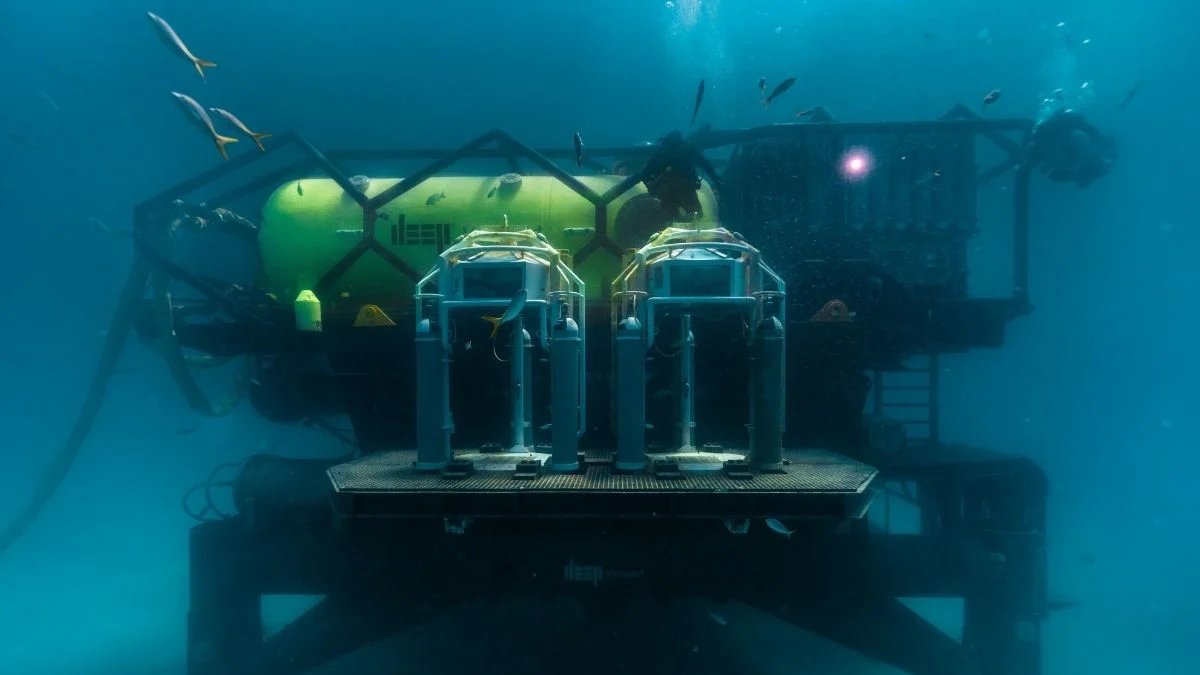
Soon, a crew of 'aquanauts' will do exactly that, inhabiting the first iteration of Vanguard, a short-term stay subsea habitat designed by ocean engineering company DEEP.
This is not the first time humans have experimented with ocean-floor living, but it's the first time DEEP – a private company founded in 2021 – has enabled it.
Vanguard is a pilot for their much more ambitious project, Sentinel, which the company claims will enable "both short-term and semi-permanent deployments anywhere on the continental shelf" by 2027.
Vanguard, which has been installed on a fixed platform at Tennessee Reef in the Florida Keys National Marine Sanctuary, 17 meters (56 feet) underwater, can house up to four crew members at a time.
ScienceAlert spoke to DEEP's director of scientific research, Dawn Kernagis, who will be one of Vanguard's first crew members.
Kernagis's research focus is human physiology in extreme environments, especially as it relates to the brain and nervous system.
She was previously a crew member on NASA's NEEMO 21 undersea habitat mission, so she is no stranger to undersea living.
For scientists, spending continuous time at depth for research does offer some perks.
"We want to expand subsea habitation for broader humanity," – Dawn Kernagis, DEEP director of scientific research
For instance, bringing samples to the surface has always been a bugbear for marine biologists: the rapid change in pressure wreaks havoc on a specimen.
"When a sample gets brought to the surface, it decompresses. So now, whatever the molecular signature is, whatever the cell signature is [that you're looking at in the sample], it's really related to that decompression process, right? So you're not really seeing what that sample was like at depth," Kernagis explained.
"We're really excited about being able to revisit a lot of that science, and create this new opportunity for being able to process samples in near-real time, at depth."
Vanguard is also equipped with sensors that take continuous measurements of underwater conditions, even when humans aren't present.
Those pressure conditions are a big part of human life aboard Vanguard, too, where inhabitants will essentially be living in a pocket of submerged air, at almost the same pressure as the surrounding ocean.
Essentially, Vanguard is one big decompression chamber that controls the internal pressure, and its inhabitants, saturation divers.
"It's like you've been SCUBA diving for a really long time, and your tissues and your blood gets saturated with nitrogen, the inert gas that you're breathing," Kernagis said.
"That kind of diving has been around for a long time… essentially, once you're saturated, you could stay down there for weeks, months at a time."
Crew members can leave the habitat on an 'umbilical' – a cord that pumps air from the Vanguard's supply, rather than a SCUBA tank – which allows for dives outside the structure lasting several hours, rather than the typical 60-minute limit to traditional recreational diving.
When they first arrive at Vanguard, transported via mini-submersibles, the crew and the habitat itself are 'compressed', with pressure controlled to match conditions outside. But after the crew enter, the vessel is closed off, and its contents, air and crew included, go through a gradual decompression.
"You're essentially 'ascending'… you're still on the bottom but the pressure inside that vessel is being reduced until it gets to the equivalent of the pressure we're living at here on the surface," Kernagis explained.
After a night of decompression, Vanguard is re-compressed to pressure just above the levels outside, and then the divers can jump right back in the ocean via the habitat's 'moon pool': a kind of downwards doorway open directly to the seafloor.
Crew members will be in contact with an onshore base 24/7, via satellite communications. A generator on a buoy at the surface provides power; fresh water is supplied to a tank, not recirculated. Sewage and wastewater are captured and removed.
Habitats like Vanguard have great scientific potential, but there are many other possible applications.
DEEP's project partners offer some hints at other commercial interests: the Unique Group, for instance, is a subsea tech and engineering company that services the oil and gas, renewable energy, and defense sectors, while Bastion Technologies services American aerospace, oil and gas, and defense industries.
"There's a long history of using subsea habitats on the defense side of things," Kernagis said.
"One of the things we're really interested in looking at is human machine teaming. So, for example, how do divers in the water intersect with robots, whether there's autonomous underwater vehicles or remote underwater vehicles."
Another of DEEP's partners, Triton Submarines, is more focused on the recreational and commercial side of undersea living, which hints at the potential tourism applications of DEEP's technology.
Related: US Scientist to Live Underwater For 100 Days in Record-Breaking Experiment
"We want to expand subsea habitation for broader humanity," Kernagis told ScienceAlert.
She lists artists, historians, students and educators as potential future inhabitants.
"I think also politicians, that would be great, right? To give them that exposure of what's beneath the surface of the ocean."
For now, however, Vanguard's primary purpose is scientific research, to monitor the reef in which it is situated, and the crew who inhabit it.
"We're really working hand-in-hand with the National Marine Sanctuary to make sure that it's not just us putting the habitat down, but they're also seeing the maximum use of that habitat for science and restoration purposes," Kernagis said.
This article was fact-checked by Clare Watson and edited by Peter Dockrill. While we pride ourselves on our process, we are only human. If you spot a mistake, please let us know.
Facts Only
* Vanguard is a short-term stay subsea habitat designed by DEEP.
* The project is a pilot for the Sentinel project.
* Vanguard is installed at Tennessee Reef in the Florida Keys National Marine Sanctuary.
* Vanguard is 17 meters (56 feet) underwater.
* Vanguard can house up to four crew members.
* Dawn Kernagis is the director of scientific research at DEEP and a future crew member.
* Kernagis's research focus is human physiology in extreme environments, particularly the brain and nervous system.
* Researchers seek the ability to process samples at depth, avoiding decompression effects.
* Vanguard functions as a decompression chamber controlling internal pressure.
* Crew members use an umbilical for dives lasting several hours instead of standard recreational limits.
* The habitat maintains saturation pressure similar to the surrounding ocean.
* Surface support includes satellite communication, power from a surface buoy, and waste removal systems.
Executive Summary
Full Take
Sentinel — Human
The text reads like well-researched journalistic reporting that effectively synthesizes technical and speculative information through expert testimony.