Art & Exhibitions
Rarely Seen Botero Works Spotlight His Overlooked New York Years
'Botero in New York' at Sotheby's explores how the city helped shape the artist's sensual style.
Fernando Botero left his indelible mark on New York, in the 14 monumental sculptures that lined Park Avenue in 1993, as well as the Adam and Eve statues that still stand at the entrance to Time Warner Center. But the city also left its imprint on the Colombian master. A new exhibition is uncovering how Botero’s years in New York helped cultivate the visual language that would become his signature.
“Botero in New York” is the first exhibition at Sotheby’s Breuer headquarters to be dedicated to a single artist. Organized in partnership with the Botero family, the non-selling show brings together more than 20 rarely seen paintings and sculptures from his archive and other private collections, many of which are going on view in New York for the first time. In particular, it will trace the development of “Boterismo,” the artist’s singular style defined by voluminous forms that evoke strength and sensuality.
“There is a particular resonance in presenting this project in New York,” Anna Di Stasi, Sotheby’s global head of Latin American art, told me over email. “Botero arrived in the city at a moment when abstraction dominated the conversation around contemporary painting. His response was not simply to reject that world, but to develop another way of being modern through figuration, scale, surface, and the reworking of art-historical sources.”
The Village Years
The Botero that landed in New York in the late 1950s was already a roving man. From his native Medellín, he had sailed for Europe at age 20 on a voyage funded by his first solo show in Bogotá. He studied at the Academia de San Fernando in Madrid, visited the Louvre in Paris, and immersed himself in the Renaissance greats in Florence. To make ends meet, he sold his copies of works by Diego Velázquez and Francisco Goya on the streets.
In New York, Botero settled in Greenwich Village, a neighborhood already populated by Beat poets and abstract painters. One fateful day in 1961, he happened to encounter Dorothy Miller, the first professional curator at the Museum of Modern Art, in his building. Though Miller was there to visit another artist, she left with Botero’s Mona Lisa, Age Twelve (1959).
The acquisition opened doors for Botero in the city and beyond. His circle grew to include French gallerist Claude Bernard, Swiss art dealer Ernst Beyeler, and Marlborough Gallery’s Pierre Levai. At the same time, his art thrived: Botero produced works such as Pope Leo X (After Raphael) in 1964 and The Presidential Family in 1967, developing his voluptuous figures and flat colors so that they harbored sharp critique, wry humor, and emotional weight.
Remarkably, even as Abstract Expressionism and Pop thrived in the city, Botero remained devoted to figuration. Though his style made him “a leper” amid the “dictatorship of abstract art” by his admission, he persisted—and prevailed. His debut exhibition at Marlborough in 1972 sold out. “I just make paintings and sculptures the way I like,” he told Artforum in 1985.
“He made figuration itself the site of radical invention,” Di Stasi said. “He remained committed to recognizable subjects, but transformed the way bodies, objects, and space behaved within the picture.”
New York Revisited
The artist’s distinctive visual language garnered him a solid collector base in his lifetime and his market has grown more international since his death in 2023. According to the Artnet Price Database, auction sales of his work reached an all-time high of $53.8 million in 2024, the same year in which his auction record was set at Christie’s for the $5.1 million sale of his 1979 picture, The Musicians.
The Sotheby’s exhibition offers selections from his formative New York period that reveal the genesis of this style. Among the earlier works are Mona Lisa, Age Thirteen (1959), a close cousin of the canvas that MoMA acquired, and Apotheosis of Ramón Hoyos (1959), an ode to the Colombian cyclist that features Botero’s rare engagement with abstraction. The artist’s bold reimagining of art history shows up: Sunflowers (1977) renders Vincent van Gogh’s choice subject newly rotund, while Still Life with Watermelon (1965) injects zesty color and volume into the Spanish still life tradition.
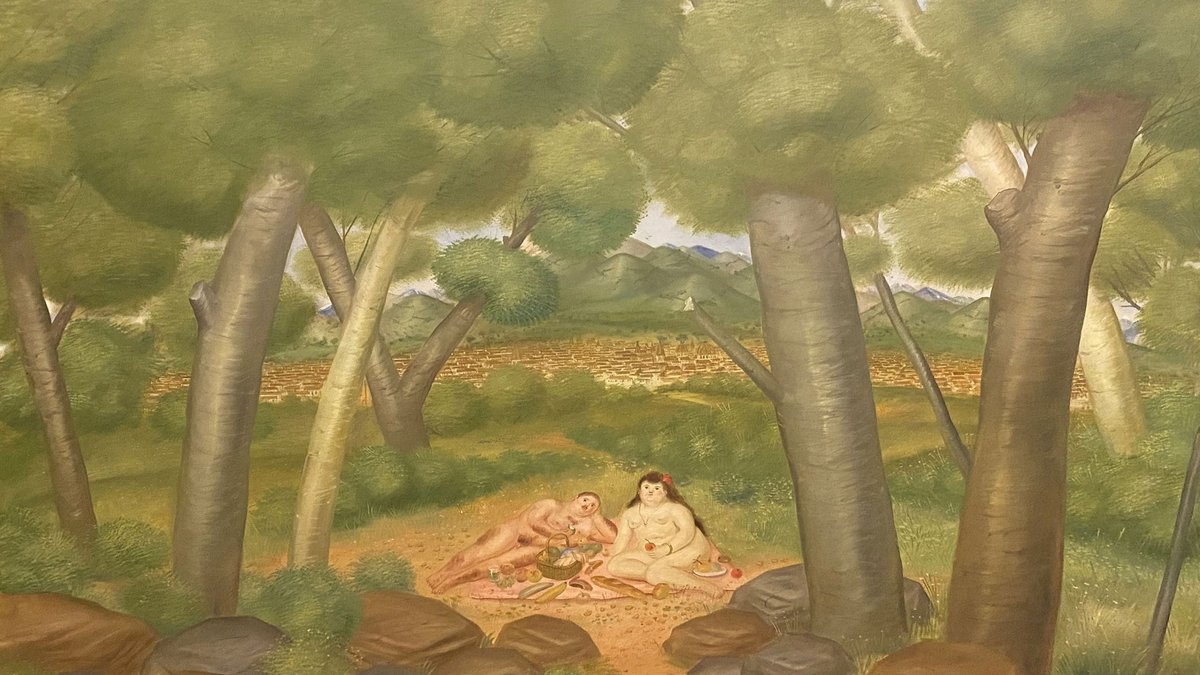
Picnic (1973), meanwhile, is making its public debut. Set in a verdant woodland, the scene is centered on two Boterian nudes reclining on a mat, the contents of their picnic basket neatly depicted. It’s a low-key nod to Édouard Manet’s Luncheon on the Grass (1863), the tranquil scene giving way to more layered reflections of class and manners.
The collective effect of these works, Di Stasi said, challenges the notion that Botero’s style appeared overnight and remained unchanged. Instead, the exhibition presents a glimpse of “a young artist testing, revising, and consolidating a visual language.”
“Botero in New York” is on view July 22–September 7 at Sotheby’s New York, 945 Madison Ave, New York.