On July 5, Venezuelan Independence Day, locals in the city of La Guaira are worn down by deep sadness in conversations crowded with questions about the well-being of relatives and acquaintances. Almost 200 buildings in this state capital collapsed after twin earthquakes struck on June 24, and now locals, often family members of the missing, pick through the rubble of collapsed apartment buildings.
They have almost no heavy equipment to work with. The recovery is continuing primarily by hand with rudimentary tools.
Hope for finding more survivors is just about gone now. Most of the search-and-rescue teams that had arrived from around the world in the immediate aftermath of the earthquakes have returned to their home countries as the search for survivors transitions to an effort to recover the dead.
More than 10 days after experiencing twin earthquakes of magnitudes 7.2 and 7.5, Venezuela is still reeling.
The capital city of Caracas and the state of La Guaira bore the brunt of the damage. La Guaira is a small but economically important coastal state, located 40 minutes by car from Caracas. It includes the country’s main international airport and seaport, as well as public and private housing by the Caribbean Sea.
By July 7, the death toll, still rising, had reached more than 3,500 people, with 16,000 injured and 18,000 displaced. The Venezuelan government has so far not released an estimate on the number of people who remain missing, but Tom Fletcher, the United Nations emergency relief coordinator, said on June 29 that a number as high as 50,000 was “terrifyingly plausible.”
According to satellite imagery from NASA, at least 58,000 buildings across Caracas and La Guaira metro areas have been destroyed or damaged. An initial assessment by the U.N. Office for Disaster Risk Reduction estimates direct physical damage to housing and infrastructure across Venezuela at $37 billion.
When not clearing debris, La Guaira’s survivors devote some time each day to finding food and water at aid centers set up by international humanitarian groups and the Venezuelan government across the city.
El pueblo salva al pueblo
One of the local survivors is Alexis Omaña, 50. His apartment building in Caraballeda, a city in central La Guaira State, completely collapsed. But in a stroke of luck, he and his family had gone to a family party in Caracas on the day of the earthquakes, a decision that saved their lives. The Omaña family has found shelter in temporary housing in Caracas.
Since the day after the quakes, Mr. Omaña has been going back and forth on his motorbike between the shelter site and his former home. He has been assisting local and international urban search-and-rescue teams pull surviving neighbors out of the rubble and organizing fellow volunteers into work teams.
He speaks warmly about the fast response the city received from the international rescuers, including a team from the United States who worked at his collapsed apartment building, and about the courage of fellow volunteers from his community. A popular saying in Venezuela is: El pueblo salva al pueblo (“The people save the people”).
But like many others in Venezuela, Mr. Omaña could not speak as kindly about the performance of Venezuelan government officials. “They did nothing,” he says bitterly.
His exasperation with the government and the leadership of President Delcy Rodríguez is a sentiment widely shared by other Venezuelans on social media.
Mr. Omaña has survived other disasters in La Guaira, including deadly mudslides in 1999 at the beginning of the Hugo Chávez presidency. But “this is the worst we have experienced,” he says.
Despite that history and with desolation all around him, Mr. Omaña has no intention of abandoning his community. “I love La Guaira,” he says. “I was raised here…. We have to start over again.”
Other local people who accompanied Mr. Omaña are wondering how to deal with their damaged homes, but more immediately they are concerned about how to get food and water for their families. “We have no jobs now,” one explains.
The earthquakes rumbled across a country already grappling with a years-long humanitarian crisis, as Caritas Internationalis, the church’s global relief network, has reported. Venezuelans have struggled through years of economic turmoil and decline. The nation’s health care system is in shambles.
Venezuelans have yet to realize any appreciable social or economic improvements since the Trump and Rodríguez administrations re-established a working relationship in the aftermath of a U.S. raid on Caracas in January. That military intervention removed Nicolás Maduro from the presidency and left sales from the nation’s oil industry under the control of the White House.
When the earth trembled and high-rises in Caracas and La Guaira collapsed, the government was unable to deploy heavy machinery sufficient to the level of the catastrophe.
With a government response absent in many communities, average Venezuelans around the country stepped up to fill the humanitarian void. National solidarity has been evident in the line of private cars and trucks filled with donations moving along the Caracas-La Guaira highway.
Handwritten signs on car and truck windows offer “Ayuda Humanitaria” (“Humanitarian Aid”) or “Free Wi-Fi.” Hundreds of other fundraising and aid delivery initiatives have been created online. Many are led by members of the vast Venezuelan diaspora; an estimated 8 million Venezuelans left the country for other nations in Latin America and the United States as the Chavismo era exhausted itself.
Making education a priority
This solidarity also infuses Catholic efforts to respond to the disaster in Venezuela. Fe y Alegría (“Faith and Joy”), a well-known and well-regarded education and social movement, was founded by José María Vélaz, S.J., in a working-class neighborhood in Caracas in 1955. The now-global movement is the largest Jesuit-run educational network in the world, serving more than 700,000 students across 22 countries and three continents.
Each Fe y Alegría school is more than a collection of classrooms for the often impoverished urban and rural communities they serve. The movement is “about the people,” says José Gregorio Terán, S.J., the general director of Fe y Alegría in Venezuela.
Nineteen Fe y Alegría schools suffered significant damage in the twin earthquakes, according to the latest numbers from the organization. Some students and staff remain unaccounted for, and many others have completely lost their homes.
Fe y Alegría Simón Bolívar, in Caraballeda, is one of the most affected schools. With 600 primary and secondary students, it has become an emergency shelter for the surrounding community.
Sadly, 11 students and three teachers remain among the missing. “The earthquake is felt within,” the school’s director, Leonardo Suárez, told visitors.
Fe y Alegría’s emergency response is focused on damage assessment, psychosocial and pastoral accompaniment for staff and students, and ensuring that services and supplies are restored in affected schools. A longer-term strategic plan for recovery in Venezuela is being crafted by Fe y Alegría’s directors. It will include reassessing needs at schools that escaped direct damage from the earthquakes.
Fe y Alegría was already struggling through some of Venezuela’s pre-existing conditions, trying to address low salaries and the continuing loss of teachers to emigration. With the country staggered by hyperinflation, the official minimum wage for Venezuelan public sector workers remains frozen at the equivalent of $1 each month.
Workers rely on bonuses and adjustments from the government that get actual monthly wages up to $240, an income still far below the cost each month for a basic basket of goods. Currently, a Fe y Alegría teacher’s income can reach $350 per month after adding non-salary bonuses from the local Ministry of Education and from private donors.
Many Venezuelans rely on remittances from abroad or “gray market” income. As much as 80 percent of the population has been reduced to poverty.
Father Terán hopes to see education and health services elevated to first-level priorities in any plan for Venezuela’s long-term recovery. “The Venezuelan government must think really [critically] about where to place its interests,” he tells America. “Oil and energy investment can provide immediate returns, but if education does not get the same priority level, [social] costs will be much higher in the future. It is not just a moral issue, but a strategic one.”
The Xavier Network connects Jesuit relief and economic development efforts and mission offices across North America, Europe and Australia. It has launched a global emergency appeal for the Society of Jesus’ efforts in Venezuela, including Fe y Alegría, Jesuit Refugee Service-Venezuela and others, in coordination with the local province.
“Funds are reaching people who need them, quickly and accountably,” says Nate Radomski, the executive director for American Jesuits International, one of the key partners in the Xavier campaign. (The campaign’s progress can be tracked through the Fe y Alegría Venezuela official website.)
Keeping schools open and functioning are especially important after disasters like the twin earthquakes. “They provide psychological support for children,” Mr. Radomski says, “They provide protection, and they provide support for parents.”
The Venezuelan Catholic Church, the largest religious denomination in the country, is stepping up as the institutional force behind a nationwide collection and distribution of humanitarian relief through Caritas Venezuela. It also, of course, continues to offer spiritual consolation through the calamity.
“We can be tempted to think this was an act of wrath,” says Father Terán. “But God does not send any earthquakes. He is the one who brings us closer to life.”
“We believe in the Resurrection”
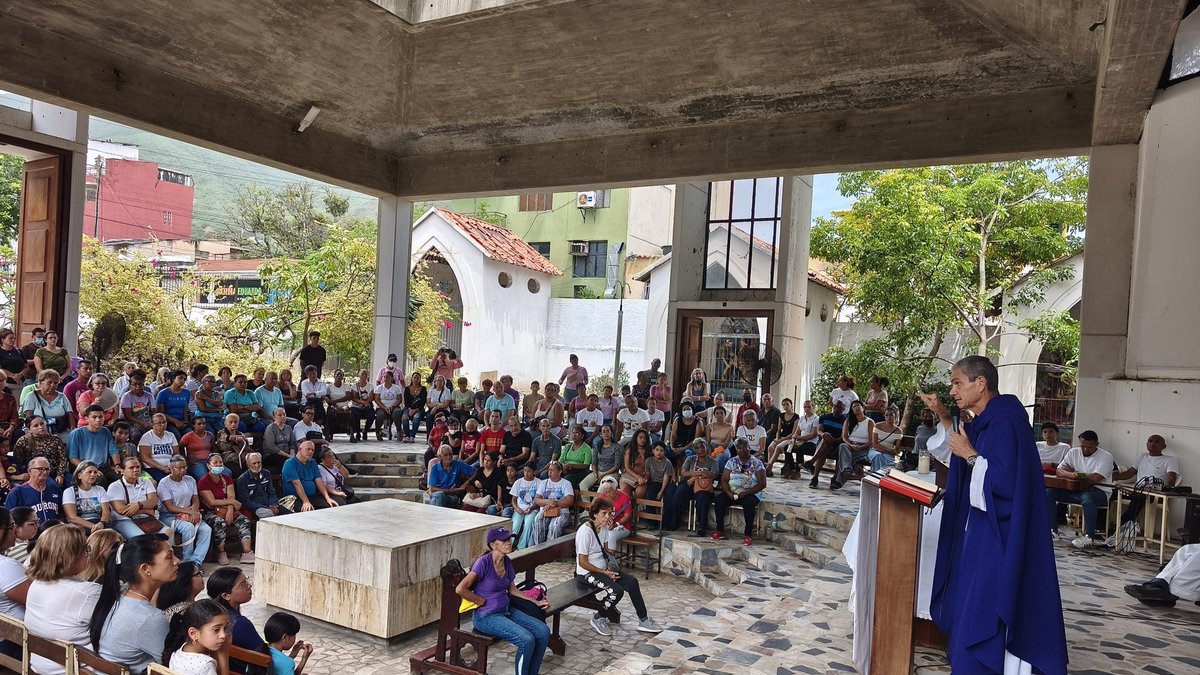
The entire facade of San Sebastián church, located in Maiquetía, a La Guaira barrio, collapsed during the quakes, but fortunately there was no loss of life at the church, its pastor, Father Rafael Troconis, reported. But many parishioners lost friends and family as their homes fell around them. They were commemorated during Masses celebrated in a nearby public square on July 5.
The Gospel for the day was the story of the raising of Lazarus (Jn 11:1-37). “The Son of God does not remain indifferent or impassive to suffering because God chose to suffer and chose to give meaning to suffering,” Father Troconis told his parishioners during his homily. “There are people who have sacrificed whole days digging, sometimes with their hands.”
“That pain has been worth it so that a person could be found or perhaps so that a family might at least find the body of their loved one…. But the story does not end there because three days later the most important event in history took place: Jesus rose.”
“Death will not have the last word in the lives of people, in our lives, my brothers and sisters,” Father Troconis said. “We believe in the Resurrection.”
Find out how you can help Venezuela’s recovery by visiting the American Jesuit International Urgent Call for Venezuela, Catholic Relief Services or Caritas Internationalis.
Facts Only
* Twin earthquakes occurred on June 24 with magnitudes of 7.2 and 7.5.
* Approximately 200 buildings collapsed in La Guaira.
* The death toll reached more than 3,500 people by July 7.
* 16,000 people were injured and 18,000 displaced.
* Satellite imagery showed at least 58,000 buildings across Caracas and La Guaira metro areas were destroyed or damaged.
* The U.N. Office for Disaster Risk Reduction estimates direct physical damage to housing and infrastructure across Venezuela at $37 billion.
* Search and rescue teams from around the world returned as the focus shifted to recovering the dead.
* Alexis Omaña's apartment building in Caraballeda, La Guaira State, collapsed.
* Surviving residents are currently seeking food and water at aid centers.
* Nineteen Fe y Alegría schools suffered significant damage.
Executive Summary
Full Take
The narrative presents a collision between catastrophic physical reality and the failure of systemic support, which is then mediated through localized acts of resilience and institutional response. The focus shifts from immediate search-and-rescue to long-term societal decay, highlighting a profound disconnect between state capacity and human need. The contrast between the local experience—where community members organize for survival and express direct frustration toward official leadership—and the distant, high-level economic figures (like the $37 billion damage estimate) reveals a critical failure in governance where macro-statistics obscure micro-suffering.
The pattern observed is the channeling of profound collective trauma into tangible acts of localized solidarity, exemplified by the "El pueblo salva al pueblo" sentiment and the work of groups like Fe y Alegría. This suggests that when formal institutional structures fail to provide safety or basic needs, social capital and communal networks become the primary, immediate mechanisms for survival and dignity. The context deepens the implication: economic stagnation, prior humanitarian crises, and political instability create a brittle environment where reliance on state support is superseded by reliance on neighborly bonds and transnational aid networks. Furthermore, the framing that posits a choice between prioritizing immediate economic returns (oil) versus long-term social investment (education/health) reflects a systemic dilemma where short-term strategic incentives consistently override necessary social provisioning for human security.
Bridge Questions: What mechanisms can be developed to ensure that post-disaster recovery funding is deployed immediately and effectively at the local level, bypassing bureaucratic delays? How can institutional frameworks be redesigned to integrate community-led resilience efforts rather than operating in parallel to them? If international aid remains largely external, what internal social contracts must be renegotiated to sustain collective action during protracted crises?
Sentinel — Human
The text reads like a detailed journalistic report blending hard facts about the earthquake aftermath with deeply contextualized, emotionally charged accounts of community resilience and systemic failures in Venezuela.