(Kinshasa) – The authorities in the Democratic Republic of Congo are increasingly harassing and arbitrarily detaining journalists, activists, and political opposition members, Human Rights Watch said today.
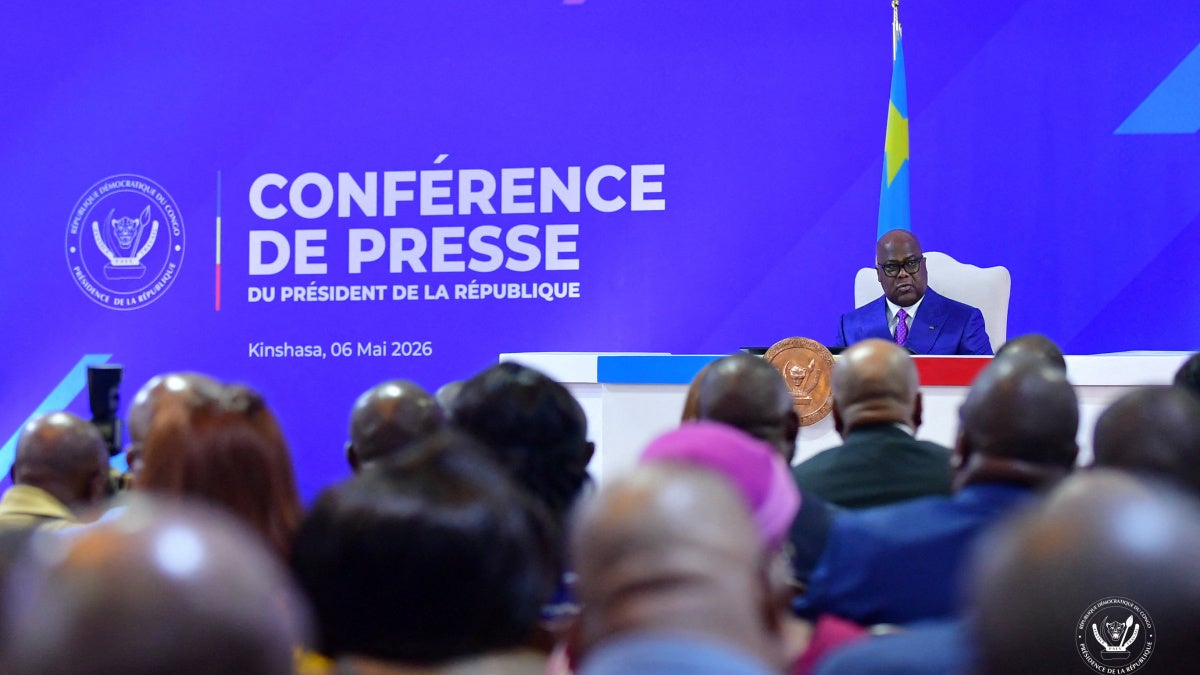
The clampdown on critical voices has occurred amid the Rwandan-backed M23 armed group’s occupation in eastern Congo and political tensions surrounding a potential constitutional amendment through which President Félix Tshisekedi may seek to extend his presidency beyond the two-term limit. Tshisekedi most recently raised the constitutional revision during a nationally televised news conference on May 6, 2026.
“Congolese citizens have the right to express their opinions and concerns without fear of repression, but doing so is becoming increasingly difficult,” said Philippe Bolopion, executive director of Human Rights Watch. “Congolese authorities should end their restrictions on the rights to free speech and protest and ensure that everyone in Congo can express their peaceful views without facing harassment, arbitrary arrest, or detention.”
Between January and May 2026, Human Rights Watch interviewed six civil society representatives, eight opposition activists, and two journalists in Congo about growing restrictions on the rights to freedom of expression and peaceful assembly.
On March 24, police in the capital, Kinshasa, fired tear gas and used violence against protesters peacefully demonstrating against proposed constitutional changes, according to media reports and representatives of the opposition party Commitment for Citizenship and Development Party (Engagement pour la Citoyenneté et le Développement, or ECiDé), who were at the protest.
Two ECiDé representatives said that police arrested 15 opposition members and protesters and took them to the Matete district police station, where they released 5 and transferred the others to the prosecutor's office. The 10 were released the following evening.
Two journalists said that they had to go into hiding after intelligence agents came to their apartments looking for them following the journalists’ statements critical of government policy, including the possibility of a constitutional amendment to extend the presidential term limit.
Congo is engaged in an armed conflict in the east with Rwandan government forces and the abusive M23 armed group, which captured major cities in 2025. As the hostilities have escalated, Congolese authorities have increasingly targeted individuals who they claimed were in collusion with the M23 and other opposition armed groups.
On January 9, National Intelligence Agency (Agence nationale de renseignements) agents arrested Jordan Saidi Atibu, the coordinator of the Kisangani branch of the Observatory of Parliamentary and Government Action (Observatoire d’Actions Parlementaire et Gouvernementale).The group was created in Bukavu, South Kivu province, several years before the M23 took control of the city in February 2025. A credible source said the intelligence agency questioned Atibu because of his appointment as head of the movement. He spent 40 days in a cell with no access to light before his release.
On March 3, three intelligence agents arrested Serge Sindani, a journalist and director of Kis24.info, and questioned him about having ties to the M23 and the Alliance Fleuve Congo, the political-military coalition that includes the M23. He was held for 10 days without charge.
A Human Rights Watch report previously documented 17 cases of enforced disappearances of political figures and human rights activists, with many found, sometimes months later, in the custody of the National Cyber Defense Council (Conseil national de cyberdéfense, or CNC). The CNC, alongside the Congolese National Police and the president’s Republican Guard, has arbitrarily arrested and detained people.
Of those 17 cases, 9 were released and 8 remain in detention. Two of them, Aubin Minaku, former president of the National Assembly as a People's Party for Reconstruction and Democracy (Parti du peuple pour la reconstruction et la démocratie, or PPRD) representative under former President Joseph Kabila, and Emmanuel Shadary, the PPRD’s permanent secretary, have been in CNC custody since January 18, 2026, and December 16, 2025, respectively. Six were transferred from the CNC but remain in detention, with five awaiting trials for charges of insulting the state or complicity with the M23.
On March 9, the Kinshasa/Ngaliema Peace Tribunal convicted Parole Kamizelo, another PPRD member whom CNC agents arrested on December 6, 2025, on the charge of insulting the head of state. Kamizelo’s lawyer said that they consider the charges to be politically motivated and have filed an appeal.
Members of the opposition parties Action for Democracy and Development in Congo (Action pour la démocratie et le développement au Congo) and Together for the Republic (Ensemble pour la République) reported attacks on their headquarters, although it was often difficult to establish direct responsibility.
The Kinshasa provincial coordinator of Together for the Republic said that on the night of February 21, in Kimbanseke, a Kinshasa municipality, young people identifying themselves as supporters of the leading government party Union for Democracy and Social Progress (Union Pour la Démocratie et le Progrès Social) vandalized the opposition party’s headquarters. Human Rights Watch has verified a video in which young people were singing lyrics indicating they belonged to the government party while they removed a banner for the opposition party’s leader.
Civil society groups across the country have faced growing repression for criticizing the government’s provision of public services, Human Rights Watch said. The authorities have harassed, arbitrarily arrested, and detained demonstrators during several protests organized by the citizens’ movement Struggle for Change (Lutte pour le Changement, or Lucha). On May 9, a military court convicted three Lucha members of threatening state security and sentenced them to two months in prison, releasing them for time served after they organized a peaceful protest to ask for safe drinking water in Bunia, Ituri province, in March. On January 20, the police arrested and detained four Lucha activists for organizing a peaceful demonstration about growing insecurity in Kalemie, Tanganyika province. They were released the same day.
In Matadi, Kongo Central province, the authorities detained 10 demonstrators for several hours after they participated in a March 23 protest demanding access to electricity, said a protester who was there.
The International Covenant on Civil and Political Rights and the African Charter on Human and Peoples’ Rights, both of which Congo has ratified, prohibit arbitrary arrest and detention, and protect everyone’s rights to freedom of expression, association, peaceful assembly, and a fair trial.
“The increasing repression in Congo should be considered an urgent warning sign as the political environment heats up,” Bolopion said. “The authorities should stop harassing and intimidating journalists, opposition members, and civil society activists, release those wrongfully detained, and create a climate in which everyone can freely, openly, and safely challenge the government’s views.”
Facts Only
Congolese authorities have harassed and detained journalists, activists, and opposition members in 2026.
President Félix Tshisekedi raised the possibility of a constitutional amendment to extend term limits in a May 6, 2026, address.
On March 24, 2026, police in Kinshasa used tear gas and violence against protesters opposing constitutional changes, arresting 15 people.
Two journalists went into hiding after intelligence agents sought them for criticizing government policy.
On January 9, 2026, intelligence agents arrested Jordan Saidi Atibu, a civil society coordinator, detaining him for 40 days without light.
On March 3, 2026, intelligence agents arrested journalist Serge Sindani, holding him for 10 days without charge.
The National Cyber Defense Council (CNC) has detained 17 political figures and activists, with 8 still in custody as of May 2026.
Aubin Minaku and Emmanuel Shadary, former PPRD officials, have been held by the CNC since January 18, 2026, and December 16, 2025, respectively.
On March 9, 2026, a Kinshasa court convicted PPRD member Parole Kamizelo of insulting the head of state.
Opposition party headquarters have been vandalized, with attackers identifying as supporters of the ruling Union for Democracy and Social Progress.
On May 9, 2026, a military court sentenced three Lucha activists to two months in prison for organizing a protest over drinking water.
Congo has ratified the International Covenant on Civil and Political Rights and the African Charter on Human and Peoples’ Rights.
Executive Summary
Full Take
The strongest version of this narrative highlights a clear pattern of state repression in Congo, where authorities are systematically targeting dissent amid political and military crises. The government’s actions—arbitrary detentions, violent dispersal of protests, and accusations of collusion with rebel groups—fit a recognizable playbook of authoritarian consolidation. The timing is critical: as Tshisekedi floats constitutional changes to extend his rule, the crackdown serves to silence opposition before it gains momentum. The use of national security justifications (e.g., ties to M23) mirrors classic strategies to criminalize dissent under the guise of stability.
Patterns detected: **ARC-0024 Ambiguity** (vague accusations of "collusion" without evidence), **ARC-0043 Motte-and-Bailey** (invoking national security to justify repression while avoiding scrutiny), **ARC-0012 Fear Appeals** (leveraging conflict with Rwanda to stifle criticism).
The root cause is a paradigm of power preservation. Congo’s political elite, facing both internal opposition and external conflict, are defaulting to coercion rather than addressing underlying grievances. The implications are severe: eroding civic space risks entrenching instability, as marginalized groups—whether opposition parties or civil society—are pushed toward radicalization or silence. The second-order consequences include normalized impunity for security forces and a chilling effect on journalism, further obscuring the truth in a region already plagued by misinformation.
Bridge questions: How might international pressure (e.g., sanctions, diplomatic isolation) alter the government’s calculus? What role do regional dynamics (e.g., Rwanda’s involvement) play in shaping Congo’s domestic repression? Would a transparent constitutional process defuse tensions, or is the damage to trust already irreversible?
Counterstrike scan: A coordinated influence campaign would likely amplify the government’s framing of critics as "traitorous" or "pro-Rwanda," while downplaying civilian casualties or legal violations. The actual content aligns with this pattern—emphasizing security threats over rights—but stops short of outright disinformation. The focus on verifiable cases (e.g., named detainees, court records) suggests journalistic rigor rather than propaganda. No evidence of a structured disinformation operation is present.
Sentinel — Human
This analysis is grounded in specific, documented reports and local details, strongly suggesting human journalistic authorship focused on evidence-based reporting of human rights issues.