The Ministry of Foreign Affairs (MOFA) has established a “diplomatic allies prosperity economic and trade office” to encourage local companies to invest in the nation’s allies, Minister of Foreign Affairs Lin Chia-lung (林佳龍) said in New Taipei City yesterday, as he also confirmed that the Kingdom of Eswatini has invited President William Lai (賴清德) to visit the country.
Lin made the remarks at the opening ceremony of the Eswatini Cultural Fair, organized by Leezen Co (里仁), which pledged NT$2 million (US$62,321) in funding to the ministry’s project to deepen Taiwan’s economic and trade cooperation with its allies.
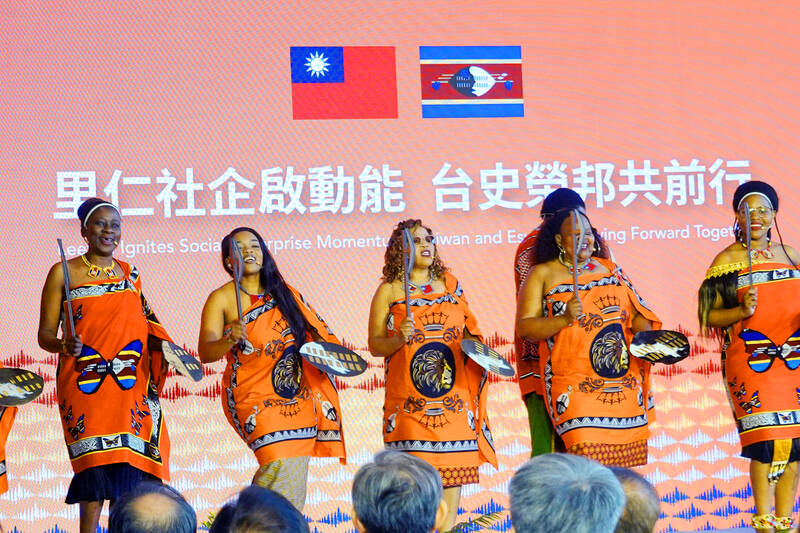
The opening ceremony began with a traditional dance by Eswatini students in Taiwan, followed by a promotional video showing the southern African country’s natural and cultural features.
Photo: CNA
Talking about his visit to Eswatini in April last year, Lin said he was very impressed during the trip, including seeing the “Big Five” animals of Africa within two hours and its beautiful landscape, allowing him to truly understand why the country is often called the “Switzerland of Africa.”
This year marks the 58th anniversary of Eswatini’s independence, King Mswati III’s 58th birthday and his 40th year on the throne, as well as 58 years of diplomatic relations with Taiwan, Lin said, lauding the two nations’ long and strong friendship.
Aside from tourism, the exchanges between the two countries also extend to trade and investment, as well as the establishment of a Taiwan industrial innovation park, Lin said.
Photo: Yu Chao-fu, Taipei Times
Leezen has imported many fair-trade, organic and handmade products from Eswatini to Taiwan for the cultural fair, which are to be sold at its more than 135 shops across the nation, he said.
More than 1,400 Eswatini women have gained a job and income through microentrepreneurship programs, helping to empower them and improve gender equity, he said.
Inspired by Leezen and referencing the concept of the Central America Trade Office, the ministry has established a “diplomatic allies prosperity economic and trade office,” which is a public-private partnership to encourage Taiwanese companies to invest in the nation’s allies.
Twelve companies have joined the program, with each providing NT$2 million to jointly establish a trading company, Lin said.
Leezen president Lee Miao-ling (李妙玲) said she visited Eswatini in July last year and saw the local need for economic support, so the company organized the cultural fair to bring the country’s unique products, including animal-shaped candles, batik fabric accessories, handwoven baskets, chili sauce and marula body oil to Taiwanese consumers.
“We believe Taiwan’s social enterprises also have the ability to support and participate in international cooperation, allowing more people to get to know our close ally in Africa,” she said.
“This event is more than a marketplace, it is a celebration of friendship, partnership and shared values between the Kingdom of Eswatini and the Republic of China, Taiwan,” First Secretary for Information of the Embassy of the Kingdom of Eswatini in Taiwan Abbigail Pieterse said.
The fair gives Taiwanese consumers the opportunity to experience the kingdom’s high-quality products, which represent its culture, the people and their commitment to sustainable development, she said.
“This fair is a symbol of a strong cooperation between the Kingdom of Eswatini and the Republic of China, Taiwan. It demonstrates how economic collaboration can strengthen diplomatic ties and deepen people-to-people connection,” she said. “Let’s continue building bridges between our nations, through trade, cultural exchange and shared prosperity.”
The Eswatini products would be sold at Leezen’s shops nationwide until April 9.
The Eswatini Cultural Fair is co-organized by the International Cooperation and Development Fund, the Tse-Xin Organic Agriculture Foundation, and the Bliss and Wisdom Cultural and Educational Foundation, with advisory support by MOFA.
NETWORK-MAPPING PROJECT: The database contains 170 detailed files of Taiwanese politicians and about 23 million records of household registration data in Taiwan China has developed a network-mapping project targeting political figures and parties in Taiwan to monitor public opinion during elections and to craft tailored influence campaigns aimed at dividing Taiwanese society, according to documents leaked by Chinese technology firm GoLaxy (中科天璣). The documents, collected by Taipei-based Doublethink Lab, showed a database was specifically created to gather detailed information on Taiwanese political figures, including their political affiliations, job histories, birthplaces, residences, education, religion and a brief biography about them. Several notable Taiwanese politicians are in the database, including President William Lai (賴清德), former president Tsai Ing-wen (蔡英文), Minister of Foreign Affairs Lin Chia-lung (林佳龍),
KEY INDUSTRY: The vice premier discussed a plan to create a non-red drone supply chain by next year, which has been allocated a budget of more than NT$7.2 billion The government has budgeted NT$44.2 billion (US$1.38 billion) to cultivate Taiwan’s uncrewed aerial vehicle (UAV) industry over the next five years, which would make the nation a major player in the industry’s democratic supply chain in the Asia-Pacific region, Premier Cho Jung-tai (卓榮泰) said yesterday. Cho made the remarks during a visit to the facilities of Cub Elecparts Inc (為升電裝). Democratic Progressive Party (DPP) Legislator Chen Su-yueh (陳素月) and Chinese Nationalist Party (KMT) Legislator Hsieh Yi-fong (謝依鳳) also participated in the trip. Cub Elecparts has transitioned from the automotive industry to the defense industry, which is the top priority among the nation’s
UPGRADED MISSILE: The Chungshan Institute of Science and Technology is reportedly to conduct a live-fire test of the Hsiung Feng III anti-ship missile on Thursday next week The US Army is planning to build new facilities to boost explosives production and strengthen its supply chain, a move aimed at addressing munitions shortages and supporting obligations to partners including Taiwan, Ukraine and Israel, Defense News reported. The army has issued a sources sought notice for a proposed Center of Excellence at the Blue Grass Army Depot in Kentucky, the report said. The facility would serve as a hub within the US industrial base for the production of key military explosives, including research department explosives (RDX) and high melting explosives (HMX), while also supporting research and development of next-generation materials. The proposed
SOUTH KOREA DISPUTE: If Seoul continues to ignore its request, Taiwan would change South Korea’s designation on its arrival cards, the foreign ministry said If South Korea does not reply appropriately to a request to correct Taiwan’s name on its e-Arrival card system before March 31, the government would take corresponding measures to change how South Korea is labeled on the online Taiwan Arrival Card system, the Ministry of Foreign Affairs said yesterday. South Korea’s e-Arrival card system lists Taiwan as “China (Taiwan)” in the “point of departure” and “next destination” fields. Taipei has asked Seoul to change the wording. Since March 1, South Koreans who hold government-issued Alien Resident Certificates (ARC) have been identified as from “South Korea” rather than the “Republic of Korea,” the
Facts Only
The Ministry of Foreign Affairs (MOFA) of Taiwan established a "diplomatic allies prosperity economic and trade office" to encourage local companies to invest in Taiwan’s allies.
Foreign Minister Lin Chia-lung announced the initiative during the opening of the Eswatini Cultural Fair in New Taipei City.
The fair was organized by Leezen Co, which pledged NT$2 million to MOFA’s project to deepen economic and trade cooperation with Taiwan’s allies.
Eswatini has invited President William Lai to visit the country.
This year marks the 58th anniversary of Eswatini’s independence, King Mswati III’s 58th birthday, his 40th year on the throne, and 58 years of diplomatic relations with Taiwan.
Leezen Co has imported fair-trade, organic, and handmade products from Eswatini to sell at its 135 shops across Taiwan.
More than 1,400 Eswatini women have gained jobs and income through microentrepreneurship programs.
Twelve Taiwanese companies have joined the program, each contributing NT$2 million to establish a trading company.
The Eswatini Cultural Fair is co-organized by the International Cooperation and Development Fund, the Tse-Xin Organic Agriculture Foundation, and the Bliss and Wisdom Cultural and Educational Foundation.
Taiwan has budgeted NT$44.2 billion to cultivate its drone industry over the next five years.
Taiwan has warned South Korea that it will change South Korea’s designation on its arrival cards if Seoul does not correct Taiwan’s name on its e-Arrival card system by March 31.
Executive Summary
Full Take
The narrative presented here highlights Taiwan’s strategic efforts to deepen economic and cultural ties with its diplomatic allies, particularly Eswatini, while also asserting its sovereignty in international relations. The establishment of the "diplomatic allies prosperity economic and trade office" reflects a proactive approach to fostering mutual economic benefits, leveraging private-sector participation to strengthen diplomatic relationships. The Eswatini Cultural Fair serves as both a cultural exchange and an economic initiative, showcasing products that empower local communities, particularly women, through microentrepreneurship. This aligns with broader themes of sustainable development and gender equity, which are increasingly central to international cooperation narratives.
However, the inclusion of Taiwan’s warning to South Korea over its e-Arrival card system introduces a layer of diplomatic tension, underscoring Taiwan’s ongoing struggle for recognition and respect in international forums. This dual focus—on strengthening alliances while asserting sovereignty—reveals a paradigm where economic and cultural diplomacy are intertwined with geopolitical assertions. The pattern here suggests a calculated effort to use soft power (cultural exchanges, economic cooperation) to reinforce Taiwan’s position on the global stage, while simultaneously pushing back against perceived slights to its sovereignty.
The broader implications of this narrative are significant for human agency and dignity. On one hand, initiatives like the Eswatini Cultural Fair and the economic trade office empower local communities and foster cross-cultural understanding. On the other, the diplomatic spat with South Korea highlights the fragility of Taiwan’s international standing and the constant need to defend its identity. The second-order consequences could include strengthened ties with allies who recognize Taiwan’s sovereignty, but also potential backlash from nations that prioritize relations with China.
Bridge questions to consider: How might Taiwan’s economic diplomacy initiatives be perceived by countries that do not officially recognize it? What are the potential risks and benefits of intertwining economic cooperation with diplomatic assertions? How could Taiwan’s approach to sovereignty disputes evolve in response to changing international dynamics?
Counterstrike scan: If this narrative were part of a coordinated influence campaign, the playbook might involve emphasizing Taiwan’s economic and cultural contributions to allies while framing sovereignty disputes as unjust provocations. However, the content does not appear to match this pattern, as it presents a balanced account of Taiwan’s initiatives and diplomatic challenges without overt manipulation.
Patterns detected: none
Sentinel — Human
The article shows strong signs of human authorship, with varied sentence structure, personal anecdotes, and specific details that are unlikely to be AI-generated.