A post on marine insurance – by popular demand
For a brief moment at the beginning of the month, the key to traffic flow through the Strait of Hormuz seemed to hang in London. Within hours of the United States and Israel launching airstrikes on sites across Iran, a meeting of the Joint War Committee was convened in the heart of the city.
But this was no gathering of four-star generals. The Leadenhall-based Joint War Committee is made up of senior underwriters in the marine insurance industry, whose job it is to determine regions of the world that present enhanced risk of peril. On March 1, they expanded their map of so-called ‘listed areas’ to incorporate large parts of the Gulf.
For shipowners and charterers, this had implications for insurance cover. All have policies in place to accommodate a range of risks – hull damage, cargo, crew, third-party liability. The unpredictability of war – and its tendency not to hew to standard actuarial trends – means war risk has long occupied a category of its own, but most seafarers have a policy to cover that, too.
When hostilities erupted, those policies came into focus. Commentators saw several leading insurers issue cancellation notices and concluded that war risk cover was being pulled entirely. They suggested that was a reason for the collapse in traffic through the Strait. Donald Trump promptly intervened, announcing that the United States Development Finance Corporation would step in “to provide political risk insurance and guarantees for the Financial Security of ALL Maritime Trade, especially Energy, traveling through the Gulf.”
The reality was more mundane. Reinsurers backing a specific layer of cover for charterers had got nervous and, exercising a contractual right, excluded Gulf claims at 72 hours’ notice. The insurers, their hands forced, duly notified clients. It wasn’t the first time – the same sequence had played out after Russia invaded Ukraine in 2022, and again when Houthi attacks escalated in the Red Sea in 2024. Each time, replacement cover was on the market before the old contracts expired. The Joint War Committee was blunt: “Despite some regrettably incorrect reporting about cancellation, hull war insurance cover remains in place and available in the London market.”
What did change was price. “I think we have had in the last week a 500% increase on war risk insurance,” shipping magnate Nikolas Tsakos told investors on his earnings call a few days into the war. “I think from what we used to do it at $0.15 per deadweight ton, we’re up to close to $1 now or $0.75 to a $1. So that’s a huge increase.”
And that was just the beginning. By mid-March, cover had leaped to around 5% of a vessel’s value – roughly five times even those early-war rates. Insuring a $100 million tanker through the Strait now costs in the region of $5 million.1
But when faced with the risk of a direct hit, crossing the Strait isn’t just a matter of insurance. “Our main concern is the safety of the crews,” the CEO of d’Amico International Shipping told investors on his call last week. “It’s not that of the vessel itself – because the vessel itself can be insured in normal circumstances.”
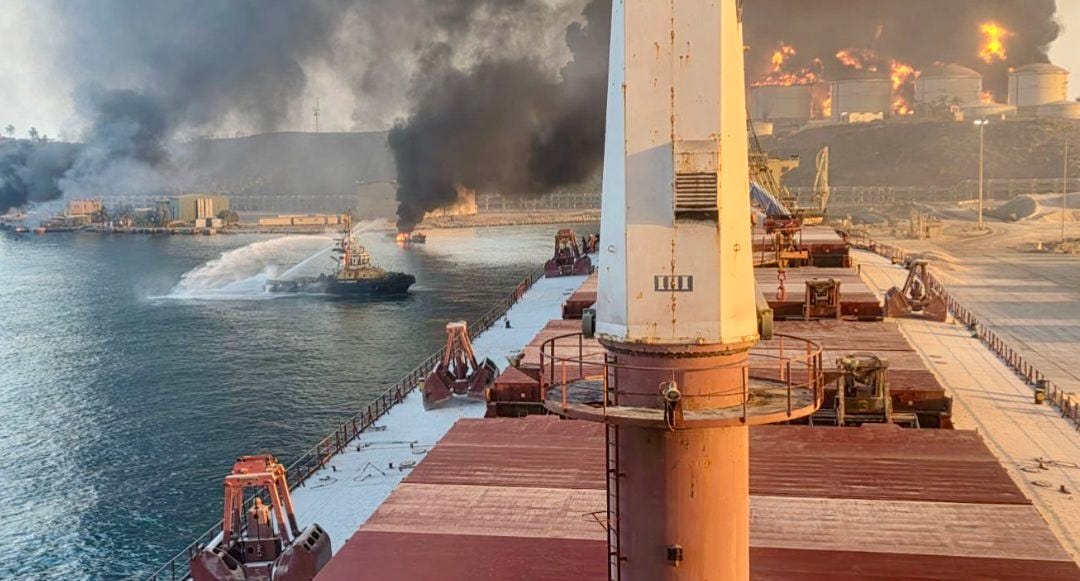
Through the beginning of this week, there have been 18 direct attacks on commercial vessels in the Gulf, plus another five which have suffered near misses or minor damage. This is not somewhere a prudent captain takes a laden tanker, however much Donald Trump inveigles him to “show some guts”. London’s moment of apparent influence over Hormuz traffic turned out to be a misreading. The key didn’t hang there after all.
The episode, though, is a useful entry point into a market that most people never think about until something flares up. I had flagged last week that I was going to write about marine insurance, and the response from readers persuaded me to weigh anchor. To explore how the market works – and what this crisis reveals about it – read on.
Facts Only
The Joint War Committee, based in London, expanded its "listed areas" to include large parts of the Gulf on March 1, 2024.
The committee consists of senior underwriters in the marine insurance industry.
Some reinsurers excluded Gulf claims with 72 hours' notice, leading to cancellation notices from insurers.
War risk insurance premiums for vessels increased from $0.15 per deadweight ton to $0.75–$1 in early March.
By mid-March, war risk insurance costs reached approximately 5% of a vessel’s value.
Insuring a $100 million tanker through the Strait of Hormuz cost around $5 million.
Eighteen direct attacks on commercial vessels occurred in the Gulf, with five additional near misses or minor damage incidents.
The U.S. Development Finance Corporation announced it would provide political risk insurance for maritime trade in the Gulf.
Shipping executives, including the CEO of d’Amico International Shipping, prioritized crew safety over vessel insurance.
The Joint War Committee clarified that hull war insurance remained available in the London market despite misreporting.
Similar insurance disruptions occurred after Russia’s invasion of Ukraine in 2022 and Houthi attacks in the Red Sea in 2024.
Executive Summary
Full Take
The narrative around marine insurance in the Strait of Hormuz reveals how financial mechanisms intersect with geopolitical tensions, often amplifying perceptions of risk. The strongest version of this story highlights the rapid response of insurance markets to conflict, where premiums skyrocket not due to a lack of coverage but because reinsurers recalibrate risk in real time. The misreporting of "cancelled" insurance—later corrected by the Joint War Committee—demonstrates how easily technical adjustments can be misconstrued as systemic failures, especially when political figures like Trump intervene with grandiose promises. This aligns with **ARC-0024 Ambiguity**, where complexity is reduced to binary outcomes (e.g., "insurance pulled entirely"), and **ARC-0043 Motte-and-Bailey**, where the initial panic ("no coverage") retreats to a more nuanced reality ("higher costs but coverage exists").
The root cause here is the assumption that markets alone can price the unpriceable—war’s unpredictability. Insurance models rely on actuarial trends, but war defies such calculations, forcing underwriters into reactive, short-term decisions. The historical echo is clear: from Ukraine to the Red Sea, the same pattern repeats—reinsurers pull back, premiums spike, and governments step in to backstop risk. Yet the human cost—crew safety, the reluctance of captains to sail through conflict zones—remains underemphasized in financial discussions.
Implications for human agency are stark. Shipowners and crews bear the immediate risks, while insurers and governments profit from or mitigate the fallout. Second-order consequences include higher energy prices, supply chain disruptions, and the normalization of state-backed insurance as a tool of geopolitical leverage. Missing perspectives: How do crews themselves assess risk versus corporate or state directives? Would a decentralized insurance model (e.g., mutual aid among shipowners) change outcomes?
Counterstrike scan: A bad actor pushing this narrative might exaggerate the "collapse" of insurance to stoke fear of trade disruptions, framing it as a failure of markets to justify state intervention. The actual content doesn’t fully match this—it corrects misinformation and centers market mechanics—but the initial panic serves as a case study in how financial technicalities can be weaponized for broader agendas.
Sentinel — Human
The text shows signs of human authorship with stylistic variations, personal voice, and anecdotal evidence. However, it's important to note that AI-assisted writing tools may have been used for editing or formatting.