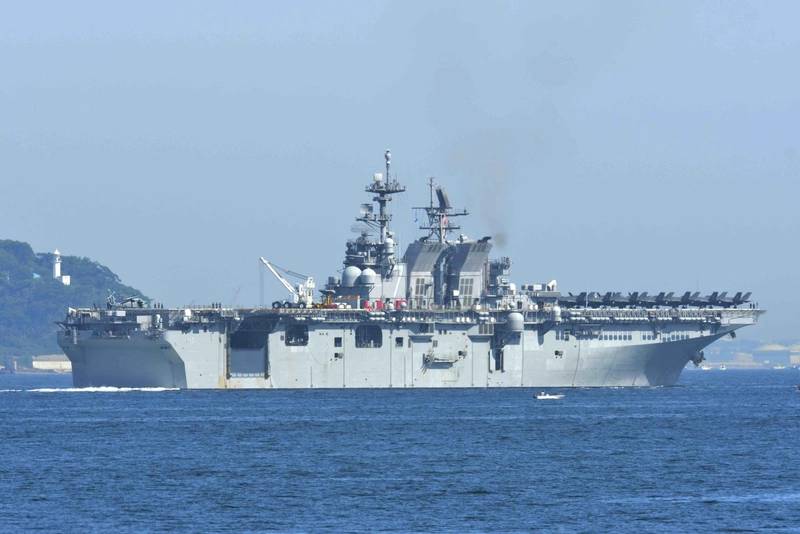
The U.S. military is deploying a large amphibious assault ship with thousands of additional Marines and sailors to the Middle East, three U.S. officials told Reuters on Friday, as Iran's new supreme leader hailed Iran's "unity" and "resistance".
Reuters had reported that Washington, desperate to reopen the Gulf oil bottleneck of the Strait of Hormuz, shut by Iran since the U.S. and Israel attacked almost three weeks ago, was considering deployments up to and including landings.
Oil prices have risen around 50% since the start of the war.
The news came shortly after President Donald Trump again vented his fury at U.S. allies for declining to help open the strait while fighting continued, albeit in a conflict they were neither consulted on nor advised of.
"COWARDS, and we will REMEMBER!" he wrote.
The sources, speaking on condition of anonymity, did not say what the role of the additional troops would be.
MIDDLE EAST MARKS END OF RAMADAN AND PERSIAN NEW YEAR
As Muslims around the region tried to celebrate Eid al-Fitr, which ends the fasting month of Ramadan, and Iranians marked Nowruz, the Persian New Year, the prospect of a quick end to a war about to enter its fourth week seemed remote.
Mujtaba Khamenei, Iran's new supreme leader, who has not been seen in public since the Israeli attack that killed his father and predecessor on the war's first day, posted a Nowruz message on his Telegram channel.
"The enemy believed that by targeting the leader (Ayatollah Ali Khamenei) and influential figures, it could instil fear and force the people to withdraw," it said.
"But the nation responded with unity ... resistance, and dealt a disorienting blow to the enemy."
The benchmark price of Brent crude oil was up slightly, near $110, after surging the day before on growing fears that the largest ever disruption to world energy supplies would trigger a global economic shock.
Even if the conflict does stop soon, there will be no rapid recovery from the upheaval caused by airstrikes and Iran's virtual closure of the Strait of Hormuz, the conduit for 20% of the world's oil and liquefied natural gas.
Israel did promise to avoid further attacks on Iran's South Pars gasfield the day after an Iranian retaliatory strike on Qatar caused damage that will leave the world short of natural gas for years to come.
But Kuwait's state oil firm said its Mina Al-Ahmadi refinery had suffered multiple drone attacks on Friday that set some units alight.
Germany, Britain, France, Italy, the Netherlands and Canada, as well as NATO non-member Japan, pledged in a joint statement on Thursday to join "appropriate efforts to ensure safe passage through the Strait".
The leaders of Germany and France, however, made clear that this presupposed an end to the fighting.
On his social media platform on Friday morning, Trump restated a long-standing complaint:
"...they complain about the high oil prices they are forced to pay, but don’t want to help open the Strait of Hormuz, a simple military maneuver that is the single reason for the high oil prices," he wrote. "So easy for them to do, with so little risk. COWARDS, and we will REMEMBER!"
AS FUEL PRICES CLIMB, U.S. VOTERS OPPOSE IRAN GROUND WAR
While soaring U.S. diesel and gasoline prices can only hurt Trump's core political support, the war is also unpopular with voters, and a potential ground operation even more so, as his Republicans prepare to defend slim majorities in midterm congressional elections.
A U.S. official and three people familiar with the matter told Reuters this week that the U.S. was considering deploying thousands more troops to the Middle East, potentially even landing on Iran's shore or its Kharg Island oil export hub.
Flows of crude and petroleum have dropped by about 12 million barrels per day - roughly 12% of global demand - due to output cuts and export halts by Gulf producers.
Those barrels cannot easily be replaced by the transport, shipping and manufacturing industries that rely on them, and will make themselves felt for months or even years.
International Energy Agency chief Fatih Birol told the Financial Times restoring oil and gas flows might take six months.
Israel's military said it had attacked government facilities in Tehran, and that it had this week killed a key commander in Iran's intelligence ministry, Mahdi Rostami Shamastan.
The semi-official Iranian news agency Tasnim said intelligence minister Esmail Ahmadi had also been killed, the latest of dozens of leading government, military and scientific figures assassinated by Israel.
"We have nobody to talk to," Trump said. "And you know what? We like it that way."
In Tel Aviv and Jerusalem, air raid sirens howled as explosions from interceptors rang out. The military said Iran had fired a barrage of missiles, and the ambulance service said at least one appeared to have carried dispersing cluster bombs.
Iran's Revolutionary Guards said they had attacked Haifa and Tel Aviv with multi-warhead missiles and used drones to attack stocks of drones and cruise missiles in U.S. bases, including Sheikh Isa air base in Bahrain. No comment was immediately available from U.S. forces.
The war has already killed thousands and displaced millions, mostly in Iran and in Lebanon, where Israel has attacked the Iranian-backed Hezbollah militia in the south and in Beirut.
Oil prices whipsaw after Iran attack https://reut.rs/3MNR2aF
Gulf area attacks cause extensive damage to Middle East energy infrastructure https://fingfx.thomsonreuters.com/gfx/ce/zdvxgnxzkpx/GulfAttackMap.png
Do you support sending US ground troops to Iran? https://www.reuters.com/graphics/USA-TRUMP/HP-POLL-TROOPS-20260319/klpyldnjzvg/chart_eikon.jpg
BREAKINGVIEWS-Energy shock will make hoarding the new normal Read full story
FACTBOX-How many people have been killed in the US-Israeli war on Iran? Read full story
US pump prices surge after start of Iran hostilities https://reut.rs/47prLdQ
(Reuters)
Facts Only
* The U.S. military is deploying an amphibious assault ship with approximately 3,000 Marines and sailors to the Middle East.
* Reuters reported that the deployment is aimed at reopening the Strait of Hormuz.
* Iran’s new supreme leader, Khamenei, has called for unity and resistance.
* Oil prices have risen by approximately 50% since the start of the conflict.
* President Trump criticized allies for not helping to open the strait.
* Ramadan and Nowruz were being celebrated amidst the ongoing conflict.
* Israel attacked government facilities in Tehran.
* Kuwait’s refinery suffered drone attacks.
* NATO non-member Japan has been impacted by Iranian missile strikes.
* Crude oil prices were up slightly near $110.
* Flows of crude and petroleum have dropped by approximately 12 million barrels per day.
* International Energy Agency chief Fatih Birol predicts six months for oil and gas flows to recover.