Pte
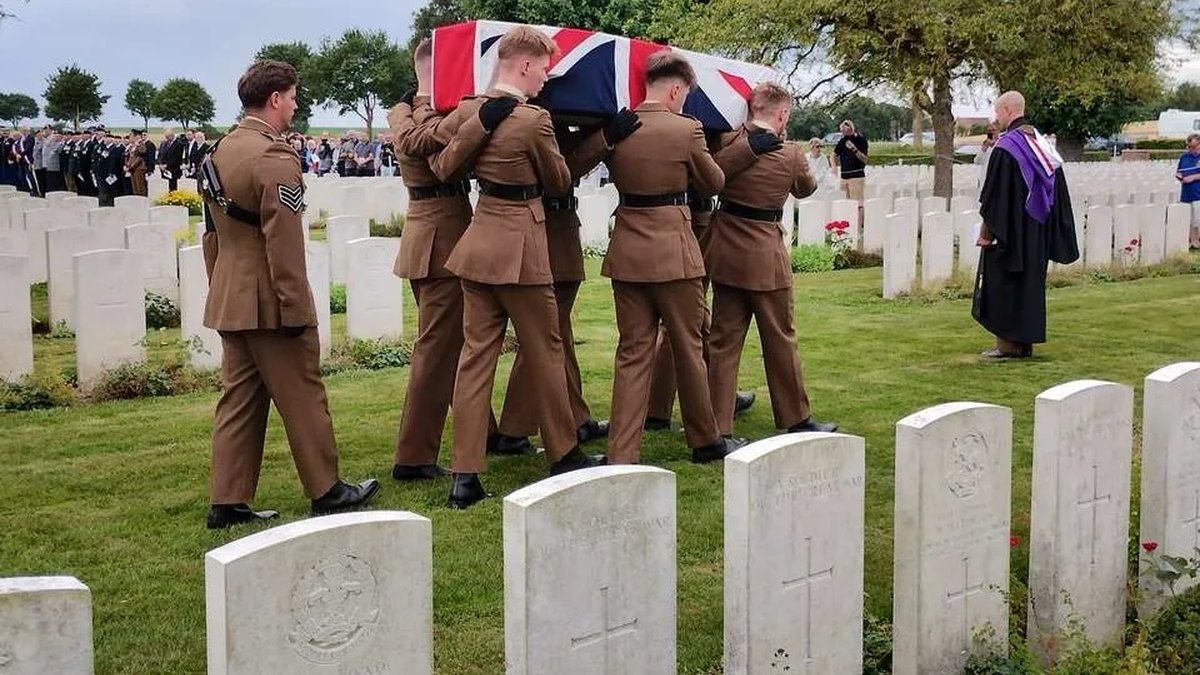
Robert Leonard Lock, of 12th Battalion The Durham Light Infantry, was laid to rest on the Somme today (30 June 2026) at a burial service organised by MOD’s Joint Casualty and Compassionate Centre (JCCC), also known as the ‘War Detectives’. The service took place at the Commonwealth War Graves Commission’s (CWGC) Warlencourt British Cemetery.
The burial service almost coincided with the 110th anniversary of the start of the Battle of the Somme which saw British and French forces attack on the morning of 1 July 1916. The date is the bloodiest in British military history, with 57,000 casualties sustained. The fighting continued until 18 November 1916 and would ultimately result in 420,000 Commonwealth casualties, 200,000 French casualties and 450,000 German casualties.
JCCC Caseworker, Rosie Barron said:
It has been a privilege to have seen Pte Lock laid to rest today in the presence of his family. It has been especially poignant as this marks the start of commemorations of the 110th anniversary of the Battle of the Somme. The story of Pte Lock reminds us that although the focus and narrative of the battle is on the high number of casualties killed or wounded, these men were not statistics, and each soldier and family affected have their own individual stories to tell. Pte Lock’s story has now been brought to a conclusion.
Pte
Lock’s remains were discovered in 2022 as a farmer ploughed his field near Le Sars. DNA testing, coordinated by JCCC, confirmed his identity. His great nephew, Anthony Wright, attended with his sons. The service was also attended by Roland Lock who, as the first cousin once removed of Pte Lock, provided a DNA sample.
Anthony Wright said:
We’re incredibly thankful to the JCCC for the great work they do so that Robert can be properly laid to rest and for giving us the opportunity to be there at the burial. Whilst it is incredibly sad, we are still very proud of the sacrifice that Robert made to protect our freedom.
By the end of the day, the sunken road had been captured and the battalion consolidated their positions. One officer was killed, another was missing and 31 other ranks were killed and 86 wounded. Pte Lock was amongst the casualties. He was 20 years old.
The service was supported by serving soldiers from The Rifles and was also attended by serving members of the German and Belgian military. The service was conducted by the Reverend Stephen Cassells CF, Chaplain to 2nd Battalion The Rifles.
Reverend Stephen Cassells CF said:
It is a privilege to play a small but important part to ensure a dignified and proper burial of a soldier who paid the ultimate sacrifice. Though over one hundred years have transitioned since his passing, it is fitting that those of antecedent regiments to his own have united to lay one of their own to rest. “Greater love has no one than this, that a person lay down their life for their friends”. John 15:13. In eternal memorial.
The grave of Pte Lock will now be cared for by the CWGC in perpetuity. Vice Admiral Peter Hudson CB CBE, Vice Chairman of the CWGC, attended the service and said:
The reburial of Private Robert Leonard Lock, on the eve of the 110th anniversary of the Battle of the Somme, is a powerful reminder of the human cost of that campaign. For more than a century he lay unknown, but today we are able to restore him to his rightful place among his comrades of the Durham Light Infantry. Through the dedication of many, and the support of his family, we ensure that his sacrifice is recognised, and that he is remembered not simply as one of the fallen, but as an individual, known and honoured once more.
Sentinel — Human
This text exhibits the structure and emotional depth typical of human-written commemorative journalism, skillfully blending historical facts with personal tribute.