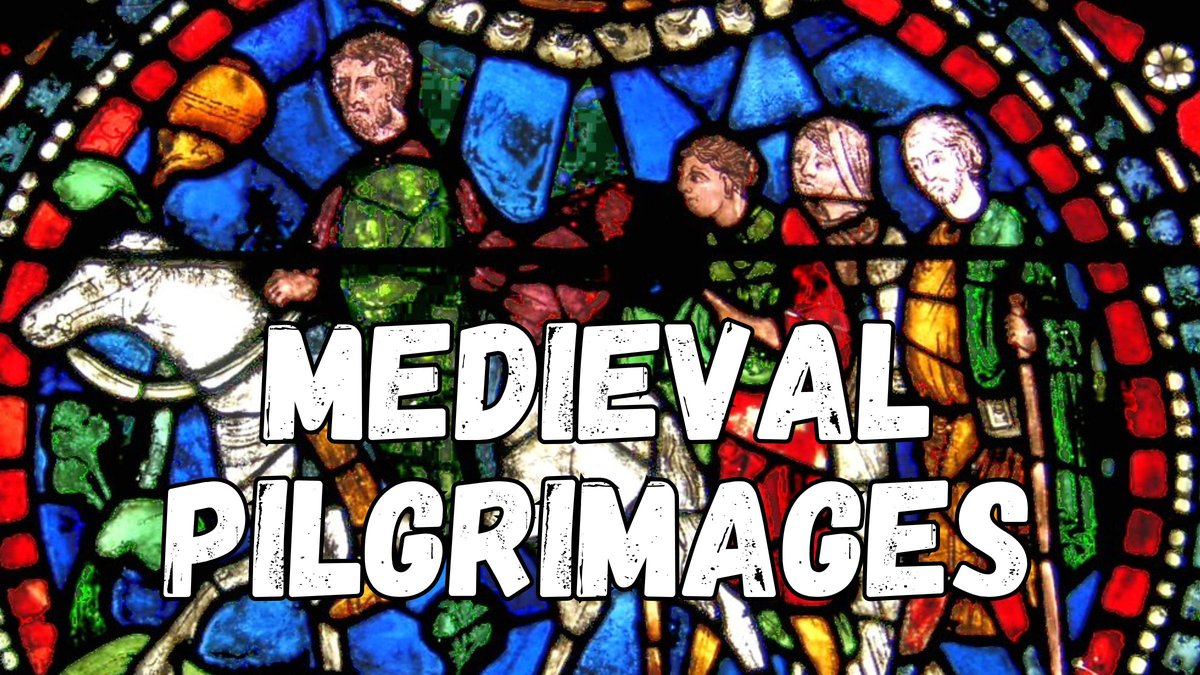
If you’re going on vacation this summer, have you considered a pilgrimage? Lucie Laumonier looks at why medieval people travelled to holy sites—and the dangers they faced along the way.
By Lucie Laumonier
A pilgrimage is a religious journey to a holy site, such as Rome or Jerusalem, or to the shrine of certain saints whose relics were said to bring about miracles. Santiago de Compostela, a pilgrimage site that developed in the Middle Ages, is still famous today and attracts large crowds from all across Europe. In 2025, the Oficina del Peregrino estimates that half a million pilgrims walked the camino and arrived at the holy site in northwestern Spain. Pilgrimage is not a phenomenon exclusive to Christianity. In Islam, the hajj, a religious journey to Mecca, constitutes one of the five pillars of the religion. Just this year, in 2026, Al Jazeera has reported that over 1.5 million Muslims have made the trip to Mecca.
In late medieval Europe, saints’ relics were a powerful incentive for pilgrimage. Hundreds and hundreds of local shrines reported miracles that would, hopefully, attract visitors. In England, for instance, the pilgrimage to Canterbury was associated with the martyrdom of St. Thomas Becket (sanctified in 1173). In France, pilgrims could go to St. Denis, near Paris, to visit the tomb of St. Louis (Louis IX, sanctified in 1297). But, while relics were not necessary for miracles to occur, they did increase the chances of one happening.
Margery Kempe herself, in the beginning of the fifteenth century, accomplished four pilgrimages: one, the easiest, to Canterbury, and then to Santiago de Compostela, Rome, and Jerusalem where she experienced “great spiritual comfort” and wished to return “to acquire more pardon for herself.” The main reasons why medieval people embarked on a pilgrimage were, in no particular order, the remission of their sins—like Margery Kempe—the desire to renounce the world and adopt a more ascetic life, to visit the holy places of Christianity, or to receive a healing miracle.
Journey to Jerusalem
For western Europeans, a pilgrimage to Jerusalem was a dangerous and expensive enterprise. A twelfth-century account of a pilgrimage to the Holy Land written by Englishman Saewulf testifies to the great perils of long-distance travel. Saewulf had made his way to southern Italy by land. He mentions that the coasts of the peninsula are the usual departure points of pilgrimages to Jerusalem. Saewulf embarked on a ship and “the very same day, when we were on the sea, a long way from the harbor, we suffered shipwreck for the violence of the waves.” Quite the beginning of a trip!
Once the ship was repaired, off they went. The party made a stop in Corfu, a Greek island. Hopping from island to island, they were rerouted “by a great storm” but, making the most of their trip, Saewulf and his companions visited the sanctuary of St. Andrew the Apostle. In early August, they were in Corinth, where they “suffered many hardships” but continued their journey, passing through sites where St. Paul and other Apostles had preached. They visited Rhodes and reflected on the history of the Colossus and then made a stop on the island of Cyprus, rich with apostolic history. But, departing from Cyprus, they “were tossed about by storms at sea” and, “one night, being violently driven by a contrary wind,” Saewulf and his companions were carried back to the harbor of Cyprus.
Finally, thirteen weeks after their departure, they arrived in Jaffa (today in Israel). The following day, Saewulf wrote, a formidable sea storm destroyed quantities of ships whose crew perished, their bodies carried by the currents and washed ashore. “Thus, out of thirty very large ships (…) all laden with pilgrims or merchandise, scarcely seven remained unwrecked by the time I had left the shore,” Saewulf wrote. “More than a thousand persons of either sex perished on that day,” he said, thanking the Lord for his mercy. But Saewulf’s pilgrimage was not yet over. Two days of travel separated him from Jerusalem. The “mountainous road, rocky, and very dangerous,” was lined with dead bodies, Saewulf asserted, from people killed by wild beasts, all the while “Saracens” were on the lookout for potential victims. Quite dramatically, Saewulf noted that, “On that road not only the poor and the weak, but even the rich and the strong, are in danger.” Finally, his party made it safely to Jerusalem, three months after they had left Italy.
Saewulf’s experience, of which some details had probably been exaggerated, underlines that a pilgrimage also allowed for tourism. The author and his companions regularly stopped at holy sites, noting that famous apostles and saints had lived there or done certain deeds at certain places. Likewise, Saewulf’s writings are full of references to historical sites they passed through or stopped at, where famous battles had taken place or that were of importance in classical history. The purpose of the journey was to reach the Holy Land, but the pilgrimage also had a cultural value, making such a long and perilous endeavour certainly more enjoyable.
Journey to Santiago de Compostela
One of Europe’s most popular pilgrimages brought travelers to Compostela. The pilgrimage to Santiago de Compostela leads to the shrine of the apostle Saint James the Great (Sant Iago in Spanish). The saint’s remains were allegedly found in the beginning of the ninth century by a hermit. By the 830s, a small town and a church had been established on the site of the discovery. In the late eleventh century the construction of a cathedral began, still standing today with early modern additions.
Four main routes led to Compostela, but all converged in the southwest of France where pilgrims would cross the Pyrenees Mountains. Along the routes were inns, monasteries, and relay posts where pilgrims could rest. The routes to Compostela were marked by local sanctuaries along the way, where pilgrims could purchase souvenirs and collect pilgrim badges—that is, keepsakes testifying to the long journey they had embarked on. Each local sanctuary had its own badges. Scallop shells were a symbol of the Camino de Santiago that pilgrims would get once they had reached Compostela.
Practical knowledge of medieval pilgrimages comes from manuscripts such as the Pilgrim’s Guide to Santiago de Compostela, the fifth book of the Codex Calixtinus, compiled c. 1140 by a French scholar. The codex presents itself as an anthology of sermons, prayers and miracles, all connected to Saint James and its cult. Its fifth book, known as the Pilgrim’s Guide, compiles a series of advice for pilgrims travelling to the sanctuary. In a colourful language, the Guide’s author describes locations and local people, offering information on what to do and what to avoid.
The region of Bordeaux, the author writes, “is excellent in wine, abundant in fishes, but of rustic language.” Further south in Gascony, pilgrims would encounter the Gascons, a population “fast in words, loquacious, given to mockery, libidinous, drunkards, prodigal in food, ill-dressed, and rather careless in the ornaments they wear.” Thankfully, they are also “well-trained in combat and generous in the hospitality they provide.” The author of the present column is from Gascony but likes to think she has great taste in clothing!
The author of the Pilgrim’s Guide also warned its readers about robbers in the south of France, who steal pilgrims’ mounts. A little further down the road, the guide reads, ferrymen extort ridiculous sums of money from innocent pilgrims trying to cross a river. Then, in the Basque country, south of Bayonne, are toll-collectors who “actually advance towards the pilgrims with two or three sticks, extorting by force an unjust tribute. And if some traveler refuses to hand over the money at their request, they beat him with the sticks and snatch away the toll-money while cursing him and searching even through his breeches.”
Pilgrimages were in fact so dangerous that people with enough wealth seeking miracles could actually stay in the safety of their home, send wax candles to the saint’s shrine and pay someone to embark on the religious journey on their behalf! Some people, when making their last will and testament, required that their heirs embark on a pilgrimage for the salvation of their soul. If the heirs refused, they wouldn’t receive the inheritance. In fact, pilgrims tended to draft a will before leaving, a clear sign of the dangers they were about to face, and a testimony to their desire to leave their affairs in order.
If you’re going on vacation this summer, have you considered a pilgrimage? Lucie Laumonier looks at why medieval people travelled to holy sites—and the dangers they faced along the way.
By Lucie Laumonier
A pilgrimage is a religious journey to a holy site, such as Rome or Jerusalem, or to the shrine of certain saints whose relics were said to bring about miracles. Santiago de Compostela, a pilgrimage site that developed in the Middle Ages, is still famous today and attracts large crowds from all across Europe. In 2025, the Oficina del Peregrino estimates that half a million pilgrims walked the camino and arrived at the holy site in northwestern Spain. Pilgrimage is not a phenomenon exclusive to Christianity. In Islam, the hajj, a religious journey to Mecca, constitutes one of the five pillars of the religion. Just this year, in 2026, Al Jazeera has reported that over 1.5 million Muslims have made the trip to Mecca.
In late medieval Europe, saints’ relics were a powerful incentive for pilgrimage. Hundreds and hundreds of local shrines reported miracles that would, hopefully, attract visitors. In England, for instance, the pilgrimage to Canterbury was associated with the martyrdom of St. Thomas Becket (sanctified in 1173). In France, pilgrims could go to St. Denis, near Paris, to visit the tomb of St. Louis (Louis IX, sanctified in 1297). But, while relics were not necessary for miracles to occur, they did increase the chances of one happening.
Margery Kempe herself, in the beginning of the fifteenth century, accomplished four pilgrimages: one, the easiest, to Canterbury, and then to Santiago de Compostela, Rome, and Jerusalem where she experienced “great spiritual comfort” and wished to return “to acquire more pardon for herself.” The main reasons why medieval people embarked on a pilgrimage were, in no particular order, the remission of their sins—like Margery Kempe—the desire to renounce the world and adopt a more ascetic life, to visit the holy places of Christianity, or to receive a healing miracle.
Journey to Jerusalem
For western Europeans, a pilgrimage to Jerusalem was a dangerous and expensive enterprise. A twelfth-century account of a pilgrimage to the Holy Land written by Englishman Saewulf testifies to the great perils of long-distance travel. Saewulf had made his way to southern Italy by land. He mentions that the coasts of the peninsula are the usual departure points of pilgrimages to Jerusalem. Saewulf embarked on a ship and “the very same day, when we were on the sea, a long way from the harbor, we suffered shipwreck for the violence of the waves.” Quite the beginning of a trip!
Once the ship was repaired, off they went. The party made a stop in Corfu, a Greek island. Hopping from island to island, they were rerouted “by a great storm” but, making the most of their trip, Saewulf and his companions visited the sanctuary of St. Andrew the Apostle. In early August, they were in Corinth, where they “suffered many hardships” but continued their journey, passing through sites where St. Paul and other Apostles had preached. They visited Rhodes and reflected on the history of the Colossus and then made a stop on the island of Cyprus, rich with apostolic history. But, departing from Cyprus, they “were tossed about by storms at sea” and, “one night, being violently driven by a contrary wind,” Saewulf and his companions were carried back to the harbor of Cyprus.
Finally, thirteen weeks after their departure, they arrived in Jaffa (today in Israel). The following day, Saewulf wrote, a formidable sea storm destroyed quantities of ships whose crew perished, their bodies carried by the currents and washed ashore. “Thus, out of thirty very large ships (…) all laden with pilgrims or merchandise, scarcely seven remained unwrecked by the time I had left the shore,” Saewulf wrote. “More than a thousand persons of either sex perished on that day,” he said, thanking the Lord for his mercy. But Saewulf’s pilgrimage was not yet over. Two days of travel separated him from Jerusalem. The “mountainous road, rocky, and very dangerous,” was lined with dead bodies, Saewulf asserted, from people killed by wild beasts, all the while “Saracens” were on the lookout for potential victims. Quite dramatically, Saewulf noted that, “On that road not only the poor and the weak, but even the rich and the strong, are in danger.” Finally, his party made it safely to Jerusalem, three months after they had left Italy.
Saewulf’s experience, of which some details had probably been exaggerated, underlines that a pilgrimage also allowed for tourism. The author and his companions regularly stopped at holy sites, noting that famous apostles and saints had lived there or done certain deeds at certain places. Likewise, Saewulf’s writings are full of references to historical sites they passed through or stopped at, where famous battles had taken place or that were of importance in classical history. The purpose of the journey was to reach the Holy Land, but the pilgrimage also had a cultural value, making such a long and perilous endeavour certainly more enjoyable.
Journey to Santiago de Compostela
One of Europe’s most popular pilgrimages brought travelers to Compostela. The pilgrimage to Santiago de Compostela leads to the shrine of the apostle Saint James the Great (Sant Iago in Spanish). The saint’s remains were allegedly found in the beginning of the ninth century by a hermit. By the 830s, a small town and a church had been established on the site of the discovery. In the late eleventh century the construction of a cathedral began, still standing today with early modern additions.
Four main routes led to Compostela, but all converged in the southwest of France where pilgrims would cross the Pyrenees Mountains. Along the routes were inns, monasteries, and relay posts where pilgrims could rest. The routes to Compostela were marked by local sanctuaries along the way, where pilgrims could purchase souvenirs and collect pilgrim badges—that is, keepsakes testifying to the long journey they had embarked on. Each local sanctuary had its own badges. Scallop shells were a symbol of the Camino de Santiago that pilgrims would get once they had reached Compostela.
Practical knowledge of medieval pilgrimages comes from manuscripts such as the Pilgrim’s Guide to Santiago de Compostela, the fifth book of the Codex Calixtinus, compiled c. 1140 by a French scholar. The codex presents itself as an anthology of sermons, prayers and miracles, all connected to Saint James and its cult. Its fifth book, known as the Pilgrim’s Guide, compiles a series of advice for pilgrims travelling to the sanctuary. In a colourful language, the Guide’s author describes locations and local people, offering information on what to do and what to avoid.
The region of Bordeaux, the author writes, “is excellent in wine, abundant in fishes, but of rustic language.” Further south in Gascony, pilgrims would encounter the Gascons, a population “fast in words, loquacious, given to mockery, libidinous, drunkards, prodigal in food, ill-dressed, and rather careless in the ornaments they wear.” Thankfully, they are also “well-trained in combat and generous in the hospitality they provide.” The author of the present column is from Gascony but likes to think she has great taste in clothing!
The author of the Pilgrim’s Guide also warned its readers about robbers in the south of France, who steal pilgrims’ mounts. A little further down the road, the guide reads, ferrymen extort ridiculous sums of money from innocent pilgrims trying to cross a river. Then, in the Basque country, south of Bayonne, are toll-collectors who “actually advance towards the pilgrims with two or three sticks, extorting by force an unjust tribute. And if some traveler refuses to hand over the money at their request, they beat him with the sticks and snatch away the toll-money while cursing him and searching even through his breeches.”
Pilgrimages were in fact so dangerous that people with enough wealth seeking miracles could actually stay in the safety of their home, send wax candles to the saint’s shrine and pay someone to embark on the religious journey on their behalf! Some people, when making their last will and testament, required that their heirs embark on a pilgrimage for the salvation of their soul. If the heirs refused, they wouldn’t receive the inheritance. In fact, pilgrims tended to draft a will before leaving, a clear sign of the dangers they were about to face, and a testimony to their desire to leave their affairs in order.
Lucie Laumonier is a medieval historian and professor at Concordia University, Montreal. Her newest book is Charity and Community in Montpellier, 13th–16th Centuries: The Multiplication of Loaves. You can follow Lucie on Instagram @lucie_in_academia
Click here to read more from Lucie Laumonier
Further Readings:
William Melczer, The Pilgrim’s Guide to Santiago de Compostela (New York: Italica Press, 1993)
Mary-Ann Stouck (ed.) Medieval Saints: A Reader (Toronto: University of Toronto Press, 2008)
John F. Romano (ed.) Medieval Travel and Travelers: A Reader (Toronto: University of Toronto Press, 2020)
Top Image: A group of medieval pilgrims depicted at Canterbury Cathedral – Wikimedia Commons
Subscribe to Medievalverse
Related Posts