Presented By: Ackman-Ziff
100 Years of Ackman — Built to Last
By Ackman-Ziff April 30, 2026 12:00 am
reprintsThere are certain milestones in business that make you stop and reflect on what it truly takes to endure. Ackman-Ziff reaching its 100th year is one of those moments. A century in business is rare in any industry. In real estate capital advisory, a world defined by economic cycles, capital flows, shifts in investor sentiment, and varying trends in tenant demand, this is an extraordinary achievement that was built on trust and relationships over decades.
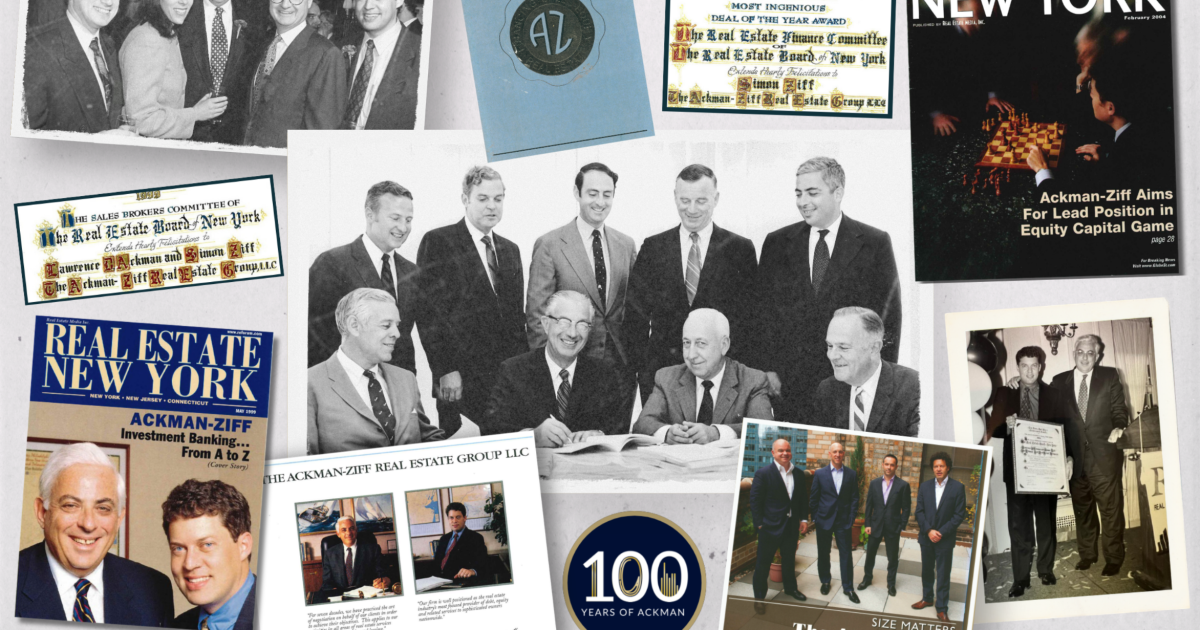
The story begins in 1926, when Herman and Bert Ackman founded Ackman Brothers. It continued through Larry Ackman’s arrival after Harvard Business School in 1964, through his son Bill’s early years at the firm before charting his own path in investment management, and through Simon Ziff’s partnership with Larry beginning in 1989. What emerged from those decades of collaboration is what the firm is today: a leading boutique real estate capital advisory practice operating at the intersection of complex transactions, capital and relationships.
But the numbers and the timeline tell only part of the story.
More than a business — a legacy of relationships
Listening to the people who have built and sustained Ackman-Ziff, what comes through most clearly isn’t deal volume or market position. It’s the depth of the relationships.
Over its history, the firm has advised some of the most prominent real estate families in the United States — Silverstein, Durst, Gural, Korein, Grant, Benenson, Tisch, Rose, Marx, Rudin, Tishman, Fisher, Resnick, Helmsley, Wien, Malkin and Elghanayan among others. These aren’t transactional relationships. They are partnerships forged over generations, tested through market downturns, and sustained by a consistent commitment to doing things the right way.
Simon Ziff, who has led the firm for more than three decades, describes it simply:
“Relationships, creativity, team, trust, obsession with finding money — and the Golden Rule. Each of those is imperative. We love what we do, and we believe in doing it the right way.”
On confidentiality, a value the firm treats as foundational, he adds:
“The deals we work on aren’t our deals; they belong to our clients. They decide what’s shared with the press — and when they do, we always appreciate being included.”
That kind of quiet commitment to clients, repeated over 100 years, is precisely how a firm like this endures.
Russell Schildkraut, a 28-year veteran and principal of Ackman-Ziff, points to the internal culture that makes it possible:
“The firm’s culture is grounded in teamwork, a strong internal environment, deep capital relationships, and a clear commitment to business ethics. Understanding who the client is and consistently acting in their best interest is fundamental.”
The courage to evolve
Longevity doesn’t come from standing still. It comes from knowing when to move, when to hold, and how to execute when it matters most. The current leadership team reflects a shared set of convictions built over decades.
Patrick Hanlon speaks to the firm’s capacity for reinvention:
“Ackman-Ziff has continuously evolved, from early expansion into joint venture equity to a broader national platform, including emerging sectors such as single-family rental, build-to-rent, energy, and powered land.”
Jason Krane frames the firm’s enduring value proposition with characteristic clarity:
“Capital has always been at the center of the business. It is not only about cost, but about structure, flexibility, and long-term alignment with client objectives.”
And Evan Linkner captures what separates experience from expertise:
“The firm’s role is often to navigate complexity. Transactions may appear straightforward on the surface but require experience and creativity to execute effectively.”
Investing in the next generation
One of the most meaningful expressions of the firm’s values isn’t a transaction, it’s a program. AZ Educate, Ackman-Ziff’s education and mentorship platform, has connected more than 500 undergraduate and graduate students with experienced owners, operators and capital providers. It is, in many ways, the same capability that has defined the firm for a century, bringing together the right people, ideas and capital, now extended to those beginning their careers.
That commitment to education traces directly back to Larry Ackman, who, alongside Simon Ziff, helped fund ethics coursework at New York University — an initiative that has grown into what is now recognized as the Ackman Lectures in Real Estate Leadership and Ethics. It reflects a belief the firm has held from the beginning: that long-term success in business is inseparable from ethics and responsibility.
A story still unfolding
Larry Silverstein, who has watched the firm navigate decades of market cycles alongside his own career, offered this reflection on the occasion:
“Reaching 100 years in business or in life is no small thing. (I would know as I recently celebrated my 94th birthday!) It requires imagination, hard work, and the kind of steadfast integrity that allows relationships to endure across generations. Ackman-Ziff has demonstrated all of these qualities for a century, and the real estate industry is better for it.
“I have watched this firm navigate changing markets and economic cycles with a rare blend of intelligence, innovation and humility. They listen before they speak, they think before they act, and they place their clients’ interests ahead of their own — principles that never go out of style.
“A hundred years is a milestone few companies ever see, and even fewer deserve as much as Ackman-Ziff. I congratulate them on this extraordinary achievement, and I have no doubt that they will continue to succeed for another century.”
The Durst Organization’s Douglas and Jody Durst echoed the sentiment:
“We have enjoyed a long-standing relationship, shaping the New York City skyline together. Our fathers worked closely with Larry Ackman and team, and we proudly worked with Simon and the next generation. Ackman-Ziff has expertly supported 33 transactions for The Durst Organization, providing invaluable guidance and financing.”
A hundred years. Four generations of clients. Countless transactions that never made the press, by design. And a team that shows up every day guided by the same principles that were set in motion a century ago.
The Ackman-Ziff story isn’t finished. It’s still being written — one relationship at a time.
Facts Only
Ackman-Ziff was founded in 1926 as Ackman Brothers by Herman and Bert Ackman.
Larry Ackman joined the firm in 1964 after graduating from Harvard Business School.
Simon Ziff became a partner with Larry Ackman in 1989.
The firm has advised real estate families including Silverstein, Durst, Gural, Korein, Grant, Benenson, Tisch, Rose, Marx, Rudin, Tishman, Fisher, Resnick, Helmsley, Wien, Malkin, and Elghanayan.
Simon Ziff has led the firm for over three decades.
The firm operates in sectors such as single-family rental, build-to-rent, energy, and powered land.
AZ Educate, the firm’s mentorship program, has connected over 500 students with industry professionals.
Larry Ackman and Simon Ziff funded ethics coursework at New York University, now known as the Ackman Lectures in Real Estate Leadership and Ethics.
Larry Silverstein, a long-time client, praised the firm’s integrity and adaptability.
The Durst Organization has completed 33 transactions with Ackman-Ziff’s advisory support.
The firm emphasizes confidentiality, teamwork, and client-centric values.
Ackman-Ziff’s 100th anniversary was celebrated in April 2026.
Executive Summary
Ackman-Ziff, a boutique real estate capital advisory firm, celebrates its 100th anniversary in 2026, marking a rare milestone in an industry defined by volatility. Founded in 1926 as Ackman Brothers by Herman and Bert Ackman, the firm evolved through generations, with key figures like Larry Ackman and Simon Ziff shaping its trajectory. The firm is known for advising prominent real estate families—such as Silverstein, Durst, and Rudin—through multi-generational partnerships built on trust and confidentiality. Its culture emphasizes teamwork, ethical business practices, and client-centric values, with a focus on navigating complex transactions across sectors like single-family rentals and energy. Beyond business, Ackman-Ziff invests in education through initiatives like AZ Educate and the Ackman Lectures in Real Estate Leadership and Ethics at NYU. Industry leaders, including Larry Silverstein and the Durst Organization, have praised the firm’s integrity, adaptability, and long-term client commitment. The firm’s longevity is attributed to its ability to evolve while maintaining core principles, suggesting a model of resilience in a cyclical industry.
The narrative highlights the firm’s role in shaping major real estate deals, often behind the scenes, and its emphasis on relationships over transactional gains. However, the account is primarily celebratory, with limited critical perspectives or challenges faced by the firm. The focus on legacy and values may reflect a broader trend in family-owned businesses prioritizing reputation and continuity over short-term profits.
Full Take
This narrative presents Ackman-Ziff’s centennial as a testament to resilience in real estate advisory, framing its success through relationships, ethics, and adaptability. The strongest version of this story—its "steelman"—highlights genuine achievements: multi-generational client loyalty, a culture of confidentiality, and investments in education that extend beyond profit motives. These elements suggest a firm that has navigated economic cycles by prioritizing trust over short-term gains, a rare quality in finance.
However, the account leans heavily on testimonials and anecdotal evidence, which, while compelling, lack the rigor of independent verification. The absence of challenges—failed deals, client disputes, or strategic missteps—creates a polished but potentially incomplete picture. This aligns with **ARC-0024 Ambiguity**, where selective storytelling omits countervailing data to reinforce a narrative of unblemished success. The emphasis on "quiet commitment" and "never making the press" could also serve as a form of **ARC-0043 Motte-and-Bailey**, where the firm’s discretion is celebrated as virtue while shielding it from scrutiny.
The root cause of this narrative is a paradigm of legacy-building in family-owned businesses, where reputation and continuity are paramount. The unstated assumption is that longevity equates to excellence, yet this conflates survival with superiority. The real estate industry’s cyclical nature means many firms fail not due to poor ethics but market forces—so Ackman-Ziff’s endurance may reflect both skill and luck.
Implications for human agency are mixed. The firm’s mentorship programs and ethical initiatives suggest a commitment to stewardship, but the lack of critical reflection risks idealizing a model that may not be replicable or universally beneficial. Who bears the costs? Smaller firms without generational networks might struggle to compete in an industry where relationships are currency.
Bridge questions: How would Ackman-Ziff’s clients describe its failures, and what lessons were learned? If the firm’s success hinges on confidentiality, how can outsiders assess its true impact? What structural advantages—beyond ethics—have enabled its longevity?
Counterstrike scan: A coordinated influence campaign would amplify the firm’s legacy while suppressing dissenting voices, using testimonials to manufacture consensus. This article aligns with that playbook but stops short of overt manipulation—it’s a celebration, not propaganda. The absence of critical perspectives is notable but not necessarily sinister; it reflects the genre of commemorative storytelling.
Patterns detected: **ARC-0024 Ambiguity**, **ARC-0043 Motte-and-Bailey**
Sentinel — Human
The article exhibits the complexity, nuanced attribution, and thematic depth characteristic of human journalistic or organizational narrative writing, with low probability of synthetic generation.