Thank you for visiting nature.com. You are using a browser version with limited support for CSS. To obtain
the best experience, we recommend you use a more up to date browser (or turn off compatibility mode in
Internet Explorer). In the meantime, to ensure continued support, we are displaying the site without styles
and JavaScript.
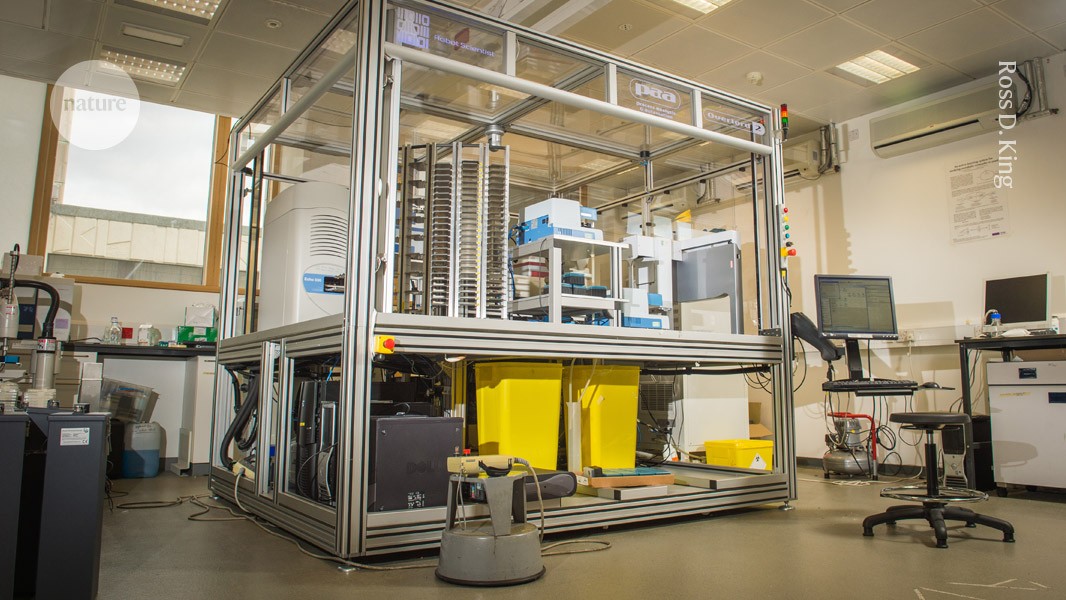
Measuring 5 metres square by 3 metres high, Eve takes up at least half of the floor space in the laboratory it now calls home.
The robotic platform at the Chalmers University of Technology in Gothenburg, Sweden, is the brainchild of autonomous-lab pioneer Ross King. It is powered by artificial intelligence, self-driving and “fairly quiet”, King says. But it’s also fast. Working at full speed, Eve’s robotic arm can move a few metres per second, with a positional accuracy of a fraction of a millimetre. The team usually runs Eve slower than that — otherwise, King says, “it’s too scary”.
Eve automates the process of early-stage drug design. One of Eve’s early achievements came in 2018, around three years after it was created, when it identified that the common antimicrobial compound triclosan can target an enzyme that is crucial to the survival of Plasmodium malaria parasites during their dormant phase in the liver1. To do this, Eve independently screened some 1,600 chemicals and modelled how their structure related to their activity to predict which ones were worth testing. King and his group armed the robot with background knowledge and a machine-learning framework for developing hypotheses. Eve then used those elements to design experiments to test these hypotheses and, crucially, performed them itself. The finding gave researchers a potential route to fighting treatment-resistant malaria. “It’s trying to make the scientific method in a machine,” says King.
In 2009, King used Eve’s predecessor to probe some of the 10–15% of yeast genes with unknown functions2. He named the system Adam — a reference to both the biblical character and the eighteenth-century economist Adam Smith, who was a strong proponent of industrial mechanization. King sees parallels in the future of science.
“A lot of biology is done like craft work,” King says: a lab with a principal investigator, postdocs and students operates much like an artisan works with their apprentices. Self-driving labs, by contrast, are more similar to a production line. As a result, “science will be done differently, like in a factory”, he adds.
The technology is still in its infancy, and most of the advances so far have been incremental. But as the field encroaches on parts of the scientific process that are typically done by people — absorbing the literature, planning experiments, analysing data and deciding what hypothesis to test next — researchers will have to grapple with what the developments mean for the future of the lab.
The anatomy of a self-driving lab
Many sectors, from agriculture to surgery, are starting to embrace the promise of AI-powered robotics. Korean car manufacturer Hyundai, for example, announced in January that it will deploy tens of thousands of autonomous humanoid robots in its manufacturing plants, and that they will be completing complex car-assembly work by 2030.
Industrial labs and centralized lab facilities have been using robots to speed up liquid handling and sample analysis since the mid-1980s. But self-driving labs can go much further. Blending AI, robotics and automated instrumentation, these platforms can design and perform experiments with minimal human input.
Adam is equipped with a freezer full of mutant yeast strains and the chemicals needed to measure cellular growth under various conditions. It also hosts three incubators, a centrifuge, two barcode readers, seven cameras and 20 environmental sensors. After being given an overarching goal by its human handlers, it independently develops hypotheses and then tests them, performing experiments much faster than a human could.
Hiring a student for the job would probably have been cheaper, King admits. But his newest robot, Genesis, will be able to do enough experiments to make the process economically feasible3. King estimates that Genesis will cost £1 million (US$1.3 million) to build — the same price as Adam or Eve individually — but he estimates that it will eventually be at least an order of magnitude cheaper than human labour. King plans to use the system — which occupies one-fifth of floor space than Eve does — to model how genes, proteins and small molecules interact in cells. Part of that will involve taking around 10,000 mass-spectrometry measurements each day.
Chemist and computer scientist Alán Aspuru-Guzik at the University of Toronto in Canada supervises a fleet of 50 self-driving autonomous robots across several labs and universities. Known as the Acceleration Consortium, it is funded by a grant worth Can$200 million (US$146 million).
One of his former postdocs, chemist Gabe Gomes, went on to set up his own autonomous lab at Carnegie Mellon University (CMU) in Pittsburgh, Pennsylvania, which he calls Coscientist4. It is part of a new generation of systems that “allows users to give instructions or [make] requests in plain English”, says Gomes. Coscientist is driven by the large language model (LLM) GPT-4 and can interpret scientific problems, collect relevant information from web and document searches, plan experiments and interface with robotic lab hardware to perform them. This is done either on external automation platforms or by using the CMU Cloud Lab — a remote-controlled, fully automated research facility built by CMU and Emerald Cloud Lab, a biotechnology company in Austin, Texas.
Coscientist has designed and run palladium-catalysed organic reactions to find the best reagents and conditions4. But it has applications across a wide range of fields, Gomes says. “It’s really field-agnostic. And as [AI] models get better, the problems that we can tackle are much greater.”
Global and cost-effective
One researcher hoping to leverage this technology is John Gregoire, chief autonomous-science officer at Lila Sciences, a start-up firm in Cambridge, Massachusetts.
With around 22,000 square metres of automated lab space at its AI Science Factory (AISF), the company plans to provide research and development services to pharmaceutical companies, materials-science firms and other research-intensive organizations. This year, it received about £500,000 from the UK government’s Advanced Research and Innovation Agency to test whether its self-driving robot — AI NanoScientist — can synthesize and improve the stability of colloidal nanoparticles, tiny particles suspended in a liquid medium.
A similar venture, Periodic Labs, was launched in 2025 in San Francisco, California. It was co-founded by San Francisco-based Liam Fedus, a creator of ChatGPT at US tech firm OpenAI, and Ekin Dogus Cubuk, who previously led materials and chemistry research at Google DeepMind. Periodic Labs has developed an automated materials-synthesis lab that can mix powders, heat them in a furnace and characterize the products. The company aims to perform 1,000 experiments each day, but Cubuk says that success will depend not on throughput, but on how well the LLM can analyse results to progress to further experiments. Similar ventures are popping up around the world, including LabGenius in London. Its discovery platform, called EVA, combines AI and robotic automation to develop complex therapeutic antibodies. Novartis, a pharmaceutical company in Basel, Switzerland, has developed a platform called MicroCycle, which can autonomously synthesize, purify and test compounds, analyse the data and choose new compounds to synthesize5. And an AI-powered robotic chemist called ChemAgents, developed by researchers at the University of Science and Technology of China in Hefei, helped its creators to discover functional materials and optimize light-activated organic reactions6.
Evidence is mounting that autonomous labs can be more cost-effective than conventional approaches are. For example, scientists at OpenAI and Ginkgo Bioworks, a biotech company in Cambridge, Massachusetts, tested more than 30,000 experimental conditions over six months. They demonstrated that blending Gingko’s Reconfigurable Automation Cart cloud lab with the GPT-5 LLM reduces the cost-per-gram of protein production in a test tube by 40% relative to state-of-the-art methods7. The experiment improved protein yield by 27%.
Humans welcome
That’s not to say robots can do everything humans can. “You can’t put a robot arm into a cage and catch a mouse in a corner, for instance. Human dexterity is amazing compared to current robots,” says King. Gregoire echoes the point, noting that some processes are simply too expensive to automate for now.
But AI-powered robots are starting to perform more-complex experiments than standard automated systems can handle, which generally involve single-stage syntheses. One robot in Aspuru-Guzik’s Acceleration Consortium, for instance, is working on multistep methods that would otherwise be difficult to automate because the desired compounds must be purified at each step — a complex, delicate task that requires nuanced judgement. Solve that problem and “the world is yours”, Aspuru-Guzik says, “because then you can, in principle, automate any chemical reaction”. Using the consortium’s SDL7 ‘scale-up’ automated lab at the University of British Columbia in Vancouver, Canada, his team is working with the pharmaceutical giant Bristol Myers Squibb in Princeton, New Jersey, on a platform that can separate mixtures of liquids. It can operate autonomously to prepare samples, measure pH and analyse the different liquid layers.
Some of these systems even have ‘eyes’. In December 2025, Aspuru-Guzik’s group published a guide on how to use a simple webcam to empower self-driving labs to watch as experiments progress and respond to what happens — in this case, the high-throughput synthesis of highly tunable, porous lattice structures known as metal–organic frameworks8. “With the computer eyes, [the robot] was able to actually see what happens in the reaction, and then actually act upon it,” he explains. It could identify plates on which products had crystallized and select only those for characterization, increasing efficiency.
Incremental improvements
For now, researchers at Lila Sciences are moving towards fully autonomous operation of the AISF for developing messenger RNA therapeutics and catalysts, but the system still relies on human input to validate AI predictions. Fedus and Cubuk say that Periodic Labs is likewise easing into the process by automating pieces of it to ensure that the AI’s proposed syntheses make sense. “It’s a very iterative process,” says Fedus.
Indeed, the types of hypothesis that self-driving labs can test for now are “relatively constrained”, says King, and focus mainly on incremental improvements. “They optimize compounds in a drug assay, or they optimize some material for a battery or solar panel.” Typically, this is accomplished using Bayesian optimization, a method that uses probabilistic modelling to select the experiments and conditions most likely to improve current results. “Bayesian optimization is awesome and powerful,” says Gomes. But Coscientist’s LLM-guided optimization technique could make things even better. The system is pretrained with chemical knowledge, giving it an edge over the conventional Bayesian approach, Gomes says.
Enjoying our latest content?
Log in or create an account to continue
Access the most recent journalism from Nature's award-winning team
Explore the latest features & opinion covering groundbreaking research
Facts Only
Ross King, a researcher at Chalmers University of Technology in Gothenburg, Sweden, developed the robotic platform Eve, which automates early-stage drug design.
Eve measures 5 meters square by 3 meters high and operates with AI, self-driving capabilities, and a robotic arm with millimeter-level precision.
In 2018, Eve identified triclosan as a potential treatment for malaria by screening 1,600 chemicals and modeling their structures.
King’s earlier system, Adam, was created in 2009 to study unknown yeast gene functions and was named after the biblical Adam and economist Adam Smith.
Adam is equipped with mutant yeast strains, chemicals, incubators, centrifuges, barcode readers, cameras, and environmental sensors.
King’s newest robot, Genesis, is estimated to cost £1 million and will perform around 10,000 mass-spectrometry measurements daily.
Alán Aspuru-Guzik at the University of Toronto oversees 50 autonomous robots as part of the Acceleration Consortium, funded by a Can$200 million grant.
Gabe Gomes, a former postdoc of Aspuru-Guzik, developed Coscientist at Carnegie Mellon University, which uses GPT-4 to interpret scientific problems and plan experiments.
Lila Sciences, a startup in Cambridge, Massachusetts, operates an AI Science Factory with 22,000 square meters of automated lab space.
Periodic Labs, co-founded by Liam Fedus of OpenAI and Ekin Dogus Cubuk of Google DeepMind, aims to perform 1,000 materials-synthesis experiments daily.
Novartis developed MicroCycle, an autonomous platform for synthesizing and testing compounds, while researchers in China created ChemAgents for discovering functional materials.
A study by OpenAI and Ginkgo Bioworks demonstrated a 40% cost reduction in protein production using AI-driven automation.
Current autonomous labs primarily focus on incremental optimizations, such as drug assays or material improvements, using methods like Bayesian optimization.
Executive Summary
Full Take
The rise of self-driving laboratories represents a paradigm shift in scientific research, blending AI, robotics, and automation to accelerate discovery. At its strongest, this narrative highlights genuine advancements: systems like Eve and Adam have demonstrated the ability to autonomously screen compounds, model biological interactions, and even identify potential treatments for diseases like malaria. The economic and efficiency gains are tangible—studies show cost reductions in protein production and the ability to perform thousands of experiments daily, far outpacing human labor. Proponents argue this could democratize science, making high-throughput research accessible to more institutions and reducing the reliance on artisan-like lab work.
Yet, the pattern scan reveals subtle tensions. The framing of autonomous labs as "factory-like" production lines risks reducing science to a mechanistic process, potentially undermining the creative and serendipitous aspects of discovery (ARC-0024 Ambiguity). The emphasis on cost-effectiveness and throughput could also pressure institutions to prioritize quantity over quality, especially if funding models favor scalable automation over exploratory research. Additionally, the reliance on AI models like GPT-4 introduces questions about transparency and bias—how do these systems handle ambiguous data, and who is accountable for errors? The narrative also leans heavily on authority figures (e.g., King, Aspuru-Guzik) and institutional backing (e.g., OpenAI, Novartis), which could create an echo chamber effect, marginalizing smaller labs without access to such resources (ARC-0012 Appeal to Authority).
Root cause: This trend reflects a broader push toward industrializing science, driven by the promise of efficiency and the allure of AI as a silver bullet. The unstated assumption is that automation can replicate—or even surpass—human intuition in hypothesis generation. Historically, this echoes the shift from craftsmanship to mass production, but science’s reliance on creativity and ethical judgment complicates the analogy. Who benefits? Large pharmaceutical companies and well-funded research hubs stand to gain the most, while early-career scientists may face displacement or a narrowing of research opportunities. Second-order consequences include potential job losses in lab roles, a homogenization of research methodologies, and the risk of AI models reinforcing existing biases in scientific literature.
Bridge questions: How might autonomous labs alter the training of future scientists—will they become operators of machines rather than independent thinkers? What safeguards are needed to ensure AI-driven research remains transparent and reproducible? Could this technology widen the gap between elite institutions and underfunded labs, or could it be designed to level the playing field?
Counterstrike scan: If this were a coordinated influence campaign, the playbook would emphasize the inevitability of AI-driven science, downplay risks, and frame skeptics as Luddites. The actual content, however, acknowledges limitations (e.g., human dexterity, validation needs) and presents a balanced view of progress and challenges. No structural alignment with manipulation patterns is detected.
Sentinel — Human
The article exhibits strong human authorship signals, including domain-specific expertise, narrative idiosyncrasies, and robust attribution, with no detectable signs of synthetic generation.