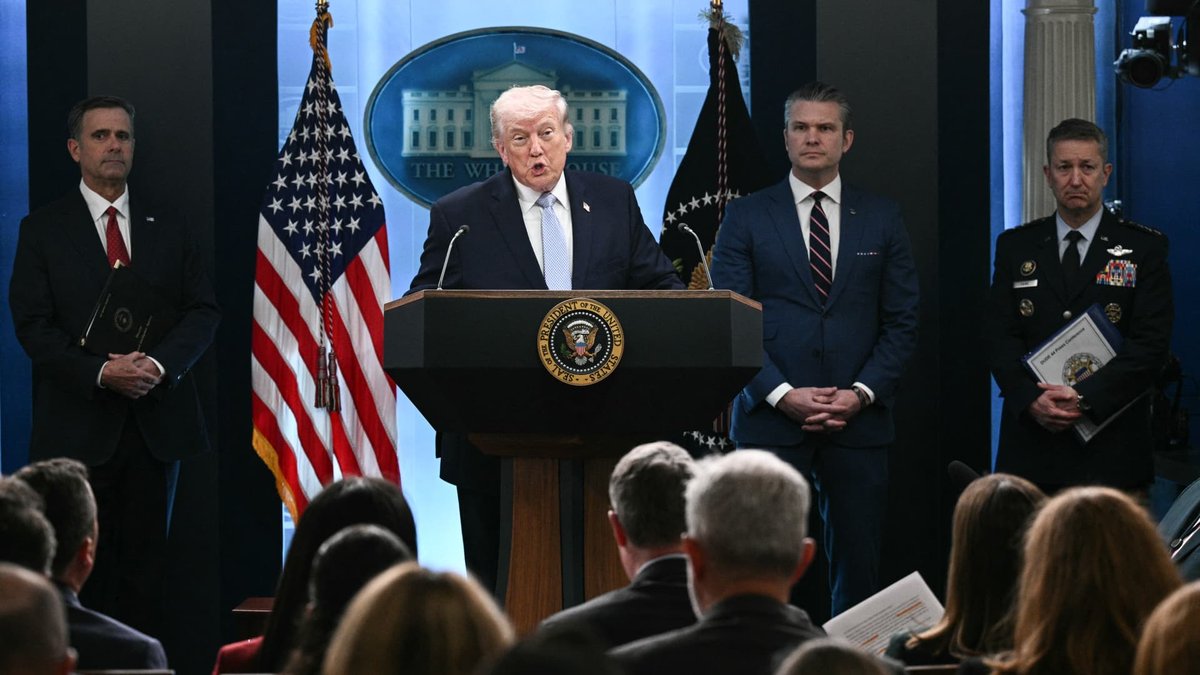
The U.S. will engage in "technical talks" with Iran and remains committed to finding a solution to the conflict, despite the two countries trading airstrikes in recent days, MS Now reported Thursday, citing a U.S. official.
The official said President Donald Trump had made his position clear and characterized Iran's attacks on commercial vessels as "acts of terrorism," according to MS Now.
Those comments come after Trump at the NATO summit in Ankara, Turkey, said that the ceasefire with Iran was "over."
The memorandum of understanding between the two countries is performance-based, and Iran's actions constitute "failed performance at an unacceptable level," the U.S. official told MS Now, adding that talks with Tehran will continue.
The ceasefire signed last month has come under serious strain in recent days with the U.S. and Iranian forces conducting strikes this week. "I don't want to deal with them [Iran] anymore," Trump said at the NATO summit.
On his way back from the summit, Trump said that Iran had called to make a deal to cease the escalating hostilities in the Middle East. "They called a little while ago. They want to make a deal so badly. I just don't know if they're worthy of making a deal. I don't know that they're going to honor the deal. That's the problem," he said.
Iranian officials have accused the U.S. of not honoring the MOU, citing violation of "Iranian adjustments" in the Strait of Hormuz, "persistent threats of further strikes" and reinstating oil sanctions.
The U.S. military conducted renewed rounds of offensive strikes against Iran in retaliation for three commercial vessels transiting the Strait of Hormuz coming under attack. The U.S. Treasury Department subsequently withdrew a waiver that had allowed Iran to sell its oil.
Oil prices were marginally lower on Friday in Asia trading, with global benchmark Brent crude futures for September delivery easing to $76.3 per barrel while U.S. West Texas Intermediate crude futures at $71.87.
Facts Only
* The U.S. will engage in "technical talks" with Iran.
* The U.S. remains committed to finding a solution to the conflict.
* The U.S. official characterized Iran's attacks on commercial vessels as "acts of terrorism."
* President Trump stated the ceasefire with Iran was "over" at the NATO summit.
* The memorandum of understanding is performance-based, and Iran's actions were deemed "failed performance at an unacceptable level."
* U.S. and Iranian forces conducted strikes during the recent days following the ceasefire.
* Trump expressed reservations about a potential deal with Iran due to concerns over honoring agreements.
* Iranian officials accused the U.S. of not honoring the MOU regarding Strait of Hormuz adjustments, threats of strikes, and oil sanctions.
* The U.S. military conducted offensive strikes in retaliation for attacks on three commercial vessels.
* The U.S. Treasury Department withdrew a waiver allowing Iran to sell its oil.
* Global benchmark Brent crude futures eased to $76.3 per barrel, and WTI crude futures were at $71.87.
Executive Summary
Full Take
The narrative presented oscillates between official diplomatic engagement and severe reciprocal actions, suggesting a fundamental disconnect between stated goals and operational realities. The emphasis on "technical talks" juxtaposed with accusations of "failed performance" reveals a tension inherent in negotiated settlements where compliance is measured against political expediency rather than pure adherence to terms. The shifting rhetoric surrounding the ceasefire—from stating it was over to questioning Iran's worthiness to make a deal—suggests that the perceived validity of any agreement is secondary to immediate security or strategic leverage for the involved parties. Furthermore, the mechanism through which disputes are managed appears reliant on asymmetric retaliation; strikes and sanctions are deployed not just as reactions but as tools to enforce perceived obligations, creating a cyclical dynamic where performance is assessed through punitive action rather than collaborative resolution. This pattern implies that in high-stakes geopolitical scenarios, institutional structures often yield to kinetic force when trust erodes, forcing actors to prioritize immediate security demonstrations over long-term compliance mechanisms.
Bridge questions: How do the differing definitions of "performance" between the U.S. and Iran influence the viability of future diplomatic frameworks? What are the underlying systemic incentives that favor retaliatory strikes over sustained engagement in this conflict? How does the use of economic tools like sanctions function as a primary mechanism for enforcing political concessions rather than simply deterring action?
Sentinel — Human
The text reads like standard, fact-based reporting synthesizing elements from multiple sources regarding ongoing geopolitical tensions between the U.S. and Iran.