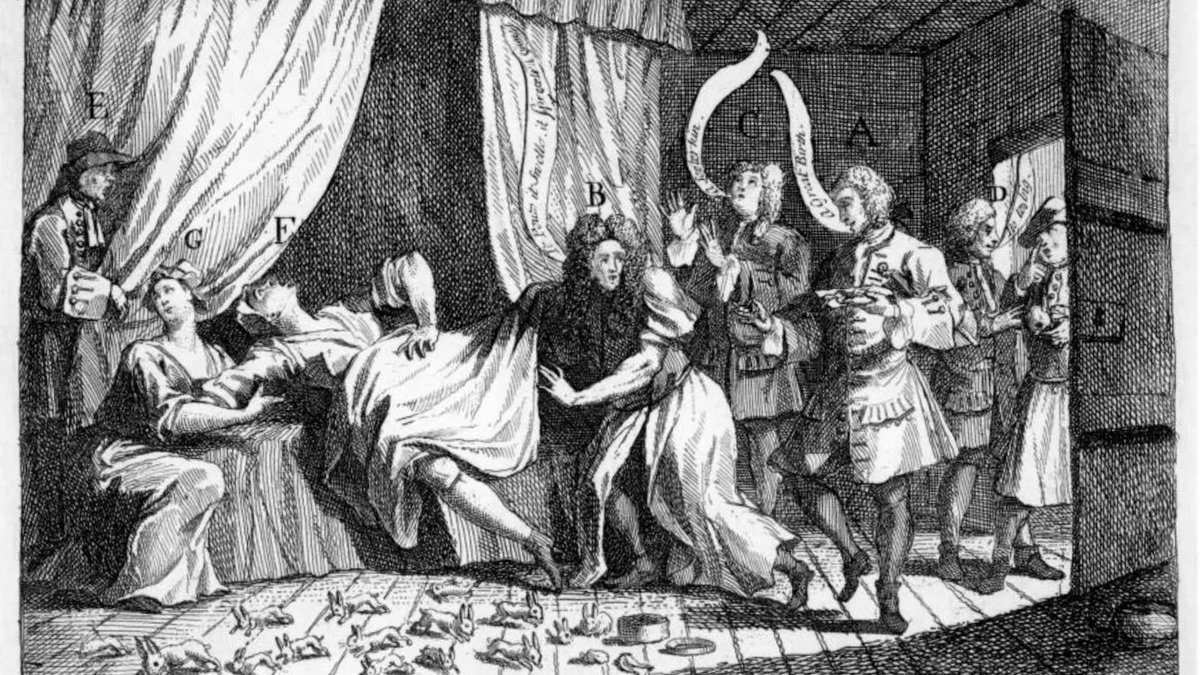
In June 1941, a Surrey-based doctor, Edward Fyfe Griffith, wrote to the medical historian, Reginald Cecil Bligh Wall to say that he had ‘come across the story of Mary Toft of Godalming’, dating from 1726. Griffith was in the process of compiling an anthology of medical writing and he eagerly informed Wall ‘I am now writing her up’. As a historian of early modern Britain, I was immediately drawn to this surprising juxtaposition in the archive. Why, I began to wonder, was a twentieth-century doctor who was deeply involved in the birth control movement so interested in an eighteenth-century reproductive scandal?
Mary Toft was a poor woman from Godalming who, in 1726, seemed to make the impossible happen. She became pregnant that year and reportedly miscarried after chasing a rabbit in the fields. Over the following weeks, she appeared to give birth to both rabbits and other animal parts. She was attended by a local surgeon, John Howard, and other prominent medical men were quickly drawn in. The affair moved from Surrey to London, attracting a great deal of press and public attention, as well as the interest of the British royal family. Eventually, Toft confessed to lying and the hoax was exposed. She was briefly imprisoned and Howard was fined. Historians have since worked to recover her account of the spectacle that unfolded, demonstrating how quickly a reproductive body came to be scrutinised as public evidence.
Griffith’s notes and correspondence on the Toft affair are currently held at the Wellcome Collection. Although I expected them to take me back to eighteenth-century Surrey, I was surprised by one particular letter that he wrote to Dr Helena Wright in June 1941. ‘Mary Toft’ was hastily written at the top and in the short letter below Griffith asked Wright to forward an enquiry about books on the early eighteenth century, ‘somewhere about 1726’. When I turned the letter over, I discovered that it was in fact typed on the back of a prescription form printed by the North Kensington Women’s Welfare Centre in West London. The form listed prices for Volpar Paste, G.P. Solubles, K.Y. Jelly, caps, condoms, and washable sheaths. The letter about Toft became an afterthought and my interest was piqued by the fact that this document revealed another, very different history of reproductive health: a printed system through which contraceptive methods could be requested and supplied.
Nowadays a visit to a sexual-health clinic in London can feel almost routine: an appointment and a brief conversation about prevention. Yet this form from the North Kensington Women’s Welfare Centre pointed back to a time when reproductive healthcare was accessed very differently. Although my initial enquiry was about Griffith’s interest in the Toft affair, it evolved into an exploration of how women sought reproductive healthcare in interwar and wartime Britain. This article therefore traces a microcosm of the radical birth-control movement in twentieth-century Britain through two distinct routes: the clinic and printed material. It asks how reproductive knowledge moved through clinic rooms and printed pages, and how women came to seek it from figures of medical authority.
In interwar Britain, instructions about birth control began to be formalised within a small and scattered network of localised clinics. The Society for Provision of Birth Control Clinics established the North Kensington Women’s Welfare Centre in 1924, and it became part of a broader landscape of women’s welfare centres, mothers’ clinics and married women’s advisory clinics. The centre was led by Margery Spring Rice, a social reformer, and Dr Helena Wright, an expert in contraceptive medicine, and together they began to develop practical clinical methods. Spring Rice helped to turn working women’s experiences of married life into tangible evidence for reproductive healthcare, whilst Wright represented an emerging female medical authority.
As I discovered whilst looking through Griffith’s papers, he established his own birth control clinic in Guildford, Surrey in 1934 and his practice was heavily influenced by the pioneering work of Spring Rice and Wright at the North Kensington Women’s Welfare Centre. In his memoir, The Pioneer Spirit (1981) Griffith recalled how his first meeting with Wright in 1930 transformed his former ‘vague ideals and ideas’ into ‘a definite purpose’ and had helped him to ‘discover a practical way of helping my patients’. Subsequently, at Griffith’s clinic, married women could access practical methods of birth control; they were charged one shilling per visit and could return as often as necessary. As its reputation grew, the Guildford clinic began to attract women from further afield. Griffith’s memoir reveals the story of one woman who had several children and a husband with tuberculosis. She was intent on reaching the clinic, so she walked for 45 minutes in the pouring rain before catching a 30-minute bus to Guildford. However, despite the vital service it provided, the existence of Griffith’s clinic was fragile because it relied upon the provision of rented rooms and carefully built local trust.
The quiet work undertaken at Griffith’s clinic was radical because it began to challenge the taboo surrounding discussions of birth control, making it speakable in ordinary places. Women were already privately managing reproductive risk, but birth control clinics created a space where their efforts could be voiced and guided by professional medical care. Women were able to express their concerns about having sex whilst avoiding pregnancy, and then leave the clinic equipped with practical methods of prevention. However, these discreet discussions were enough to disturb local propriety. The YMCA Hall in nearby Aldershot refused Griffith because it deemed his proposed work too ‘controversial’. He was fortunate to be granted rented premises in Guildford, which he described as a place of ‘polite indifference and intolerance’.
The status granted by Griffith’s gender likely contributed to his success in earning the trust and respect of both his patients and medical peers. In contrast, when Wright addressed one preparatory meeting of the local Medical Society in 1933, Griffith later heard that one doctor’s real objection was that a ‘woman doctor’ had explained contraception to a room of medical men. This twentieth-century unease around female medical authority points back to the Toft affair, bringing an earlier struggle back into view. In 1726, childbirth and miscarriage already occupied a place between competing forms of knowledge. Midwives and female attendants had intimate practical knowledge of women’s reproductive bodies; whereas male practitioners such as Toft’s surgeon, John Howard, staked their claim to public authority by recording and reporting what they saw. The press scandal that erupted around Toft made this conflict public. A woman’s body moved from female attendance into male medical testimony, then into print. In the mid-twentieth century, the direction turned again. Could women doctors assume medical authority over their male colleagues? And could women’s reproductive needs and preferences be understood as matters of welfare?
The clinic was one essential route for women to access birth control; print was another. Advice literature carried information directly into homes, and Griffith, Spring Rice and Wright became prominent voices within a wider movement for reproductive healthcare and marital advice. Their prefaces and citations helped to bind the radical birth control movement together in print, transforming previously covert reproductive knowledge into respectable medical and moral instruction. The historian, Marcus Collins has argued that Griffith and other marriage reformers exercised a ‘virtual monopoly over marriage and sex manuals in the half century following the First World War’. This highlights a striking contrast between the two histories revealed in this article. In the Toft affair, a woman’s reproductive body became an object of salacious ridicule, entering the public realm via scandal and printed satire. In Griffith’s world of birth control and marriage reform, print was used as a mechanism for turning embarrassment into practical instruction.
Griffith and his contemporaries treated the practicalities of reproductive healthcare as both a moral and medical matter. In Sex and Citizenship (1941), he framed sex and marriage as questions of public responsibility, tied to population. The second edition of another book Modern Marriage (1963) ‘showed in detail how a cap is inserted into the vagina’, which Griffith observed, would have been ‘unthinkable’ in the first edition of 1935. Furthermore, when Griffith introduced one of his earlier books provisionally titled The Childless Family (1939) to his publisher, he referred to it as a publication for ‘the lay public’, rather than ‘the Medical Profession’. This demonstrates his early commitment to challenging the stigma around birth control advice and make it visible and accessible to ordinary readers.
Griffith never did finish writing his article on Mary Toft. The anthology ran into an ‘acute shortage of paper’, its typescript was damaged during the Blitz, and it was described as being ‘in a very delicate condition’. Toft’s curious story was first made public via an eighteenth-century print scandal; Griffith met her again in wartime Britain on the back of a clinic form from the North Kensington Women’s Welfare Centre. It is now three centuries since her story emerged. Nowadays sexual health access can feel routine because the stories that made it possible have faded from view. One side of Griffith’s letter to Helena Wright focuses our attention on Mary Toft, but reused papers ask to be read on both sides. Toft’s story seems to stop there; the history preserved on the other side continues to unfold.
Note from the author: I am grateful to the 2022–23 Mary Toft reading group at Sichuan University, where my interest in Toft began.
Facts Only
* Edward Fyfe Griffith wrote to Reginald Cecil Bligh Wall in June 1941 regarding Mary Toft of Godalming (dating from 1726).
* Mary Toft reportedly became pregnant in 1726 and allegedly miscarried after chasing a rabbit, giving birth to rabbits and animal parts.
* The affair involved local surgeon John Howard and attracted press and royal interest.
* Griffith’s notes on the Toft affair are held at the Wellcome Collection.
* A letter from Griffith to Dr. Helena Wright in June 1941 was typed on a prescription form from the North Kensington Women’s Welfare Centre, listing contraceptive items like condoms and sheaths.
* The Society for Provision of Birth Control Clinics established the North Kensington Women’s Welfare Centre in 1924.
* Margery Spring Rice and Dr. Helena Wright developed practical clinical methods at the centre.
* Griffith established a birth control clinic in Guildford, Surrey in 1934.
* The Guildford clinic charged one shilling per visit and offered access to contraceptive methods.
* Griffith's work included framing sex and marriage as public responsibility in *Sex and Citizenship* (1941) and detailing insertion methods in *Modern Marriage* (1963).
Executive Summary
Full Take
Sentinel — Human
The text demonstrates high narrative cohesion and sophisticated synthesis, characteristic of experienced historical writing, integrating personal inquiry with archival evidence.