Productivity in Mexico is lower now than it was 25 years ago, according to economist Santiago Levy, who asserted on Tuesday that the lack of productivity growth is the main reason why the Mexican economy hasn’t grown at a faster pace.
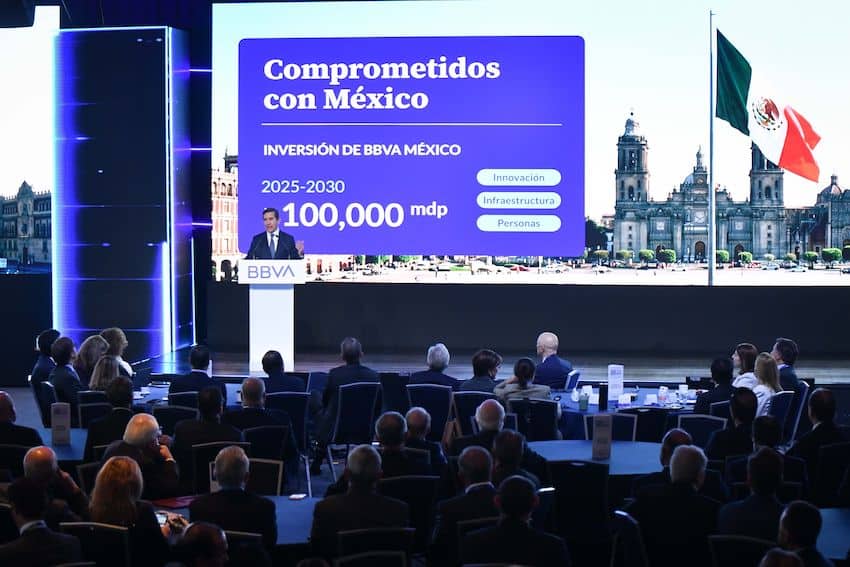
Levy, a non-resident senior fellow with the Global Economy and Development Program at Brookings Institution, a Washington, D.C.-based think tank, made his remarks at BBVA México’s National Meeting of Regional Advisors in Mexico City.
At the same event, Carlos Torres Vila, the chairman of BBVA, a multinational Spanish bank, declared that Mexico is in a favorable position to attract high levels of investment — despite the low productivity levels.
The BBVA meeting was held five days after the national statistics agency INEGI published preliminary data showing that the Mexican economy contracted 0.8% in the first quarter of 2026 compared to the previous three-month period. Annual growth in the period was just 0.2%.
In 2025, the Mexican economy grew just 0.8%, even as foreign direct investment and exports hit record highs and international tourist numbers increased more than 6%.
Levy: Productivity decline is the ‘tragedy of Mexico’
During his address at the BBVA event, Levy said that “in 25 years,” Mexico “hasn’t managed to increase its productivity.”
In fact, he added, productivity in Mexico today is lower than it was 25 years ago.
That assessment is largely supported by official data. BBVA said last October that “total factor productivity in Mexico has been negative for more than 30 years, subtracting an average of 0.5 percentage points from growth.”
“Economic growth has relied mainly on the accumulation of capital and materials, rather than on efficiency, innovation, or technological progress,” the bank added.
In Mexico City on Tuesday, Levy — a former vice president of the Inter-American Development Bank and ex-federal official who led the Mexican Social Security Institute between 2000 and 2005 — described the decline in productivity as “the tragedy of Mexico.”
Low productivity, he argued, is the main reason why the Mexican economy hasn’t expanded more quickly during times of macroeconomic stability supported by free trade agreements — including NAFTA and the USMCA — and the modernization of export sectors. Annual growth in Mexico was below 1% last year and below 2% in 2024, but the economy did expand more than 3% in 2023 and 2022.
Levy asserted that while some companies in Mexico — especially export-oriented ones that benefit from the USMCA — are very productive, many others have low levels of productivity. He said that most of those in the latter category are informal businesses, meaning that they don’t pay taxes and don’t provide benefits to their employees.
Mexico has a vast informal sector that employs more than 50% of Mexican workers. The informality rate increased 0.5 percentage points in the 12 months to March to reach 54.8%.
Citing his own calculations, Levy said that one peso invested in a formal sector company makes a 39% higher contribution to GDP than a peso invested in an informal business. If all the money invested in informal businesses over the past two decades had been invested in formal companies, productivity levels in Mexico today would be 27% higher, he asserted.
In addition, per capita income would be 17% higher, the economist said.
Levy pointed out that the proportion of formal sector workers has only declined five percentage points in the past two decades, and said that the number of informal businesses has grown in the same period.
According to BBVA, productivity in the United States “is driven by intangibles — software, R&D and highly skilled human capital — while in Mexico only 13.8% of workers have higher education, limiting productivity and perpetuating informality.”
“Overcoming this trap requires greater public and private investment, modern infrastructure, quality education, and a strategy that embraces innovation, digitalization, and artificial intelligence as engines of development,” the bank said.
Levy called for the construction of a national consensus in favor of gradual reforms to labor, tax and social protection policies, arguing that Mexico cannot achieve inclusive growth without tackling the divide between formal and informal workers.
Torres Vila: A time of ‘enormous opportunities’
In his opening address, Torres Vila declared that, “We live in a time of profound transformation” and “uncertainty,” but also a time of “enormous opportunities.”
Mexico, he said, “has the conditions to attract investment, strengthen its productive base, further integrate into global value chains, and boost its growth potential.”
Torres Vila highlighted that more than 80% of Mexican exports enter the U.S. tariff-free, and said that Mexico has highly competitive labor costs. He also said that Mexico’s proximity to and economic integration with the United States, its industrial capacity, its macroeconomic stability and its talent are all significant advantages.
“All of this puts Mexico in a privileged position to harness the opportunities stemming from nearshoring and the restructuring of global value chains,” Torres Vila said.
He acknowledged the federal government’s efforts to attract investment via Plan México, the ambitious economic initiative whose goals include making Mexico the 10th largest economy in the world by 2030. Torres Vila noted that the plan also seeks to strengthen the domestic market, lift wages for workers and support sustainable and inclusive growth.
Among other remarks, the bank executive stressed that Mexico needs investment in infrastructure, innovation and technology in order to realize its potential. He asserted that “BBVA has the scale, technology, talent and commitment to help turn that potential into reality.”
“… We believe in Mexico, in its industrial capacity, in its talent, in its integration with North America, in its companies, in its potential and we want to continue being the bank that accompanies this growth,” Torres Vila said.
With reports from EFE and La Jornada
Facts Only
Santiago Levy: economist, non-resident senior fellow with the Global Economy and Development Program at Brookings Institution
Carlos Torres Vila: chairman of BBVA, a multinational Spanish bank
Event: BBVA México’s National Meeting of Regional Advisors in Mexico City
Date: Not specified (event happened on Tuesday)
Location: Mexico City, Mexico
INEGI: national statistics agency of Mexico
Mexican economy: contracted 0.8% in the first quarter of 2026 compared to the previous three-month period; annual growth in the period was just 0.2%
Total factor productivity in Mexico: negative for more than 30 years, subtracting an average of 0.5 percentage points from growth
Executive Summary
In Mexico, economist Santiago Levy has highlighted the decline in productivity as a significant issue hindering economic growth. At a BBVA México event, he stated that productivity levels in Mexico are currently lower than they were 25 years ago, which he referred to as "the tragedy of Mexico." This assessment is supported by data showing that total factor productivity in Mexico has been negative for more than 30 years. Levy argued that this decline in productivity is the main reason why the Mexican economy hasn't grown faster despite macroeconomic stability, free trade agreements, and modernization of export sectors. He also pointed out that the proportion of formal sector workers has only declined five percentage points in the past two decades, while the number of informal businesses has grown.
In addition, Carlos Torres Vila, chairman of BBVA, declared that Mexico is in a favorable position to attract high levels of investment despite low productivity levels. This statement was made at the same event, five days after the national statistics agency INEGI published preliminary data showing that the Mexican economy contracted 0.8% in the first quarter of 2026 compared to the previous three-month period, with annual growth in the period being just 0.2%.
Full Take
The decline in productivity in Mexico is a complex issue that Levy attributes to the reliance on the accumulation of capital and materials rather than efficiency, innovation, or technological progress. He also highlighted that many informal businesses, which employ more than 50% of Mexican workers, have low levels of productivity. This informality rate increased 0.5 percentage points in the 12 months to March to reach 54.8%.
Levy's analysis suggests that if all the money invested in informal businesses over the past two decades had been invested in formal companies, productivity levels in Mexico today would be 27% higher, and per capita income would be 17% higher. He called for the construction of a national consensus in favor of gradual reforms to labor, tax, and social protection policies, arguing that Mexico cannot achieve inclusive growth without tackling the divide between formal and informal workers.
Sentinel — Human
The article shows signs of human authorship due to the presence of passion, idiosyncratic emphasis, and varied sentence length. There are no indications of synthetic generation or manipulation.