By — Mark Vancleave, Associated Press Mark Vancleave, Associated Press By — Steve Karnowski, Associated Press Steve Karnowski, Associated Press By — Todd Richmond, Associated Press Todd Richmond, Associated Press By — John Hanna, Associated Press John Hanna, Associated Press Leave your feedback Share Copy URL https://www.pbs.org/newshour/nation/no-kings-rallies-draw-crowds-across-u-s-and-europe-as-springsteen-headlines-minnesota-demonstration Email Facebook Twitter LinkedIn Pinterest Tumblr Share on Facebook Share on Twitter 'No Kings' rallies draw crowds across U.S. and Europe as Springsteen headlines Minnesota demonstration Nation Mar 28, 2026 5:27 PM EDT ST. PAUL, Minn. (AP) — Crowds of people protested Saturday against the war in Iran and President Donald Trump's actions, in "No Kings" rallies across the U.S. and in Europe. Minnesota took center stage, in what organizers expected to be mass demonstrations involving millions of people. Thousands of people stood shoulder-to-shoulder on the Minnesota Capitol lawn and surrounding streets in St. Paul. Some held upside down U.S. flags, historically a sign of distress. WATCH: 'We intend to defend our democracy,' says 'No Kings' protest organizer The event's headliner was Bruce Springsteen, who performed "Streets of Minneapolis." He wrote the song in response to the fatal shootings of Renee Good and Alex Pretti by federal agents and in tribute to the thousands of Minnesotans who took to the streets over the winter to protest the Trump administration's aggressive immigration enforcement. A man takes part in a "No Kings" protest against U.S. President Donald Trump's administration policies, in Boston, Massachusetts, U.S., March 28, 2026. Photo by Brian Snyder via Reuters. Before he launched into the song, Springsteen lamented Good and Pretti's deaths but said people's continued pushback against U.S. Customs and Immigration Enforcement has given the rest of the country hope. "Your strength and your commitment told us that this was still America," he said. "And this reactionary nightmare, and these invasions of American cities, will not stand." People rallied from New York City, with almost 8.5 million residents in a solidly blue state, to Driggs, a town of fewer than 2,000 people in eastern Idaho, a state Trump carried with 66% of the vote in 2024. Biggest crowds yet expected U.S. organizers have estimated that the first two rounds of No Kings rallies drew more than 5 million people in June and 7 million in October. This week they told reporters they expected 9 million participants Saturday, though it was too early to tell whether those expectations were met. Organizers said more than 3,100 events — 500 more than in October — were registered, in all 50 states. Demonstrators attend a "No Kings" protest against U.S. President Donald Trump's administration policies, in Washington, D.C., U.S., March 28, 2026. Photo by Leah Millis via Reuters. In Topeka, Kansas, a rally outside the Statehouse had people impersonating a frog king and Trump as a baby. Wendy Wyatt drove with "Cats Against Trump" sign from Lawrence, 20 miles (32 kilometers) to the east, and planned to drive back to her hometown for a later rally there. Wyatt said "there are so many things" about the Trump administration that upset her, but "this is very hopeful to me." GOP officials dismissive of protests White House spokesperson Abigail Jackson characterized them as the product of "leftist funding networks" with little real public support. The "only people who care about these Trump Derangement Therapy Sessions are the reporters who are paid to cover them," Jackson said in a statement. READ MORE: Trump Jr. mocks 'No Kings' protesters at business summit hosted by Saudi royals The National Republican Congressional Committee was also sharply critical. "These Hate America Rallies are where the far-left's most violent, deranged fantasies get a microphone," NRCC spokesperson Maureen O'Toole said. Protesters have a long list of causes The Trump administration's aggressive immigration enforcement, particularly in Minnesota, were just one item on a long list of protester grievances that also included the war in Iran and the rollback of transgender rights. In Washington, hundreds marched past the Lincoln Memorial and into the National Mall, holding signs that read "Put down the crown, clown" and "Regime change begins at home." Demonstrators rang bells, played drums and chanted "No kings." Bill Jarcho was there from Seattle, joined by six people dressed as insects wearing tactical vests that said, "LICE," spoofing ICE as part of what he called a "mock and awe" tour. A demonstrator holds a placard as people gather for "No Kings" protest against U.S. President Donald Trump's administration policies, in New York City, New York, U.S., March 28, 2026. Photo by Jeenah Moon via Reuters. "What we provide is mockery to the king," Jarcho said. "It's about taking authoritarianism and making fun of it, which they hate." About 40,000 people marched in a "No Kings" event in San Diego, police there said. In New York, Donna Lieberman, executive director of the New York Civil Liberties Union, said during a news conference that Trump and his supporters want people to be afraid to protest. WATCH: Millions turn out nationwide for 'No Kings' protests against Trump administration "They want us to be afraid that there's nothing we can do to stop them," she said. "But you know what? They are wrong — dead wrong." But organizers said two-thirds of the RSVPs for the rallies came from outside of major urban centers. That included communities in conservative-leaning states like Idaho, Wyoming, Montana, Utah, South Dakota and Louisiana, as well in competitive suburban areas of Pennsylvania, Georgia and Arizona. Main event is at the Minnesota Capitol Organizers designated the rally there as the national flagship event, in recognition of how the state where federal agents fatally shot two people who were monitoring Trump's immigration crackdown. Springsteen's Land of Hope & Dreams American Tour has a "No Kings" theme and kicks off Tuesday in Minneapolis. People march towards the Minnesota State Capitol to take part in a "No Kings" protest against U.S. President Donald Trump's administration policies, in St. Paul, Minnesota, March 28, 2026. REUTERS/Erica Dischino Before the rocker known as "the Boss" took the stage, organizers played a video from Robert DeNiro. The actor said he wakes up every morning depressed because of Trump but was happier Saturday because millions of people were protesting. He also congratulated Minnesota residents for running ICE out. An event on the Minnesota Capitol grounds in June drew an estimated 80,000 people and Minnesota organizers expected 100,000 on Saturday. The bill also included singer Joan Baez, actor Jane Fonda,Sen. Bernie Sanders and a long list of other activists, labor leaders and elected officials. Protesters held up a massive sign on the Capitol steps that read, "We had whistles, they had guns. The revolution starts in Minneapolis." Rallies planned outside the U.S. Rallies are also planned in more than a dozen other countries, from Europe to Latin America to Australia, Ezra Levin, a co-executive director of Indivisible, a group spearheading the events, said in an interview. Countries with constitutional monarchies call the protests "No Tyrants," he said. In Rome, thousands of people marched with defiant chants aimed at Premier Giorgia Meloni, whose conservative government saw its referendum for streamlining Italy's judiciary badly fail earlier this week amid criticism that it was a threat to the courts' independence. Protesters waved banners protesting the Israeli and US attacks on Iran, calling for "A world free from wars." In London, people protesting the war in Iran held banners that said, "Stop the far right" and "Stand up to Racism." And on Saturday morning in Paris, several hundred people, mostly Americans living in France, along with French labor unions and human rights organizations, gathered at the Bastille. "I protest all of Trump's illegal, immoral, reckless, and feckless, endless wars," Ada Shen, the Paris No Kings organizer, said. ___ Richmond reported from Madison, Wisconsin, and Hanna from Topeka, Kansas. Associated Press journalists Nicholas Garriga in Paris, Mike Pesoli in Washington, Colleen Berry in Milan, and Amy Taxin in Santa Ana, California, contributed. A free press is a cornerstone of a healthy democracy. Support trusted journalism and civil dialogue. Donate now By — Mark Vancleave, Associated Press Mark Vancleave, Associated Press By — Steve Karnowski, Associated Press Steve Karnowski, Associated Press By — Todd Richmond, Associated Press Todd Richmond, Associated Press By — John Hanna, Associated Press John Hanna, Associated Press
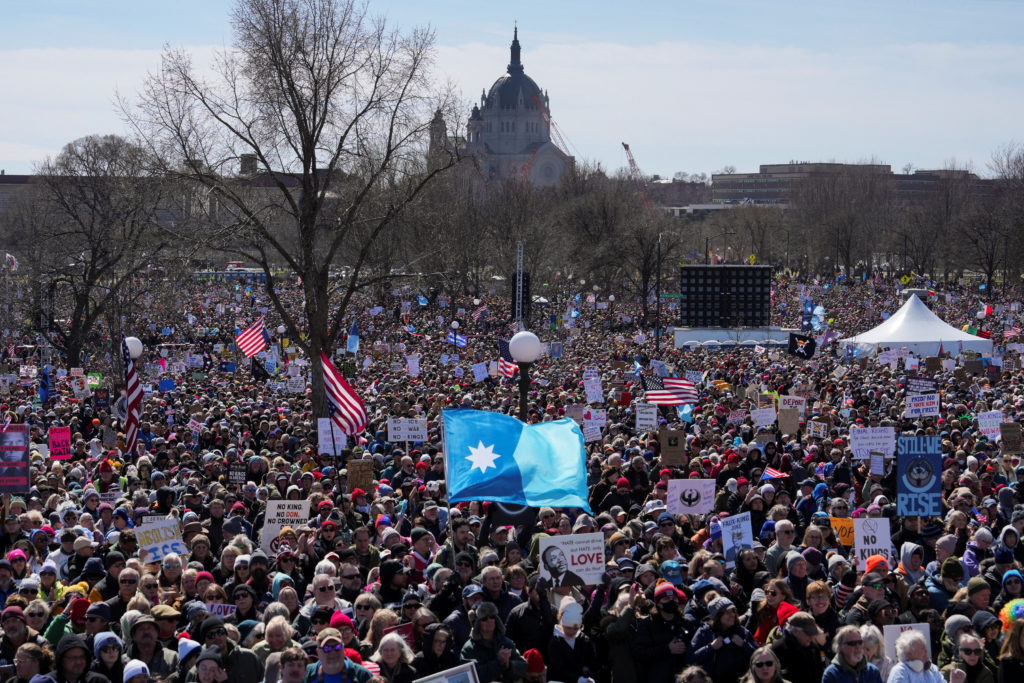
ST. PAUL, Minn. (AP) — Crowds of people protested Saturday against the war in Iran and President Donald Trump's actions, in "No Kings" rallies across the U.S. and in Europe. Minnesota took center stage, in what organizers expected to be mass demonstrations involving millions of people. Thousands of people stood shoulder-to-shoulder on the Minnesota Capitol lawn and surrounding streets in St. Paul. Some held upside down U.S. flags, historically a sign of distress. WATCH: 'We intend to defend our democracy,' says 'No Kings' protest organizer The event's headliner was Bruce Springsteen, who performed "Streets of Minneapolis." He wrote the song in response to the fatal shootings of Renee Good and Alex Pretti by federal agents and in tribute to the thousands of Minnesotans who took to the streets over the winter to protest the Trump administration's aggressive immigration enforcement. A man takes part in a "No Kings" protest against U.S. President Donald Trump's administration policies, in Boston, Massachusetts, U.S., March 28, 2026. Photo by Brian Snyder via Reuters. Before he launched into the song, Springsteen lamented Good and Pretti's deaths but said people's continued pushback against U.S. Customs and Immigration Enforcement has given the rest of the country hope. "Your strength and your commitment told us that this was still America," he said. "And this reactionary nightmare, and these invasions of American cities, will not stand." People rallied from New York City, with almost 8.5 million residents in a solidly blue state, to Driggs, a town of fewer than 2,000 people in eastern Idaho, a state Trump carried with 66% of the vote in 2024. Biggest crowds yet expected U.S. organizers have estimated that the first two rounds of No Kings rallies drew more than 5 million people in June and 7 million in October. This week they told reporters they expected 9 million participants Saturday, though it was too early to tell whether those expectations were met. Organizers said more than 3,100 events — 500 more than in October — were registered, in all 50 states. Demonstrators attend a "No Kings" protest against U.S. President Donald Trump's administration policies, in Washington, D.C., U.S., March 28, 2026. Photo by Leah Millis via Reuters. In Topeka, Kansas, a rally outside the Statehouse had people impersonating a frog king and Trump as a baby. Wendy Wyatt drove with "Cats Against Trump" sign from Lawrence, 20 miles (32 kilometers) to the east, and planned to drive back to her hometown for a later rally there. Wyatt said "there are so many things" about the Trump administration that upset her, but "this is very hopeful to me." GOP officials dismissive of protests White House spokesperson Abigail Jackson characterized them as the product of "leftist funding networks" with little real public support. The "only people who care about these Trump Derangement Therapy Sessions are the reporters who are paid to cover them," Jackson said in a statement. READ MORE: Trump Jr. mocks 'No Kings' protesters at business summit hosted by Saudi royals The National Republican Congressional Committee was also sharply critical. "These Hate America Rallies are where the far-left's most violent, deranged fantasies get a microphone," NRCC spokesperson Maureen O'Toole said. Protesters have a long list of causes The Trump administration's aggressive immigration enforcement, particularly in Minnesota, were just one item on a long list of protester grievances that also included the war in Iran and the rollback of transgender rights. In Washington, hundreds marched past the Lincoln Memorial and into the National Mall, holding signs that read "Put down the crown, clown" and "Regime change begins at home." Demonstrators rang bells, played drums and chanted "No kings." Bill Jarcho was there from Seattle, joined by six people dressed as insects wearing tactical vests that said, "LICE," spoofing ICE as part of what he called a "mock and awe" tour. A demonstrator holds a placard as people gather for "No Kings" protest against U.S. President Donald Trump's administration policies, in New York City, New York, U.S., March 28, 2026. Photo by Jeenah Moon via Reuters. "What we provide is mockery to the king," Jarcho said. "It's about taking authoritarianism and making fun of it, which they hate." About 40,000 people marched in a "No Kings" event in San Diego, police there said. In New York, Donna Lieberman, executive director of the New York Civil Liberties Union, said during a news conference that Trump and his supporters want people to be afraid to protest. WATCH: Millions turn out nationwide for 'No Kings' protests against Trump administration "They want us to be afraid that there's nothing we can do to stop them," she said. "But you know what? They are wrong — dead wrong." But organizers said two-thirds of the RSVPs for the rallies came from outside of major urban centers. That included communities in conservative-leaning states like Idaho, Wyoming, Montana, Utah, South Dakota and Louisiana, as well in competitive suburban areas of Pennsylvania, Georgia and Arizona. Main event is at the Minnesota Capitol Organizers designated the rally there as the national flagship event, in recognition of how the state where federal agents fatally shot two people who were monitoring Trump's immigration crackdown. Springsteen's Land of Hope & Dreams American Tour has a "No Kings" theme and kicks off Tuesday in Minneapolis. People march towards the Minnesota State Capitol to take part in a "No Kings" protest against U.S. President Donald Trump's administration policies, in St. Paul, Minnesota, March 28, 2026. REUTERS/Erica Dischino Before the rocker known as "the Boss" took the stage, organizers played a video from Robert DeNiro. The actor said he wakes up every morning depressed because of Trump but was happier Saturday because millions of people were protesting. He also congratulated Minnesota residents for running ICE out. An event on the Minnesota Capitol grounds in June drew an estimated 80,000 people and Minnesota organizers expected 100,000 on Saturday. The bill also included singer Joan Baez, actor Jane Fonda,Sen. Bernie Sanders and a long list of other activists, labor leaders and elected officials. Protesters held up a massive sign on the Capitol steps that read, "We had whistles, they had guns. The revolution starts in Minneapolis." Rallies planned outside the U.S. Rallies are also planned in more than a dozen other countries, from Europe to Latin America to Australia, Ezra Levin, a co-executive director of Indivisible, a group spearheading the events, said in an interview. Countries with constitutional monarchies call the protests "No Tyrants," he said. In Rome, thousands of people marched with defiant chants aimed at Premier Giorgia Meloni, whose conservative government saw its referendum for streamlining Italy's judiciary badly fail earlier this week amid criticism that it was a threat to the courts' independence. Protesters waved banners protesting the Israeli and US attacks on Iran, calling for "A world free from wars." In London, people protesting the war in Iran held banners that said, "Stop the far right" and "Stand up to Racism." And on Saturday morning in Paris, several hundred people, mostly Americans living in France, along with French labor unions and human rights organizations, gathered at the Bastille. "I protest all of Trump's illegal, immoral, reckless, and feckless, endless wars," Ada Shen, the Paris No Kings organizer, said. ___ Richmond reported from Madison, Wisconsin, and Hanna from Topeka, Kansas. Associated Press journalists Nicholas Garriga in Paris, Mike Pesoli in Washington, Colleen Berry in Milan, and Amy Taxin in Santa Ana, California, contributed. A free press is a cornerstone of a healthy democracy. Support trusted journalism and civil dialogue. Donate now
Facts Only
On March 28, 2026, "No Kings" rallies were held across the U.S. and Europe, with Minnesota as the primary location.
Thousands gathered at the Minnesota Capitol in St. Paul, some holding upside-down U.S. flags.
Bruce Springsteen performed "Streets of Minneapolis," a song written in response to the fatal shootings of Renee Good and Alex Pretti by federal agents.
Organizers estimated 9 million participants across 3,100 events in all 50 states, exceeding previous rallies in June (5 million) and October (7 million).
Protests occurred in cities like New York, Washington, D.C., and San Diego, as well as smaller towns like Driggs, Idaho.
In Topeka, Kansas, protesters impersonated a frog king and Trump as a baby.
White House spokesperson Abigail Jackson dismissed the protests as "leftist funding networks" with little public support.
The National Republican Congressional Committee called the rallies "Hate America Rallies."
Protesters cited grievances including immigration enforcement, the war in Iran, and transgender rights rollbacks.
In Washington, D.C., demonstrators chanted "No kings" and held signs like "Put down the crown, clown."
About 40,000 people marched in San Diego, according to local police.
Rallies were also held in Rome, London, and Paris, with some adapted to "No Tyrants" in constitutional monarchies.
In Rome, protesters targeted Italian Premier Giorgia Meloni over judicial reforms.
The Minnesota rally featured Joan Baez, Jane Fonda, Sen. Bernie Sanders, and other activists.
A video message from Robert DeNiro was played, praising Minnesota protesters for "running ICE out."
Organizers expected 100,000 attendees in Minnesota, up from 80,000 in June.
Executive Summary
On March 28, 2026, mass protests under the banner "No Kings" erupted across the U.S. and Europe, with Minnesota serving as the focal point. Organizers estimated 9 million participants across 3,100 events, building on previous rallies in June and October that drew 5 million and 7 million, respectively. The demonstrations targeted President Donald Trump's administration, particularly its aggressive immigration enforcement, the war in Iran, and rollbacks of transgender rights. In St. Paul, Minnesota, thousands gathered at the state Capitol, where Bruce Springsteen headlined with a song written in response to the fatal shootings of two activists by federal agents. Protests ranged from major cities like New York and Washington, D.C., to smaller towns in conservative states like Idaho and Kansas. Republican officials dismissed the protests as leftist-funded spectacles, while organizers emphasized broad participation, including in rural and conservative areas. Internationally, rallies occurred in Rome, London, and Paris, with some adapting the name to "No Tyrants" in countries with constitutional monarchies.
The protests featured a mix of cultural figures, activists, and politicians, including Joan Baez, Jane Fonda, and Sen. Bernie Sanders. Demonstrators employed symbolic acts, such as displaying upside-down U.S. flags and satirical performances mocking authoritarianism. While organizers framed the events as a defense of democracy, GOP critics labeled them as "Hate America Rallies." The scale and geographic diversity of the protests suggest a significant, though contested, mobilization against Trump's policies, with uncertain immediate political impact.
Full Take
The "No Kings" protests represent a significant escalation in organized opposition to the Trump administration, leveraging cultural icons like Springsteen to amplify grievances over immigration, war, and civil rights. The strongest version of this narrative casts the rallies as a grassroots defense of democracy, with organizers highlighting participation beyond traditional liberal strongholds—two-thirds of RSVPs came from outside major cities, including conservative states. The inclusion of satirical elements (e.g., "LICE" vests mocking ICE) and international solidarity (e.g., Paris protesters decrying Trump's wars) reinforces a framing of resistance as both serious and subversive.
However, the narrative also exhibits patterns of emotional exploitation and distortion. The upside-down U.S. flags and phrases like "reactionary nightmare" tap into weaponized anger, while the GOP's dismissal as "Hate America Rallies" reflects a motte-and-bailey tactic—criticizing the protests' tone while ignoring substantive policy critiques. The article's focus on Springsteen and celebrity endorsements risks authority games, where cultural credibility substitutes for policy debate. The root cause appears to be a clash between populist authoritarianism and liberal pluralism, echoing historical backlashes against executive overreach (e.g., Vietnam War protests). Yet the protests' decentralized nature—spanning rural Idaho to Rome—suggests a broader paradigm: a transnational pushback against perceived democratic erosion, with unclear second-order effects. Who benefits? Organizers gain momentum, but Trump's base may further entrench. Who bears costs? Polarization deepens, and marginalized groups (e.g., immigrants, transgender individuals) remain vulnerable.
Bridge questions: How might these protests reshape electoral strategies in 2026? What counter-mobilizations could emerge, and how would they frame their grievances? Would the inclusion of conservative voices (e.g., anti-war libertarians) alter the narrative's resonance?
Counterstrike scan: A coordinated influence campaign would amplify celebrity endorsements to manufacture consensus, use emotional imagery (e.g., upside-down flags) to provoke outrage, and dismiss critics as "leftist elites" to polarize. The actual content aligns partially—celebrity focus and emotional framing are present—but the geographic diversity and policy-specific grievances (e.g., ICE, Iran) suggest organic mobilization rather than astroturfing. The GOP's rhetorical counterattack ("Hate America Rallies") mirrors standard polarization tactics but lacks evidence of coordination.
Patterns detected: ARC-0043 Motte-and-Bailey (GOP framing), ARC-0024 Ambiguity (protest goals), ARC-0018 Emotional Exploitation (symbolism and language).