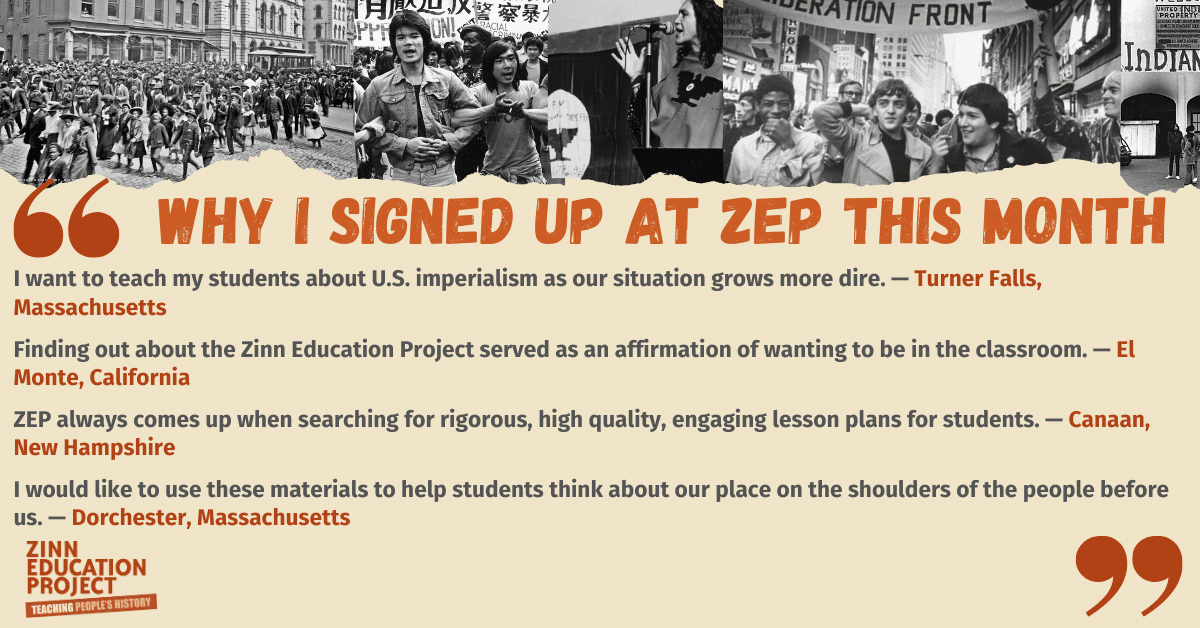
We love hearing how people found us and why they’ve signed up to access people’s history lessons from the Zinn Education Project.
Here are a few of the hundreds of comments educators shared in March.
Despite — and in response to — the Executive Orders censoring honest teaching, educators are bravely signing up at the Zinn Education Project in greater numbers.
More than 179,279 educators have signed up to access people’s history resources.
Please donate so that we can continue to provide our free lessons and defend teachers’ right to use them.
Twitter
Google plus
LinkedIn
Facts Only
The Zinn Education Project provides people’s history lessons.
Over 179,279 educators have signed up to access these resources.
Educators are joining in greater numbers despite executive orders censoring certain teachings.
The project shares testimonials from educators about why they signed up.
The organization requests donations to continue offering free lessons.
The project aims to defend teachers’ right to use its materials.
Social media links (Twitter, Google Plus, LinkedIn) are provided for sharing.
Executive Summary
The Zinn Education Project, a provider of people’s history resources, has seen a significant increase in educator sign-ups, with over 179,279 educators now registered. This surge comes amid executive orders aimed at censoring honest teaching about history, particularly in public schools. Educators are reportedly joining the platform to access free lessons and defend their right to teach these materials. The project highlights testimonials from educators who explain their motivations for signing up, emphasizing the value of alternative historical narratives. The organization also solicits donations to sustain its operations and support teachers facing restrictions on curriculum content.
The context suggests a broader debate over educational freedom and the role of historical narratives in classrooms. While the project frames its mission as a response to censorship, critics might argue that its materials present a specific ideological perspective. The call for donations underscores the financial challenges of maintaining such resources in a politically charged environment. The exact nature of the "honest teaching" being censored is not detailed, leaving room for interpretation about what content is at stake.
Full Take
The Zinn Education Project presents itself as a counterforce to what it frames as censorship of honest historical education. At its strongest, this narrative highlights the importance of diverse perspectives in education and the resilience of educators seeking to teach beyond traditional curricula. The project’s emphasis on testimonials from teachers humanizes the issue, making it relatable to those who value academic freedom.
However, the framing risks emotional exploitation by positioning the project as a heroic resistance against vague "censorship," without specifying which executive orders or policies are directly targeting its content. The appeal for donations, while necessary for sustainability, could be seen as leveraging a sense of urgency or moral duty to solicit funds. The lack of detail about the contested historical narratives leaves room for distortion—readers might assume the worst about the censorship without evidence of its scope or intent.
Root cause: This narrative reflects a broader cultural battle over historical memory and who controls educational narratives. The unstated assumption is that mainstream curricula are inadequate or biased, and that "people’s history" offers a corrective. This echoes historical patterns where marginalized groups challenge dominant narratives, but it also risks reinforcing a binary of "honest" versus "dishonest" teaching, which may oversimplify complex debates about pedagogy and objectivity.
Implications: For human agency, this empowers educators to seek alternative resources but may also polarize discussions about history education. The beneficiaries are teachers and students who gain access to diverse materials, while the costs could include heightened political scrutiny or backlash against educators. Second-order consequences might include further politicization of classrooms or the normalization of bypassing official curricula.
Bridge questions: What specific historical content is being censored, and by whom? How do we balance the need for diverse perspectives with the risk of ideological indoctrination in education? What evidence would change your view on whether this project is a necessary corrective or a partisan tool?
Counterstrike scan: A coordinated influence campaign might use emotional appeals about "censorship" to rally support while obscuring the actual content being disputed. The actual content here does not fully match this pattern, as it provides concrete numbers and educator testimonials, but the lack of specificity about the censorship could be exploited by bad actors to amplify division. The call for donations, while standard for nonprofits, could be weaponized to frame the project as under siege, even if the threat is overstated.
Patterns detected: ARC-0024 Ambiguity (vague references to censorship without specifics), ARC-0043 Motte-and-Bailey (defending "honest teaching" as a broad principle while potentially advocating for specific ideological content).
Sentinel — Human
This analysis suggests that the text might have been produced by a machine or AI, given its balanced framing and vague attributions. However, it's important to note that human signals are present, which could indicate human involvement. Further investigation would be needed for certainty.