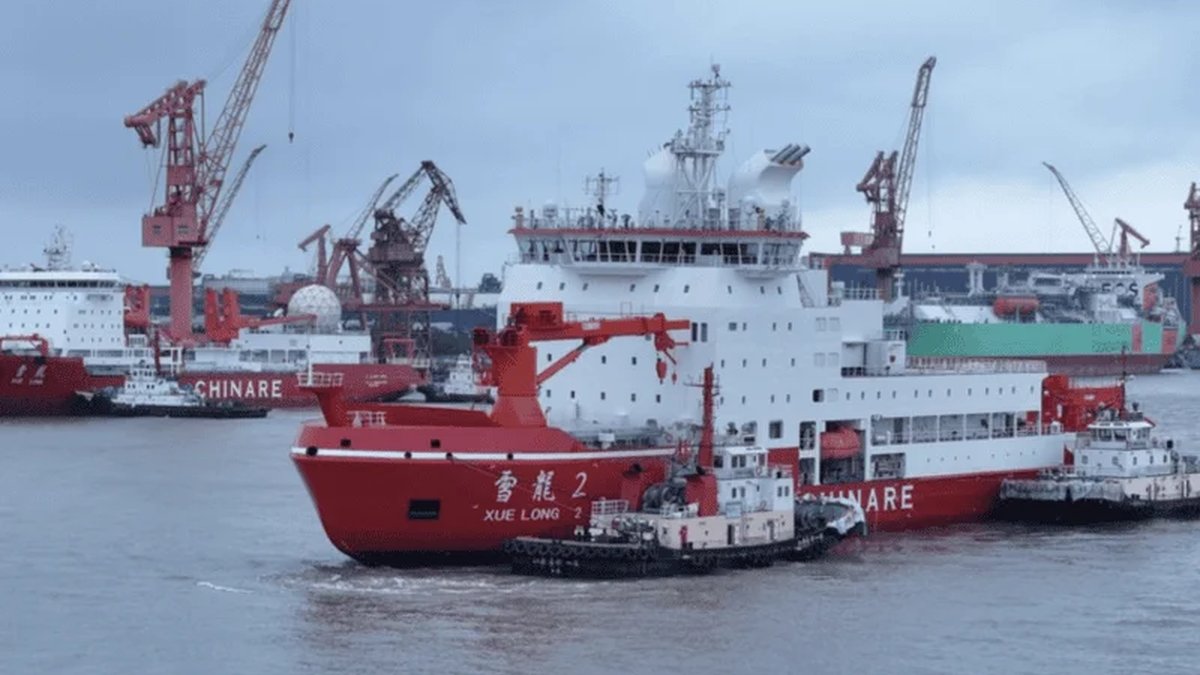
China has launched its annual Arctic summer expedition with four major research vessels heading north, expanding a polar presence that has increasingly drawn the attention of U.S. lawmakers and military planners following last yearŌĆÖs unprecedented Chinese operations near Alaska.
The Chinese Ministry of Natural Resources said icebreakers Xue Long (Snow Dragon) and Xue Long 2, together with the new polar research vessel Jidi, departed China on Friday to begin the countryŌĆÖs 16th Arctic scientific expedition, which is expected to continue until October. Deep-sea research ship Tan Suo San Hao is also expected to join the expedition.
The mission will focus on responding to climate change, marine ecosystems, atmospheric and oceanographic observations, sea ice processes, environmental monitoring and surveys supporting sustainable Arctic development, according to state media.
The deployment comes as ChinaŌĆÖs steadily expanding Arctic footprint has become an increasing strategic concern for Washington, with U.S. officials viewing BeijingŌĆÖs scientific activities as having potential dual-use applications alongside research.
The expedition follows the vesselsŌĆÖ return earlier this year from ChinaŌĆÖs Antarctic research campaign. Before redeployment north, both Xue Long and Xue Long 2 underwent maintenance and servicing at Chinese shipyards. Xue Long 2 recently completed maintenance Jiangnan Shipyard near Shanghai before returning to service.
The ships were repeatedly shadowed by U.S. Coast Guard cutters and maritime patrol aircraft as they conducted scientific operations near AlaskaŌĆÖs extended continental shelf, underscoring growing competition in the increasingly accessible Arctic. U.S. officials stressed that while freedom of navigation permits transit through international waters, scientific research within the U.S. extended continental shelf requires American consent.
Those operations have prompted calls in Congress for tighter oversight. Last month, U.S. senators introduced legislation seeking to require foreign government research vessels, including Chinese ships, to obtain U.S. authorization before conducting marine scientific research in or near the U.S. Exclusive Economic Zone and extended continental shelf, arguing existing legal authorities leave potential gaps that competitors could exploit.
China describes itself as a ŌĆ£near-Arctic stateŌĆØ and has steadily increased investment in polar research, shipping and infrastructure over the past decade despite having no Arctic coastline. Beijing argues its scientific work contributes to understanding climate change and improving knowledge of the rapidly warming region.
The vessels participating in this yearŌĆÖs expedition represent the core of ChinaŌĆÖs expanding polar fleet.
The Xue Long, originally built in Ukraine in 1993 as an Arctic cargo vessel before conversion into a research icebreaker, measures roughly 167 meters and has served as ChinaŌĆÖs principal polar research platform for nearly three decades.
Its successor, the 122.5-meter Xue Long 2, entered service in 2019 as ChinaŌĆÖs first domestically built polar icebreaker. The approximately 14,000-ton vessel is built to Polar Class 3 standards.
Joining them are the newer Jidi, an ice-class polar research vessel supporting multidisciplinary Arctic surveys, and Tan Suo San Hao, ChinaŌĆÖs latest polar-capable deep-sea research ship built to Polar Class 4 standards and equipped to support both ice operations and advanced oceanographic research.
China's military and coast guard said on Tuesday they had carried out patrols in the waters around Scarborough Shoal in the South China Sea, as part of safeguarding Beijing's territorial claims to the area.
Two U.S. senators introduced bipartisan legislation on Monday aimed at barring Chinese and Russian government-linked vessels from conducting research operations in U.S. Arctic waters, reflecting growing concern in Washington that scientific missions are increasingly being used to support intelligence gathering and strategic competition in the High North.
June 15, 2026
Total Views: 1202
Get The IndustryŌĆÖs Go-To News
Subscribe to gCaptain Daily and stay informed with the latest global maritime and offshore news
ŌĆö just like 104,827 professionals
Secure Your Spot
on the gCaptain Crew
Stay informed with the latest maritime and offshore news, delivered daily straight to your inbox
ŌĆö trusted by our 104,827 members
Your Gateway to the Maritime World!
Essential news coupled with the finest maritime content sourced from across the globe.
Sentinel — Human
This text reads like a well-structured geopolitical news report that successfully blends factual reporting with strategic context. It displays the coherence and detail typical of human journalism.