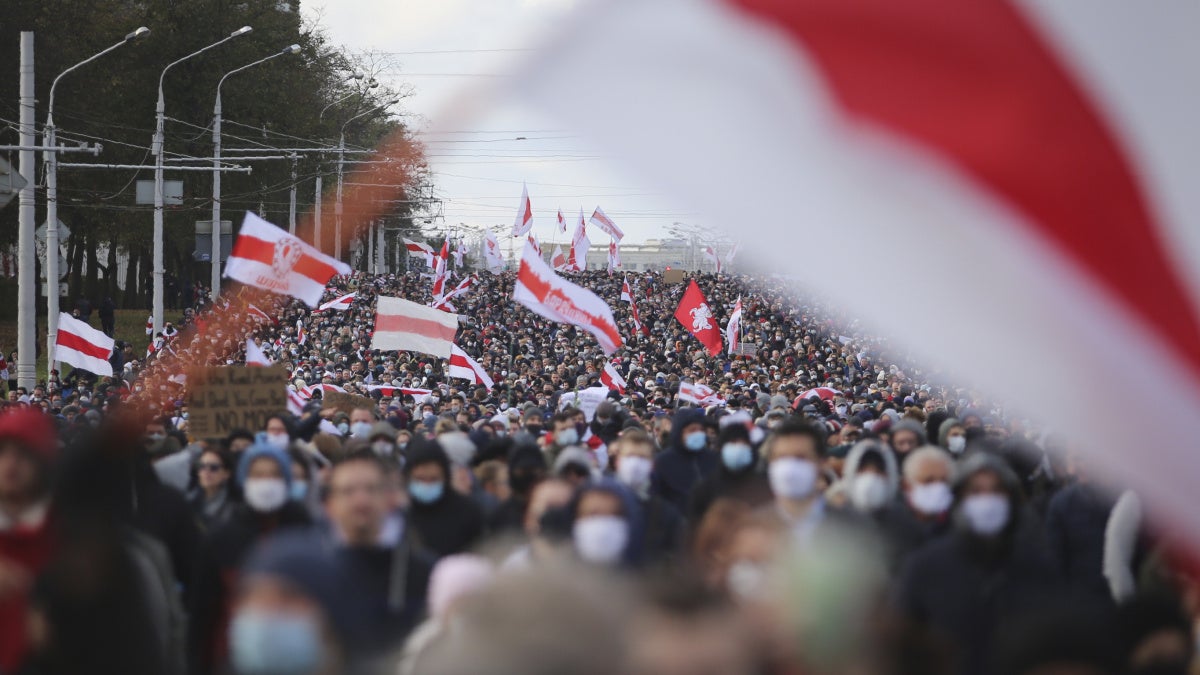
Next week, the United Nations Human Rights Council will vote on a resolution to renew the mandates of the Group of Independent Experts on the Situation in Belarus and the special rapporteur on Belarus. As Belarusian authorities continue to commit grave rights violations in the country and persecute Belarusians in exile, these mandates are vital to addressing the unrelenting rights crisis in Belarus and help provide a prospect for future accountability.
Civil society organizations, including Human Rights Watch, have long documented Belarus’ crackdown on independent voices, including the malicious prosecution and harassment of human rights defenders, journalists, lawyers, opposition politicians, protesters, and activists. At least 860 people remain behind bars for peacefully exercising their fundamental rights and freedoms and many face torture and ill-treatment in detention. Former political prisoners, including some most recently released, are forced into exile. Human rights organizations are unable to operate legally in the country.
A report presented by the group of experts during the current council session provides a clear picture of the severity of the crisis. It identifies continuing patterns of violations including arbitrary detention of individuals for their actual or perceived opposition to the government, inhumane conditions, ill-treatment, torture and death in detention, and newly verified patterns of forced exiles, forced pardon requests, and transnational repression. According to the report, some of these violations amount to crimes against humanity.
The group of experts is instrumental in preserving and analyzing evidence of grave human rights violations and, where possible, identifying those responsible, with a view to future accountability. The recent decision by the International Criminal Court (ICC) prosecutor’s office to open an investigation into alleged crimes committed by Belarusian authorities at least in part in the territory of Lithuania, an ICC member, underlines the ongoing utility for the investigative-mechanism’s work. Meanwhile, the special rapporteur is a longstanding lifeline for Belarusian civil society, ensuring that violations of all fundamental rights remain in public scrutiny.
By maintaining both the accountability-focused mechanism and the expert monitor, the council ensures that the systematic nature and gravity of Belarus’ rights violations receive in-depth scrutiny. The council should heed the call of Belarusian and international civil society organizations to renew both mechanisms and send an unequivocal message that the UN remains vigilant and committed to supporting those seeking justice and respect for human rights in Belarus.
Facts Only
United Nations Human Rights Council to vote on renewing mandates for Group of Independent Experts and special rapporteur on Belarus
Human rights crisis in Belarus due to government's crackdown on opposition voices, peaceful protesters, journalists, lawyers, and activists
At least 860 individuals detained; many face torture and ill-treatment
Former political prisoners forced into exile
Human rights organizations unable to operate legally in Belarus
Report by Group of Independent Experts highlights continuing patterns of violations including arbitrary detention, inhumane conditions, torture, death in custody, forced exiles, and transnational repression
Executive Summary
Full Take
As the UN Human Rights Council prepares to vote on the renewal of mandates for the Group of Independent Experts and special rapporteur on Belarus, it is crucial to consider the broader context of continued human rights abuses in Belarus. The crisis has seen a wide range of opposition figures and peaceful protesters targeted, with at least 860 individuals detained and facing harsh treatment in custody. Notably, the recent decision by the International Criminal Court (ICC) prosecutor's office to open an investigation into alleged crimes committed by Belarusian authorities underscores the importance of maintaining accountability-focused mechanisms like the Group of Independent Experts.
In terms of manipulation patterns, it is worth considering the potential use of ARC-0024 Ambiguity in this narrative. The report's assertion that some abuses amount to crimes against humanity is a powerful claim, yet it leaves room for debate regarding the specific incidents and individuals involved. It is essential to maintain a principled skepticism towards such strong statements while acknowledging their potential validity within the broader context of widespread human rights violations in Belarus.
Patterns detected: ARC-0024 Ambiguity
Ultimately, the renewal of both mechanisms would send a clear message that the UN remains committed to supporting those seeking justice and respect for human rights in Belarus. However, it is crucial for readers to recognize the complex nature of this ongoing crisis and remain vigilant against manipulation tactics that may seek to distort or oversimplify the reality on the ground.
Bridge questions:
What perspectives are missing from this narrative?
How can international communities more effectively support Belarusian civil society in their efforts to promote human rights?
Sentinel — Human
This article appears to be written by a human journalist, showcasing a unique writing style, varying sentence lengths, and a passionate and informative narrative about the human rights situation in Belarus.