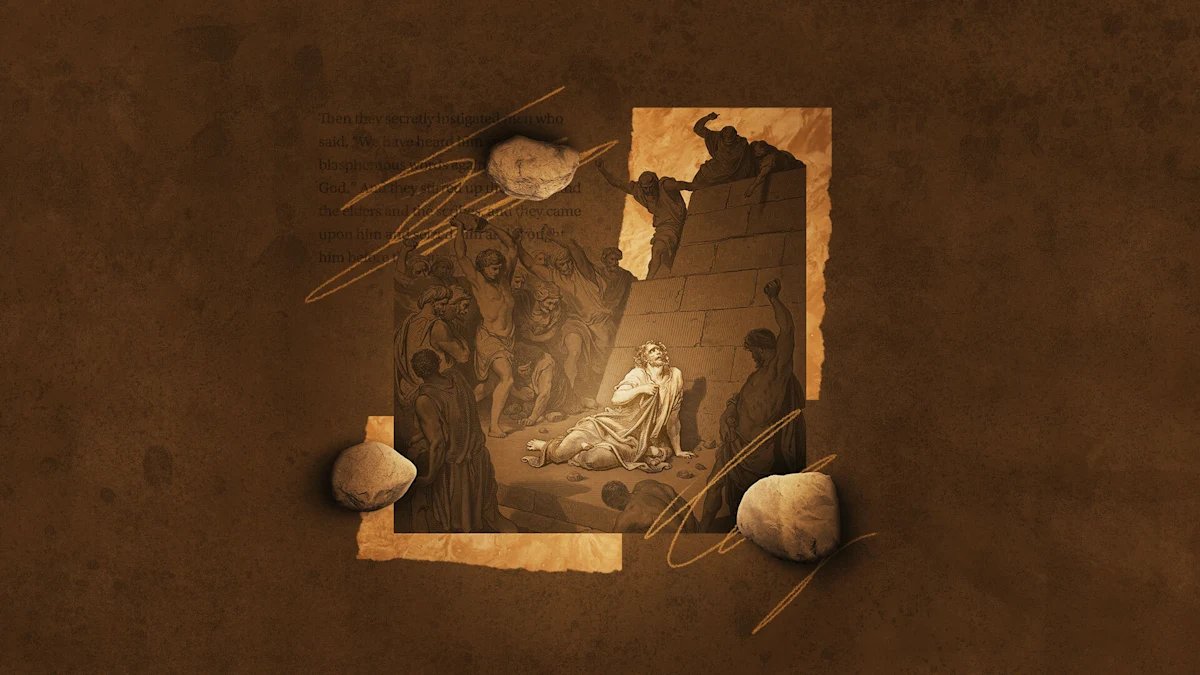
There is a temptation to assume that the people who receive the most attention in Scripture must be the most significant. Yet Stephen reminds us that significance in God’s kingdom is not measured by the amount of space devoted to a person, but by the God to whom that person points.
Though Stephen’s ministry is recorded in only two chapters of Acts, his role is crucial in the unfolding story of redemption. More importantly, his life directs our attention not to himself but to Christ. Stephen stands at a pivotal moment in the history of the early church. Before Jesus’ ascension, He promised that the Holy Spirit would empower His disciples to be His witnesses in Jerusalem, Judea, Samaria, and to the ends of the earth (Acts 1:8). Through Stephen’s ministry and martyrdom, that promise begins to advance beyond Jerusalem. The persecution that followed Stephen’s death scattered believers throughout Judea and Samaria, leading to the further spread of the gospel.
This should encourage us. God graciously used a man whose entire ministry is summarized in only two chapters to help advance His kingdom. Outside of Acts 6 and 7, Stephen is mentioned only a few more times in the book of Acts. Yet his influence was profound because God delights to use ordinary believers for extraordinary purposes.
Character
As the church continued to grow, so did its needs. A complaint arose because the Hellenistic (Greek-speaking Jewish) widows were being neglected in the daily distribution of food. In response, the Apostles instructed the church to select seven qualified men to oversee this ministry (Acts 6:1–6). The first man named is Stephen, and he is introduced as “a man full of faith and of the Holy Spirit.” While this description likely characterized all seven men, Luke places special emphasis on Stephen. These characteristics were especially evident in his life. What defined Stephen’s character? He was a man full of faith and of the Holy Spirit.
Stephen had been saved by faith, the gift by which sinners are justified and reconciled to God (Rom. 5:1). Paul says there is one faith, and yet the experience of that faith may vary (Eph. 4:5). For example, Paul says there is weak and strong faith (Rom. 4), and Jesus referred to those with little faith (Matt. 14). However, Luke tells us that Stephen was a man full of faith. His faith was steadfast, courageous, and unwavering in the face of opposition.
Faithful Christian living is not measured by prominence, longevity, or earthly success. It is measured by steadfast faith in Christ.
He was also a man full of the Holy Spirit. This does not mean he received a second conversion or a higher spiritual status than other Christians. To be a Christian is to have the Spirit of Christ (Rom. 8:9). Rather, Scripture teaches that God often grants special measures of the Spirit’s power for particular tasks and trials (Matt. 10:16–20). Stephen was continually strengthened and equipped by the Spirit for whatever challenges lay before him. In his book The Spirit of Promise, Donald Macleod notes that:
The Holy Spirit is not something God’s children can do without. He is indispensable. Nor is he something they can store up. They need more and more. They need again and again. And the only way they can ensure that they are always full is to be always asking.1
A man full of faith and of the Holy Spirit was also full of grace and power. Stephen had been saved by grace through faith and set for us an example that grace saves and grace transforms. The grace of God that saves us changes us not simply in status but in character. God’s grace in our lives brings a kind of charm and sweetness to it. At the same time, the Spirit of God empowered him to use his gifts for the building up Christ’s church (1 Cor. 12:7–11).
Calling
Stephen’s calling extended beyond serving tables (Acts 6:1–6). He faithfully fulfilled that responsibility, but God also called him as a powerful witness to the gospel. It’s striking to think that a man marked by such a godly character was called into a ministry marked by intense opposition. Stephen’s ministry did not lead to comfort or popularity; instead, it led him into conflict. The longest recorded sermon in Acts isn’t found in a worship service but rather a courtroom of sorts. Stephen is on trial for being charged with blasphemy before the religious leaders. Instead of a personal defense, Stephen recounts Israel’s history. His point is clear: They understood many of the facts of their history but failed to grasp its meaning. Every event in Israel’s story pointed forward to the coming of Christ. Stephen addresses their misunderstanding of God’s promise and God’s presence beginning with Abraham, Joseph, Moses, and even David and Solomon. The point was that God’s presence with God’s people isn’t confined to a building made with human hands, and even Solomon acknowledges this (1 Kings 8). All of Israel’s history culminates in Jesus Christ. The temple was never the ultimate hope of God’s people, for Christ is the true cornerstone, and through Him, God is building His church with living stones from every nation and people.
Crown
Stephen’s life concludes with a fitting fulfillment of his name. All seven men chosen in Acts 6 bear Greek names because they were appointed to minister among Greek-speaking believers. Stephen’s name means “crown” or “garland.” In the ancient world, a crown was awarded to a victorious athlete and honored leaders. How fitting that Stephen would receive a far greater crown, the crown of righteousness promised to all who love Christ’s appearing (2 Tim. 4:6–8). His final moments are remarkable. As he faced death, Luke tells us that he was once again “full of the Holy Spirit.” Gazing into heaven, he saw the glory of God and Jesus standing at God’s right hand. The Savior upon whom he had fixed the eyes of faith throughout his life now stood before him in glory. Like his Lord, he prayed and forgave saying, “Lord, do not hold this sin against them” (Acts 7:60). Like his Lord, he entrusted his spirit into God’s hands. In such violent persecution, Stephen’s death is described with remarkable peace: “He fell asleep.”
Stephen’s life reminds us that faithful Christian living is not measured by prominence, longevity, or earthly success. It is measured by steadfast faith in Christ. Therefore, might we find great encouragement and exhortation in the hymn lyrics:
Turn your eyes upon Jesus, look full in his wonderful face;
and the things of earth will grow strangely dim
in the light of his glory and grace.
-
Donald Macleod, The Spirit of Promise (Tain, Ross-shire, UK: Christian Focus, 1986), 85–86. ↩
More from this teacher
Danny Myers
Rev. Danny Myers is associate pastor of Smyrna Presbyterian Church in Smyrna, Ga.
Facts Only
* Stephen's role in the unfolding story of redemption is crucial.
* His ministry directs attention toward Christ.
* The promise of the Holy Spirit empowering witnesses extended beyond Jerusalem through Stephen’s ministry and martyrdom.
* Seven men were selected to oversee food distribution (Acts 6:1–6).
* Stephen was named as one of the seven men chosen for this oversight.
* Stephen was described as a man full of faith and of the Holy Spirit.
* His faith was steadfast, courageous, and unwavering in opposition.
* The ministry led to conflict and a trial concerning blasphemy.
* Stephen's name means "crown" or "garland."
* Stephen was filled with the Holy Spirit during his final moments.
Executive Summary
Full Take
Sentinel — Human
The text is a deeply reflective theological essay structured around Stephen's example, demonstrating strong thematic cohesion typical of human-led spiritual exposition.